
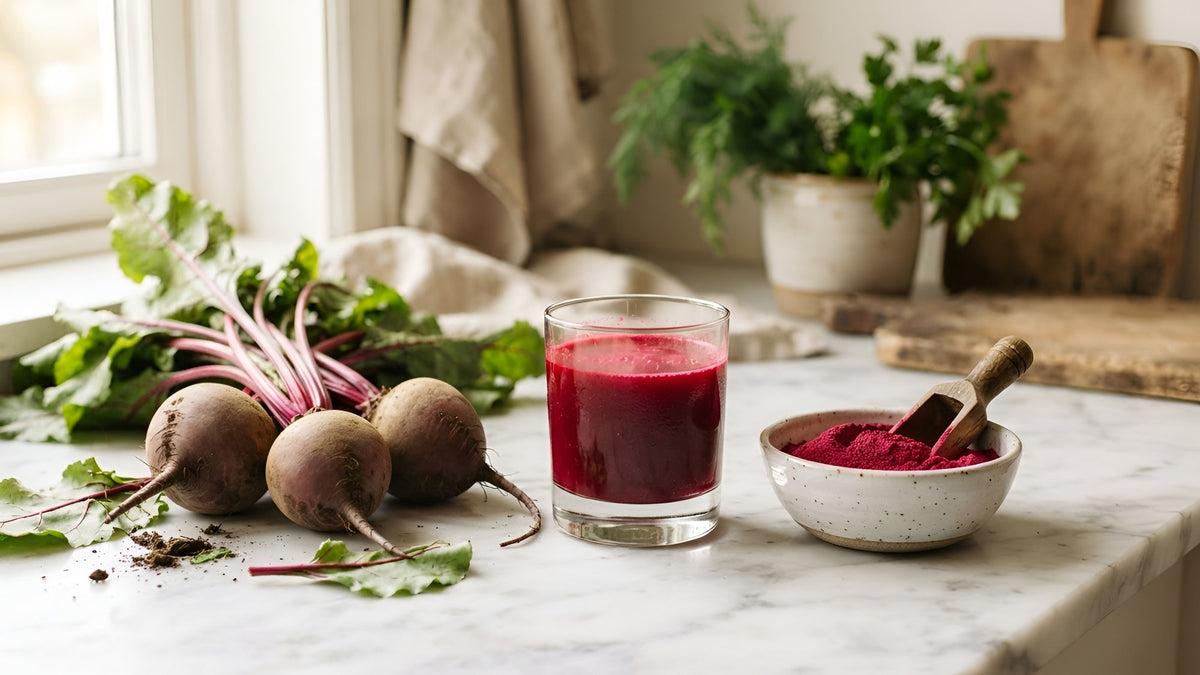
Beetroot capsules vs. beet juice comes down to what you want from beets. Juice delivers the most dietary nitrate in one glass and is the form most sports studies have used, but it brings natural sugar, a strong taste and a short shelf life. Powder mixes into drinks. Capsules such as Beetroot+™ give you a measured amount of beetroot with no prep, no taste and no added sugar, which makes them the easiest form to take every day.
All three come from the same red root, and none of them is "the best" for everyone. Here is a fair look at how they differ, what each is good for, and where our capsules fit.
Key takeaways
- Juice delivers the most dietary nitrate in one glass and is the form most sports studies have used.
- Capsules give you a measured amount of beetroot with no prep, no taste and no added sugar.
- Beetroot+ is two capsules once a day with food, for 1,300 mg of beetroot root powder per serving.
- The best form is the one you will actually keep taking.
Why do people take beetroot at all?
Beets are naturally rich in dietary nitrate. Your body can convert nitrate into nitrite and then into nitric oxide, a molecule that helps blood vessels relax and supports healthy blood flow. Beets also contain betalains, the pigments that give them their deep red color and provide antioxidant support. Our article What Does Beetroot Do for Blood Pressure and Circulation? covers the research in more depth.
Beetroot capsules vs. beet juice vs. powder at a glance
| Beet juice | Beet powder | Beetroot capsules | |
|---|---|---|---|
| Nitrate per serving | Highest, especially concentrated "shots" | Varies widely by product | Lower; most labels list beetroot amount, not nitrate |
| Sugar | Natural sugar from the juice | Some natural sugar from beets | Very little: no added sugar |
| Taste | Earthy and strong | Earthy unless flavored | None |
| Convenience | Needs refrigeration once open | Needs a glass and a spoon | Swallow with food, travel-friendly |
| Best for | Training days, athletes | People who like a daily drink | A simple everyday routine |
When does beet juice make sense?
Juice delivers the most dietary nitrate in one glass and is the form most sports studies have used. A 2017 systematic review in Nutrients found that beetroot juice can improve cardiorespiratory endurance in athletes, usually taken a few hours before exercise. If you are training for a race and want to experiment with a pre-workout beet shot, juice is the form the research is built on. The trade-offs are the taste, the natural sugar and the short life of an open bottle.
When does beet powder make sense?
Powder sits between the two. It mixes into water or a smoothie, travels well and keeps for months. Flavor and nitrate content vary a lot between products, so read the label. If you like a daily drink, our Daily Beets+™ is a berry-flavored beetroot powder that supports healthy blood flow and circulation and natural energy and endurance.*
When do beetroot capsules make sense?
With capsules, the amount is the same every day and there is nothing to mix or taste. That matters more than it sounds: a beet habit only works if it lasts, and many people who start with juice give up because of the taste or the fuss. Capsules are not designed to match the nitrate in a concentrated juice shot; they are designed to make beetroot an easy, consistent part of your day.
Meet Beetroot+: one ingredient, clearly labeled

Beetroot+ is two capsules once a day with food, for 1,300 mg of beetroot root powder per serving. There is no blend: one ingredient, one amount, in a vegetable capsule. The label does not standardize nitrate content, so Beetroot+ is described by its beetroot amount rather than a nitrate dose. The 60-capsule bottle is a 30-day supply.
Beetroot+ supports circulatory and heart health and provides antioxidant support.* It is caffeine-free, so it fits any time of day. Every batch is third-party tested for purity and potency by an outside lab and made in an NSF-certified, GMP-certified, FDA-registered U.S. facility; see our standards page for how we test. For timing ideas, read How to Take Beetroot Capsules.
How to choose the form that fits you
- Start with your goal. A pre-race boost points toward juice; a steady daily habit points toward capsules or powder.
- Be honest about taste. If earthy flavors put you off, capsules remove the problem.
- Check the sugar. If you watch sugar, capsules are the simplest choice.
- Read the label. Look for a clear amount of beetroot, the serving size and independent testing.
- Pick what you will repeat. The best form is the one you will actually keep taking.
Beets of any kind can turn urine or stools pink or red for a day or so. It is harmless and well known, but it surprises people the first time. If you are pregnant or nursing, take medication or have a known medical condition, consult your physician before use, and do not exceed the recommended dose.
What about whole beets?
Whole beets are a fine choice too. Roasted, steamed or grated raw into a salad, they bring fiber, folate, potassium and their natural pigments along with their nitrate. The catch is time: beets take a while to cook and stain everything they touch. Many people enjoy whole beets when they have time to cook and rely on a capsule or powder on busy days, which is a perfectly sensible mix.
Frequently asked questions about beetroot capsules vs. beet juice
Are beetroot capsules as good as beet juice?
They do different jobs. Juice delivers more nitrate per serving and is what most exercise studies used. Capsules deliver a measured amount of beetroot with no added sugar or taste, which suits an everyday routine.
Can I take Beetroot+ and drink beet juice too?
Many people combine food sources of beets with a supplement. Follow the Beetroot+ label of two capsules once a day with food, and check with your healthcare provider if you take medication.
Do beetroot capsules contain sugar?
Beetroot+ contains beetroot root powder in a vegetable capsule with microcrystalline cellulose and magnesium stearate. It has no added sugar. The whole serving is 1,300 mg of beetroot powder, so the natural sugar it carries is small.
What time of day should I take beetroot capsules?
The label says once a day with food, and because Beetroot+ is caffeine-free, any meal works. Many people take it with breakfast or before an afternoon workout.
Why does beetroot turn urine pink?
Some people do not fully break down the red pigments in beets, so they pass through. It is called beeturia, it is harmless, and it fades within a day or two.
Related reading from our Wellness Hub
- What Does Beetroot Do for Blood Pressure and Circulation?
- How to Take Beetroot Capsules: A Daily Routine With Beetroot+
Sources
- Domínguez R, et al. Effects of Beetroot Juice Supplementation on Cardiorespiratory Endurance in Athletes. A Systematic Review. Nutrients, 2017
- Lidder S, Webb AJ. Vascular effects of dietary nitrate (as found in green leafy vegetables and beetroot) via the nitrate-nitrite-nitric oxide pathway. British Journal of Clinical Pharmacology, 2013
Individual results vary.
*These statements have not been evaluated by the Food and Drug Administration. This product is not intended to diagnose, treat, cure, or prevent any disease.

