Ceylon vs cassia cinnamon comes down to four differences: where it grows, what the bark looks like, how it tastes and how much coumarin it carries. Ceylon cinnamon, often called "true cinnamon," comes mainly from Sri Lanka and has thin, papery layers and a delicate flavor. Cassia, the kind most supermarket cinnamon is made from, has a thick, hard bark, a stronger bite and much more coumarin. Ceylon Cinnamon+ uses Ceylon cinnamon bark only.
Key takeaways
- Ceylon cinnamon, often called "true cinnamon," comes mainly from Sri Lanka and has thin, papery layers and a delicate flavor.
- Cassia generally contains far more coumarin than Ceylon, according to Germany's Federal Institute for Risk Assessment.
- Most ground cinnamon in supermarkets is cassia unless the label says Ceylon.
- Ceylon Cinnamon+ is a one-ingredient formula: 1,200 mg of Ceylon cinnamon bark in every two-capsule serving. The label says not to exceed the recommended dose, and that pregnant or nursing mothers, children under the age of 18, and individuals with a known medical condition should consult a physician before using this or any dietary supplement.
- The U.S. National Center for Complementary and Integrative Health (NCCIH) notes that Ceylon cinnamon in larger amounts during pregnancy is considered unsafe, that little is known about the safety of larger amounts while breastfeeding, and that there are theoretical reasons to suspect that some components of cinnamon may interact with an anticancer medicine or nicotine. It advises anyone who takes any type of medicine to talk with a health care provider before using cinnamon or other herbal products.
Ceylon vs cassia cinnamon at a glance
| Feature | Ceylon cinnamon | Cassia cinnamon |
|---|---|---|
| Botanical name | Cinnamomum zeylanicum (also C. verum) | Cinnamomum cassia and related species |
| Main origin | Sri Lanka and southern India | China, Indonesia, Vietnam |
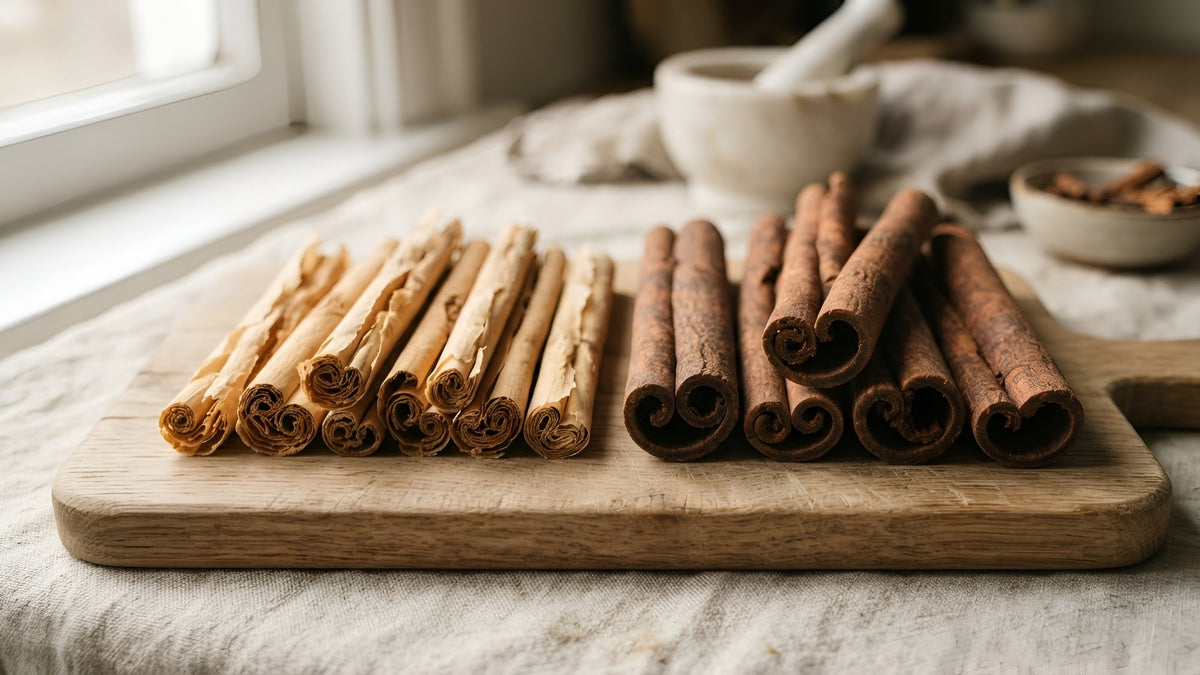
| Stick | Many thin layers rolled like a cigar, crumbles easily | One thick, hard layer curled from both sides |
| Color | Light tan | Darker reddish brown |
| Flavor | Mild, sweet, slightly citrusy | Strong, spicy, sometimes bitter |
| Coumarin | Low, often only traces | Much higher |
| Price | Higher | Lower, so it dominates supermarket shelves |
Where each one comes from
Both spices are the dried inner bark of trees in the laurel family. Ceylon cinnamon takes its name from Ceylon, the former name of Sri Lanka, which still produces most of the world's supply. Workers peel the thin inner bark by hand and roll it into quills, layer inside layer. Cassia comes mostly from China, Indonesia and Vietnam, and its bark is harvested thicker, which is why a cassia stick is hard enough to snap rather than crumble.
Why coumarin matters in the Ceylon vs cassia question
Coumarin is a natural flavor compound found in cassia and a few other plants. Germany's Federal Institute for Risk Assessment (BfR) has set a tolerable daily intake for coumarin, because large amounts taken over time have been linked to liver effects in sensitive people. According to the BfR, cassia generally contains far more coumarin than Ceylon. That is why people who use cinnamon every day, rather than as an occasional sprinkle, often choose Ceylon.
This is not a reason to throw out the cinnamon in your spice rack. A sprinkle on oatmeal is a very different thing from large daily amounts. It is a reason to know which kind you are using when cinnamon becomes a daily habit.
How to tell which cinnamon you have
- Read the label. If it does not say Ceylon, Cinnamomum zeylanicum or C. verum, assume it is cassia. "Saigon" and "Korintje" cinnamon are cassia types.
- Look at the stick. Thin, many-layered and crumbly points to Ceylon; one thick, hard roll points to cassia.
- Taste and smell. Ceylon is softer and sweeter; cassia is bolder and hotter.
- Ground cinnamon is harder. Once powdered, the two look alike, so the label is your only reliable guide.
Why Ceylon Cinnamon+ uses true cinnamon

Ceylon Cinnamon+ is a one-ingredient formula: 1,200 mg of Ceylon cinnamon bark in every two-capsule serving. Because it is designed for daily use, we chose the variety prized as true cinnamon. The full amount is printed on the label, with nothing else in the formula besides the capsule.
Ceylon Cinnamon+ supports healthy blood flow and provides potent antioxidant support.*
- Directions: two capsules once a day, 20-30 minutes before a meal with an 8 oz glass of water, or as directed by your healthcare professional.
- Supply: 60 capsules, a 30-day supply.
- Capsule: plant-based pullulan; the product is vegan, gluten-free, non-GMO and caffeine-free.
The label also says not to exceed the recommended dose, and that pregnant or nursing mothers, children under the age of 18, and individuals with a known medical condition should consult a physician before using this or any dietary supplement. NCCIH adds that Ceylon cinnamon in larger amounts during pregnancy is considered unsafe, and that little is known about whether it is safe to use Ceylon or cassia cinnamon in larger amounts while breastfeeding. NCCIH also says there are theoretical reasons to suspect that some components of cinnamon may interact with an anticancer medicine or nicotine, and advises anyone who takes any type of medicine to talk with a health care provider before using cinnamon or other herbal products.
Every batch is third-party tested for purity and potency by an outside lab, and manufactured in USA with globally sourced materials in an NSF-certified, GMP-certified, FDA-registered facility. Read more on our standards page.
Frequently asked questions about Ceylon vs cassia cinnamon
Is Ceylon cinnamon better than cassia?
For flavor it is a matter of taste: Ceylon is milder, cassia bolder. For regular daily use, many people prefer Ceylon because it generally carries far less coumarin.
Is the cinnamon in my kitchen Ceylon or cassia?
Most supermarket ground cinnamon is cassia unless the label says Ceylon, Cinnamomum zeylanicum or C. verum. Sticks are easier to identify: thin, crumbly layers point to Ceylon.
Why is Ceylon cinnamon more expensive?
Ceylon bark is thin and peeled and rolled largely by hand, and it comes from a smaller growing region. Cassia is thicker, easier to harvest and grown on a much larger scale.
Can I cook with Ceylon cinnamon the same way?
Yes. It works in baking, oatmeal, coffee and savory dishes. Because its flavor is gentler, some cooks use a little more Ceylon than cassia for the same intensity.
How should I take Ceylon Cinnamon+?
The label direction is two capsules once a day, 20-30 minutes before a meal with an 8 oz glass of water, or as directed by your healthcare professional. The label also says not to exceed the recommended dose, and that pregnant or nursing mothers, children under the age of 18, and individuals with a known medical condition should consult a physician before using this or any dietary supplement. The U.S. National Center for Complementary and Integrative Health (NCCIH) notes that Ceylon cinnamon in larger amounts during pregnancy is considered unsafe and that little is known about the safety of larger amounts while breastfeeding. NCCIH also says there are theoretical reasons to suspect that some components of cinnamon may interact with an anticancer medicine or nicotine, and advises anyone who takes any type of medicine to talk with a health care provider before using cinnamon or other herbal products.
Related reading from our Wellness Hub
- Chromium and Cinnamon for Blood Sugar: What the Research Says
- Heart-Healthy Habits: Food, Movement and Sleep Basics
Sources
- NCCIH: Cinnamon, updated November 2024
- German Federal Institute for Risk Assessment (BfR): FAQ on coumarin in cinnamon and other foods, 2012
- Wang YH, et al. Cassia cinnamon as a source of coumarin in cinnamon-flavored food and food supplements in the United States. Journal of Agricultural and Food Chemistry, 2013
Individual results vary.
*These statements have not been evaluated by the Food and Drug Administration. This product is not intended to diagnose, treat, cure, or prevent any disease.