
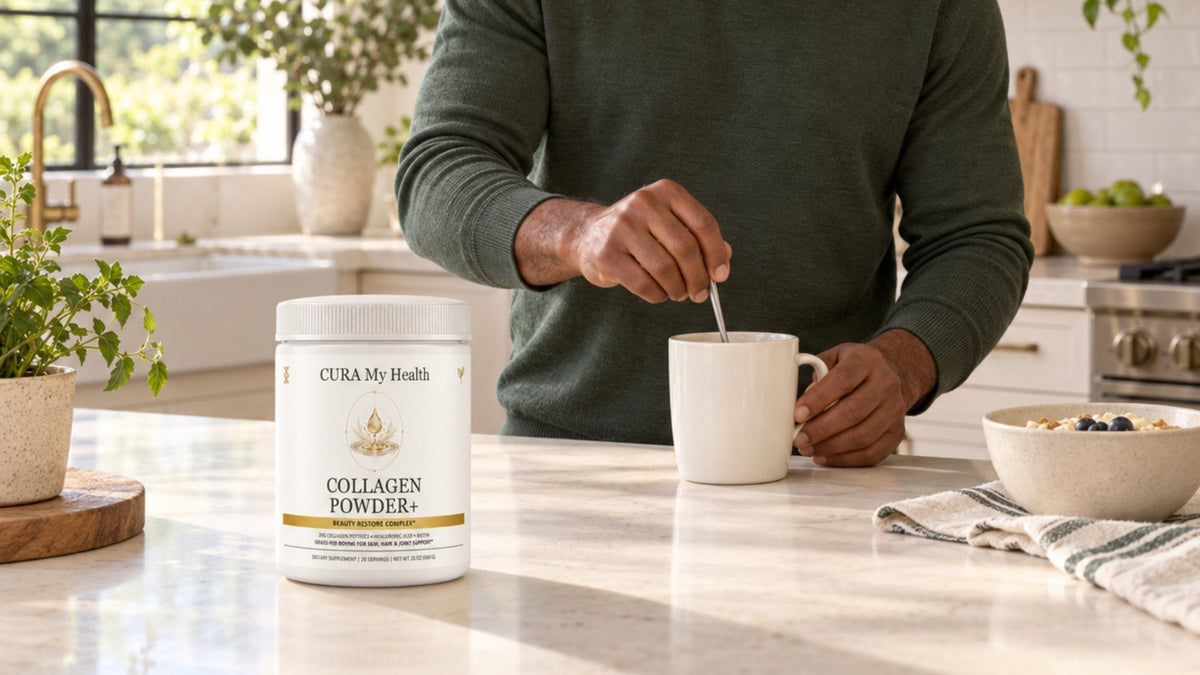
Collagen shows up in everything from coffee creamer to skincare — but the research behind it is more specific than the marketing suggests. If you're researching collagen powder, here's the evidence-based version. Meet Collagen Powder+, our unflavored daily formula.

What is collagen, and why does it matter for skin and joints?
Collagen is one of the body's main structural proteins — it's the framework of skin, tendons, cartilage, bones, and connective tissue throughout the body. The body produces its own collagen, but that natural production is well-documented to decline gradually with age, which is the biological basis for interest in collagen supplementation as part of a skin and joint-support routine.
What does the research on collagen and skin actually show?
A 2021 meta-analysis in the International Journal of Dermatology pooled 19 randomized, double-blind, controlled trials with 1,125 participants aged 20 to 70 (95% women). Compared with placebo, hydrolyzed collagen gave better skin hydration and elasticity and fewer wrinkles, and the authors based their conclusion on about 90 days of use (PubMed). This is a genuinely meaningful body of evidence — skin elasticity and hydration are measurable, objective outcomes, not just subjective impressions — though individual results vary.
What does the research on collagen and joints actually show?
A 2021 systematic review in Amino Acids looked at 15 randomized trials of collagen peptides taken alongside exercise: 12 in recreational athletes, 2 in older adults and 1 in untrained pre-menopausal women. The authors found the clearest benefit for joint function and joint pain, with some improvements in body composition, strength and muscle recovery. The joint trials used 40 mg to 10 g a day, and the authors point to 5 to 15 g a day for joint pain and function; Collagen Powder+ gives 20 g of collagen peptides a day, more than that range. The trials used several different collagen products (one was undenatured type II collagen from chicken), not bovine collagen alone. The authors note that the exact mechanisms are unclear, that 13 of the 15 trials were commercially funded and that larger studies are needed (PubMed). One of the review's authors has received research funding from Rousselot, a company that makes collagen products; the review states the company had no involvement in planning or writing it. This research is a meaningful complement to the skin research — it points to collagen's broader structural role in connective tissue generally, not just skin specifically.
To be clear about what this means: Collagen Powder+ is a dietary supplement intended for everyday skin and joint support, not a treatment for any diagnosed joint condition or skin disease.*

What's actually in Collagen Powder+
Each 2-scoop (20 g) serving delivers 18 g of protein from bovine collagen peptides, plus 90 mg of hyaluronic acid and 30 mcg of biotin (100% of the Daily Value). The only other ingredient is dicalcium phosphate. It's unflavored and dissolves into hot or cold liquids without changing the taste — a meaningful practical advantage over flavored or gritty collagen products for people who want to add it to coffee or a savory recipe without altering the flavor.
Why is hyaluronic acid included alongside collagen?
Hyaluronic acid is a water-holding molecule naturally present in skin and joint tissue, where it plays a role in retaining moisture and cushioning. Including it alongside collagen fits the same skin and joint focus the formula is built around, rather than adding an unrelated ingredient — the two are frequently paired in research and formulation because they work through complementary, if distinct, mechanisms.
Why does the formula include biotin?
Biotin is a B-vitamin commonly associated with hair, skin, and nail health, included here at 100% of the Daily Value. The NIH Office of Dietary Supplements notes that the evidence on biotin supplements for hair, nail, and skin health comes from three small studies of brittle nails, which used 2.5 mg of biotin a day, and from case reports in children and infants, and that more research is needed, especially in healthy people. Collagen Powder+ gives 30 mcg of biotin, far less than the 2.5 mg a day in those nail studies; here it is a complementary nutrient alongside collagen.
Collagen types: does the type matter?
The Collagen Powder+ label lists "Collagen Peptides (From Bovine)" and does not name a collagen type. There are multiple types of collagen in the body, with Type I found in skin, tendons, and bone. Bovine collagen sources in general contain Type I and Type III collagen, which is part of why bovine sources are commonly used in skin and joint-focused formulas specifically, as distinct from marine collagen (Type I, from fish) or the Type II collagen more specifically studied for cartilage-focused joint research. Type matters somewhat for matching a product to your specific goal, though the broader research base for hydrolyzed collagen generally — regardless of exact type — shows supportive findings across skin and joint outcomes.
How does collagen compare to just eating more protein generally?
This is a fair and common question. General dietary protein — from meat, eggs, dairy, or plant sources — supports overall muscle and tissue maintenance broadly, but it isn't collagen-specific; your body has to break down and reassemble amino acids from any protein source into whatever proteins it needs, collagen included. Collagen supplements deliver a concentrated source of the specific amino acids (notably glycine, proline, and hydroxyproline) that make up collagen structurally, in a hydrolyzed, more readily absorbed form. This is a meaningful distinction, though it doesn't mean general dietary protein is unimportant — the two are complementary, not competing, parts of a broader nutrition picture.
Does cooking or heat affect collagen powder?
Hydrolyzed collagen peptides, like those in Collagen Powder+, are generally heat-stable enough for typical use in hot coffee, tea, or cooking, unlike some more heat-sensitive supplement ingredients. This is part of the practical appeal of a powder format — it genuinely can go into a hot drink or a baked recipe without the same degradation concerns that affect some other bioactive supplement ingredients.
What does Collagen Powder+ actually support?
- Skin elasticity — supports improved elasticity of skin.*
- Joint health — supports joint health and mobility.*
- Protein intake — 18 g of protein per serving, unflavored, no added sweetener.
How and when to take it
Take two scoops (20 g) with 8 ounces of water or your favorite hot or cold recipe daily — many people stir it into morning coffee or a smoothie, since it's unflavored and dissolves easily. The 560 g container is a 28-day supply at one serving daily.
What sets Collagen Powder+ apart
- A full 18 g protein serving. A powder format allows a meaningfully larger dose per serving than most collagen capsules can deliver.
- Hyaluronic acid and biotin included. Both individually disclosed, reinforcing the skin and joint angle rather than standing alone.
- Grass-fed, pasture-raised sourcing. Also hormone-free, antibiotic-free, gluten-free, and sugar-free.
- Third-party tested, every batch. Independent lab testing for purity and potency, made in an NSF-certified, GMP-certified, FDA-registered U.S. facility — see our standards page.

Who should be cautious with Collagen Powder+
Collagen Powder+ is bovine-sourced — it is not suitable for anyone with a beef or bovine allergy, and it is not vegan or vegetarian. Its label warning reads: "If you are pregnant, nursing, allergic, have a medical condition or taking any medications, consult a doctor before using this or any other dietary supplement. Do not use if product has been opened or tampered with in any way. Keep out of reach of children. Do not use if safety seal is damaged or missing. Store in a cool, dry place."
Collagen Powder+ also contains biotin (30 mcg per serving). The NIH Office of Dietary Supplements says biotin "can interact with certain medications," gives anticonvulsants (seizure medicines) as its example, and says people who take these and other medications "on a regular basis should discuss their biotin status with their health care providers." It also notes that very high biotin intakes may interfere with some lab tests, so tell your doctor about any biotin you take.
Where Collagen Powder+ fits in a daily routine
If you want a daily collagen formula with a full 18 g protein dose alongside hyaluronic acid and biotin, Collagen Powder+ discloses every ingredient and amount on the label. Our collagen powder vs capsules guide compares the two formats in more detail.
Frequently asked questions
How long before I'd notice a difference in my skin?
Individual results vary. In a 2021 meta-analysis of 19 skin trials in the International Journal of Dermatology, the authors based their conclusion on about 90 days of taking hydrolyzed collagen.
Is collagen powder better than collagen capsules?
Powder allows a meaningfully higher protein dose per serving than most capsule products can deliver — but capsules offer convenience without mixing. Neither format is inherently superior; it comes down to preference and the dose you're aiming for.
Is Collagen Powder+ a treatment for a joint condition?
No. Collagen Powder+ is a dietary supplement for everyday joint support, not a treatment for any diagnosed joint condition — diagnosed conditions need medical care. The Collagen Powder+ label warning says: "If you are pregnant, nursing, allergic, have a medical condition or taking any medications, consult a doctor before using this or any other dietary supplement."
Is collagen the same as gelatin?
Related but different — gelatin is cooked, partially broken-down collagen (the substance that gives Jell-O its texture), while the hydrolyzed collagen peptides in supplements such as Collagen Powder+ are broken down further for easier mixing and absorption.
Will Collagen Powder+ change the taste of my coffee?
No — it's formulated unflavored specifically so it dissolves into hot or cold drinks and recipes without altering the taste.
Can I add Collagen Powder+ to a hot drink without it losing effectiveness?
Yes — hydrolyzed collagen peptides are generally heat-stable for typical hot-beverage temperatures, so stirring it into coffee or tea is a commonly used, reasonable approach.
Related reading from our Wellness Hub
How to Read a Supplement Certificate of Analysis (COA)
Sources
- Effects of Hydrolyzed Collagen Supplementation on Skin Aging: A Systematic Review and Meta-Analysis — PubMed
- The Effects of Collagen Peptide Supplementation on Body Composition, Collagen Synthesis, and Recovery From Joint Injury and Exercise: A Systematic Review — PubMed
- NIH Office of Dietary Supplements: Biotin: Fact Sheet for Health Professionals
Individual results vary.
*These statements have not been evaluated by the Food and Drug Administration. This product is not intended to diagnose, treat, cure, or prevent any disease.

