
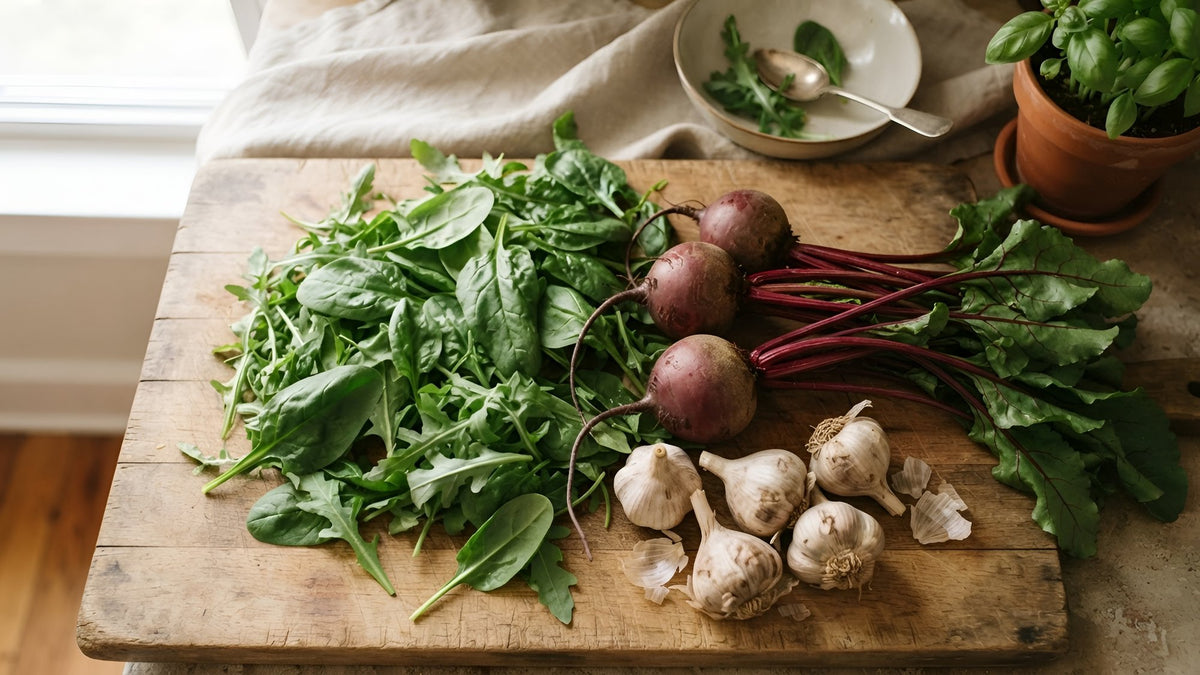
The foods that boost nitric oxide most reliably are those rich in dietary nitrate: leafy greens such as arugula, spinach and lettuce, along with beets and beet juice. Your body turns that nitrate into nitric oxide, a molecule that helps blood vessels relax and supports healthy blood flow. A second, smaller group of foods, such as watermelon and nuts, supplies amino acids your body also uses to make it.
Nitric oxide has become a popular wellness topic, and a lot of what is written about it is overstated. Here is a plain guide to how it works, which foods matter, and one surprising habit that can get in the way.
Key takeaways
- Nitric oxide is a signaling molecule that helps blood vessels relax and widen.
- Leafy greens supply most of the nitrate in a typical diet, and beets are among the richest single sources.
- Friendly bacteria in your mouth do an important part of the conversion from nitrate to nitric oxide.
- A plate built around vegetables does more than any single "nitric oxide food".
What is nitric oxide?
Nitric oxide is a signaling molecule that helps blood vessels relax and widen. The cells lining your blood vessels release it, and it tells the surrounding muscle to loosen, which supports healthy blood flow and circulation. It is also involved in how muscles use oxygen during exercise, which is why athletes became interested in beet juice.
Your body makes nitric oxide in two main ways:
- From the amino acid L-arginine, through enzymes in the blood vessel lining. L-citrulline, found in watermelon, can be turned into arginine.
- From dietary nitrate, through what researchers call the nitrate-nitrite-nitric oxide pathway. This is the route food influences most directly.
Which foods boost nitric oxide?
In a typical diet, most nitrate comes from leafy greens, and beets rank among the richest single sources. A 2013 review in the British Journal of Clinical Pharmacology highlighted green leafy vegetables and beetroot as the main dietary sources and described their effects on blood vessels in healthy volunteers.
| Food group | Examples | How it helps |
|---|---|---|
| Leafy greens | Arugula, spinach, lettuce, Swiss chard, bok choy | Very high in dietary nitrate |
| Root and stalk vegetables | Beets, celery, radishes | High in dietary nitrate |
| Melons | Watermelon | Provides L-citrulline |
| Nuts, seeds and legumes | Walnuts, almonds, pumpkin seeds, lentils | Provide L-arginine |
| Polyphenol-rich foods | Berries, pomegranate, dark chocolate, garlic | Studied for helping nitric oxide stay available |
Arugula is often the single highest-nitrate vegetable you can buy, which makes a simple arugula and beet salad one of the most efficient nitric oxide meals around.
How does food turn into nitric oxide?
The nitrate pathway has a step most people have never heard of, and it happens in your mouth.
- You eat nitrate-rich vegetables, and the nitrate is absorbed into your blood.
- Your salivary glands concentrate some of that nitrate and send it back into your mouth.
- Friendly bacteria in your mouth do an important part of the conversion from nitrate to nitric oxide, by first turning nitrate into nitrite.
- You swallow the nitrite, and your body converts it into nitric oxide where it is needed.
Research on this pathway has found that strong antibacterial mouthwash can blunt the conversion, because it reduces those helpful bacteria. If you use a strong antiseptic mouthwash several times a day, that is worth knowing; your dentist can advise on what is right for your teeth and gums.
Do beets really boost nitric oxide?
Yes, beets are one of the best-studied nitrate foods, and beet juice is the form most research has used. Our article What Does Beetroot Do for Blood Pressure and Circulation? walks through that research. If you want beets in your routine without cooking or juicing, there are two simple options:
- Beetroot+™ supports circulatory and heart health and provides antioxidant support.* It is two capsules once a day with food, giving 1,300 mg of beetroot root powder per serving. The label lists the beetroot amount rather than a nitrate dose.
- Daily Beets+™ is a berry-flavored powder with 4.5 g of beetroot powder per scoop, plus vitamin C and niacin. It supports healthy blood flow and circulation and natural energy and endurance.*
Both are third-party tested, every batch, and made in an NSF-certified, GMP-certified, FDA-registered U.S. facility. You can read how we test on our standards page.
Simple ways to eat more nitrate-rich foods
- Swap iceberg for arugula or spinach in your usual salad.
- Add a handful of spinach to eggs, soups or pasta sauce in the last minute of cooking.
- Roast beets in a batch on Sunday and add them to salads and grain bowls through the week.
- Snack on celery with nut butter, or on watermelon in summer.
- Keep a bag of walnuts or pumpkin seeds within reach.
A vegetable-rich plate matters more than any one "nitric oxide food". The same habits that support healthy blood flow, such as regular movement and good sleep, are covered in our guide to heart-healthy habits.
Who should be careful?
Food sources of nitrate are part of a normal diet. Concentrated beet products and supplements are a different matter if you take medication that affects blood pressure or blood flow, are pregnant or nursing, or have a known medical condition: talk with your healthcare provider first. Beets can also turn urine or stools pink for a day or so, which is harmless.
A day of nitrate-rich eating
Here is what that can look like without any special shopping: spinach folded into morning eggs, an arugula and roasted beet salad with walnuts at lunch, celery and hummus in the afternoon, and a side of sauteed greens with dinner. That is four easy additions, each one a food you can find in any grocery store.
Frequently asked questions about foods that boost nitric oxide
What is the fastest way to boost nitric oxide with food?
Nitrate-rich foods such as beet juice and arugula are the most direct route. Studies on beet juice often measure the effect over the following few hours, as the nitrate is converted.
Are nitrates in vegetables the same as nitrates in processed meat?
The nitrate molecule is the same, but the context is very different. Vegetables bring vitamin C and polyphenols along with their nitrate, and they are the main nitrate source in diets researchers associate with good health.
Does cooking spinach reduce its nitrate?
Boiling can move some nitrate into the cooking water. Eating greens raw, lightly steamed or sautéed keeps more of it.
Does mouthwash really affect nitric oxide?
Studies have found that strong antiseptic mouthwash can reduce the mouth bacteria that convert nitrate to nitrite. Ask your dentist which type suits you.
Can a supplement replace leafy greens?
No. A beet supplement can add to a good diet, but greens bring fiber, vitamins and minerals that no single supplement replaces.
Related reading from our Wellness Hub
- What Does Beetroot Do for Blood Pressure and Circulation?
- Heart-Healthy Habits: Food, Movement and Sleep Basics
Sources
- Lidder S, Webb AJ. Vascular effects of dietary nitrate (as found in green leafy vegetables and beetroot) via the nitrate-nitrite-nitric oxide pathway. British Journal of Clinical Pharmacology, 2013
- Domínguez R, et al. Effects of Beetroot Juice Supplementation on Cardiorespiratory Endurance in Athletes. A Systematic Review. Nutrients, 2017
Individual results vary.
*These statements have not been evaluated by the Food and Drug Administration. This product is not intended to diagnose, treat, cure, or prevent any disease.

