
How long does lion's mane take to work? In the human studies we have, changes showed up after several weeks of daily use, not after the first dose: one trial measured gains at 8, 12 and 16 weeks, and a smaller one tracked people for 28 days. So a fair expectation is a gradual, subtle change over one to three months of consistent use, if you notice one at all. Here is what the research actually measured, why lion's mane is slow, and how to give it a fair trial.
Key takeaways
- Lion's mane is not a stimulant, so there is no quick jolt to wait for.
- In the best-known trial, differences appeared at week 8 and grew through week 16.
- The human evidence is promising but still small and early.
- Give a steady daily routine at least eight weeks before you judge it.
How long does lion's mane take to work?
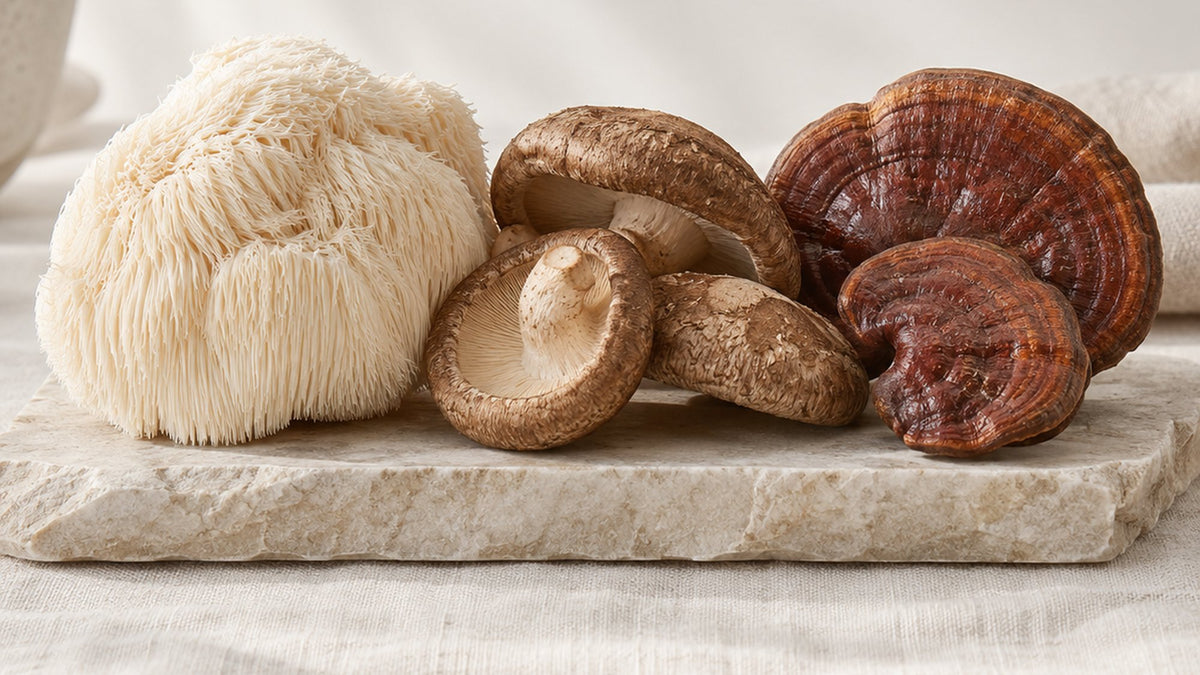
Lion's mane is not a stimulant, so there is no quick jolt to wait for. Lion's mane (Hericium erinaceus) is a shaggy white mushroom that grows on hardwood trees and has a long history in East Asian cooking and traditional practice. Lab research has focused on two groups of compounds, hericenones (from the fruiting body) and erinacines (from the mycelium), and how they relate to nerve growth factor, a protein involved in maintaining nerve cells. That kind of process, if it is relevant in people, is slow by nature. It is the opposite of caffeine, which you feel within the hour and which fades the same day.
A realistic lion's mane timeline
| Time | What to expect |
|---|---|
| First days | Usually nothing obvious. One small study saw faster performance on a single task an hour after a dose, but this is not a dependable effect. |
| 2 to 4 weeks | Some people describe feeling a little clearer or steadier; studies at this point are mixed. |
| 8 to 16 weeks | The window where the best-known trial measured its differences. |
| After stopping | In that same trial, scores drifted back down within four weeks of stopping. |
What the lion's mane studies actually measured
In the best-known trial, differences appeared at week 8 and grew through week 16. That 2009 double-blind study in Japan gave 30 older adults with mild cognitive impairment either dried lion's mane fruiting body powder (3 g a day, in tablets) or a placebo for 16 weeks. The lion's mane group scored higher on a cognitive function scale at weeks 8, 12 and 16, and the difference faded four weeks after they stopped. The researchers reported no adverse effects in lab tests.
A 2023 pilot study from Northumbria University gave 41 healthy adults 1.8 g of lion's mane a day or a placebo for 28 days. After a single dose, the lion's mane group was faster on one attention test; after 28 days there was a trend toward lower self-reported stress that did not quite reach statistical significance, and several other measures showed no difference. The authors said the results should be read with caution.
The human studies are small, so the honest answer is promising but early. Both trials used lion's mane on its own, in amounts measured in grams, so their timelines tell you how lion's mane behaved in those studies rather than what any particular product will do.
Lion's mane on the plate
Lion's mane is also a gourmet mushroom. Cooked fresh, it has a soft, stringy texture that many people compare to crab or lobster, and it is often seared in butter or added to stir-fries. Cooking with it is a pleasant way to enjoy the mushroom, though recipe amounts vary and are not the same as the measured amounts used in studies. If you have never eaten it, start with a small portion, as with any new mushroom.
What affects how quickly you notice anything
- Consistency. Daily use is what the studies tested. Skipping days resets the comparison.
- Form and amount. Fruiting body, mycelium, powder and extract are different things, and amounts vary widely between products.
- Your baseline. Sleep, stress, meals and movement shape focus more than any supplement. If those are off, they will drown out a subtle change.
- What you expect to feel. Lion's mane is not a stimulant, so "I don't feel anything" in week one is normal.
How to give lion's mane a fair trial
Give a steady daily routine at least eight weeks before you judge it. A simple plan:
- Pick one time of day and attach it to a habit, such as before breakfast.
- Change one thing at a time. If you start lion's mane and a new coffee habit in the same week, you will not know which did what.
- Write down a baseline. Rate your focus and energy from 1 to 10 for a few days before you start, then once a week.
- Review at week 8. Compare your notes, then decide whether to continue.
If you prefer a broad, caffeine-free mushroom routine rather than a single mushroom, Lions Mane 10x+™ combines ten functional mushrooms, including lion's mane fruiting bodies at 266 mg in each two-capsule serving, alongside Reishi, Shiitake, Cordyceps and a six-mushroom blend. It is made to support focus, mental clarity and healthy energy levels.* The suggested use is two capsules once daily, 20 to 30 minutes before a meal, and every batch is third-party tested for purity and potency (see our standards). For how mushroom compounds such as beta-glucans fit in, read Mushrooms for Focus and Immune Support: The Beta-Glucan Connection.
Frequently asked questions about how long lion's mane takes to work
Can you feel lion's mane right away?
Most people do not. One small study found faster performance on a single test an hour after a dose, but the main effects researchers looked for were measured over weeks. Expect a gradual change, not an immediate one.
How long should I take lion's mane before I stop?
Give it about eight weeks of daily use before deciding, since that is when the best-known trial first measured a difference. If you notice nothing after that, it is reasonable to stop.
Is it better to take lion's mane in the morning or at night?
There is no research showing one time of day works better. Many people prefer the morning because it fits a focus routine; our guide to the best time to take mushroom supplements has practical tips.
Do the effects last after you stop taking lion's mane?
In the 2009 trial, scores moved back toward where they started within four weeks of stopping. That suggests any benefit depends on continued use.
Is lion's mane safe to take every day?
The studies reported it was well tolerated over their short time frames. Mushroom allergies are possible, so stop if you notice a rash or breathing changes, and talk with your healthcare provider first if you take medication, are pregnant or nursing, or have a medical condition.
Related reading from our Wellness Hub
- Lion's Mane vs Reishi vs Cordyceps: What Each Mushroom Does
- How to Beat the Afternoon Slump Without Caffeine
Sources
- Mori K, et al. Improving effects of the mushroom Yamabushitake (Hericium erinaceus) on mild cognitive impairment: a double-blind placebo-controlled clinical trial. Phytother Res. 2009.
- Docherty S, et al. The acute and chronic effects of Lion's Mane mushroom supplementation on cognitive function, stress and mood. Nutrients. 2023.
- McCleary BV, Draga A. Measurement of beta-glucan in mushrooms and mycelial products. J AOAC Int. 2016.
Individual results vary.
*These statements have not been evaluated by the Food and Drug Administration. This product is not intended to diagnose, treat, cure, or prevent any disease.

