
If you are wondering how to keep bones strong, the short answer is: get enough calcium and vitamin D every day, add regular weight-bearing and strength exercise, eat enough protein, and skip the two habits that quietly work against bone (smoking and heavy drinking). This guide explains why each piece matters, how much of each nutrient people need, and where a clean, tested supplement fits.
Why do bones change?
Bone is living tissue. Your body removes old bone and builds new bone all the time. Early in life, building outpaces removal. Once bone mass reaches its peak in early adulthood, the balance slowly tips the other way.
For women, the change speeds up around menopause. The NIH Office of Dietary Supplements notes that menopause leads to bone loss because lower estrogen reduces calcium absorption and increases calcium loss in urine and from bone (NIH ODS, Calcium). That is one reason bone health becomes a bigger topic at that stage.
None of this means bone loss is a given. It means the daily basics matter at every stage, and the basics are simple and mostly free.
How to keep bones strong: five everyday habits
1. Get enough calcium, ideally from food first
Calcium is the main mineral in bone. The National Institutes of Health Office of Dietary Supplements (NIH ODS) lists the recommended daily amount as 1,000 mg for adults aged 19 to 50 and 1,200 mg for women 51 and older and men 71 and older; men 51 to 70 stay at 1,000 mg (NIH ODS, Calcium).
Food covers a lot of that. Some everyday sources, with amounts from the NIH ODS calcium table (NIH ODS, Calcium):
| Food | Typical serving | Approximate calcium |
|---|---|---|
| Plain low-fat yogurt | 8 oz | about 415 mg |
| Nonfat milk or calcium-fortified soymilk | 1 cup | about 300 mg |
| Canned sardines or pink salmon, with bones | 3 oz | about 180–325 mg |
| Firm tofu made with calcium sulfate | ½ cup | about 250 mg |
| Cooked kale | 1 cup | about 94 mg |
| Bok choy, raw, shredded | 1 cup | about 74 mg |
One practical note from NIH ODS: absorption from calcium supplements is highest with doses of 500 mg or less (NIH ODS, Calcium). A supplement is best used to fill a gap, not to replace food.
2. Get enough vitamin D, because calcium cannot do its job without it
Vitamin D helps your gut absorb calcium. NIH ODS lists the recommended daily amount as 600 IU (15 mcg) for adults up to age 70 and 800 IU (20 mcg) after 70, and an adult upper limit (tolerable upper intake level) of 4,000 IU (100 mcg) per day (NIH ODS, Vitamin D).
Vitamin D is hard to get from food alone. Fatty fish, egg yolks and fortified milk help, but sunlight and supplements do most of the work for many people, especially in winter. A blood test from your provider shows where you stand and can help you decide on a dose together.
3. Do not forget vitamin K
Vitamin K is needed to activate osteocalcin, a protein that binds calcium into bone. NIH ODS lists an adequate daily intake of 90 mcg for adult women and 120 mcg for adult men (NIH ODS, Vitamin K). Leafy greens supply vitamin K1. Vitamin K2 (menaquinones) comes from fermented foods and from supplements: NIH ODS says natto has high amounts of menaquinones, and other fermented foods such as cheese also contain them. This is why vitamin D3 and vitamin K2 are so often paired: D3 supports calcium absorption, and K2 supports the proteins that help direct that calcium toward bone.* We explain the pairing in detail in Why Take Vitamin D3 and K2 Together?
Safety note: the NIH Office of Dietary Supplements notes that vitamin K can interact with warfarin and other anticoagulants (NIH ODS, Vitamin K). If you take an anticoagulant such as warfarin, talk with your healthcare provider before adding any vitamin K supplement.
4. Load your bones: weight-bearing and strength exercise
Bone responds to load. When muscles pull on bone and your feet carry your weight, bone gets the signal to stay dense. The National Institute of Arthritis and Musculoskeletal and Skin Diseases (NIAMS) says a combination of weight-bearing exercise, resistance training and balance training is best for building and maintaining healthy bones: weight-bearing exercise (brisk walking, jogging, climbing stairs, dancing, racket sports), resistance or strength training (weight machines, free weights, resistance bands, your own body weight such as push-ups) and balance training (such as tai chi or step-ups) (NIAMS, Exercise for Your Bone Health).
NIAMS also gives the U.S. Department of Health and Human Services goal for adults: at least 150 minutes a week of moderate-intensity exercise, plus muscle-strengthening activities at least twice a week. A realistic way to fit that into a busy week:
- A brisk 30-minute walk on five days covers the 150 minutes. Hills and stairs count extra.
- Two short strength sessions a week: squats, lunges, a hinge move, a push and a pull.
- Balance work a few times a week, such as standing on one foot while you brush your teeth.
If you have a known bone condition or a history of fractures, check with your provider before starting.
5. Eat enough protein, and go easy on alcohol and tobacco
Protein is part of bone's framework, and NIAMS says that excessive dieting or poor protein intake may increase your risk for bone loss and osteoporosis (NIAMS, Osteoporosis). Aim to include a protein source at each meal: eggs, fish, poultry, dairy, beans, tofu or lentils.
NIAMS also names smoking and chronic heavy drinking as risk factors for osteoporosis. If you smoke, quitting helps bone along with everything else. If you drink, keep it moderate.
Which other nutrients support bone health?
- Magnesium. About half to 60% of the body's magnesium is stored in bone, and magnesium is involved in bone formation, according to NIH ODS (NIH ODS, Magnesium). Nuts, seeds, beans, whole grains and leafy greens are good sources.
- Collagen protein. Bone's framework is mostly type I collagen. Whether collagen supplements move the needle for bone is still being studied; we cover the research honestly in Do Collagen Supplements Actually Work? What the Research Says
Should you get a bone density test?
The U.S. Preventive Services Task Force (USPSTF) recommends bone density screening for women 65 and older, and for postmenopausal women under 65 who have risk factors, such as a parent who broke a hip, low body weight, smoking or excess alcohol use (USPSTF, Osteoporosis Screening). The test is called a DXA scan, and it is quick and painless. If you are unsure, ask your provider whether an earlier scan makes sense for you.
Where does a supplement fit?
A supplement fills gaps. It does not replace food or movement. For bone, the nutrients most people fall short on are vitamin D and, depending on diet, calcium. Vitamin K2 is the piece most multivitamins skip.
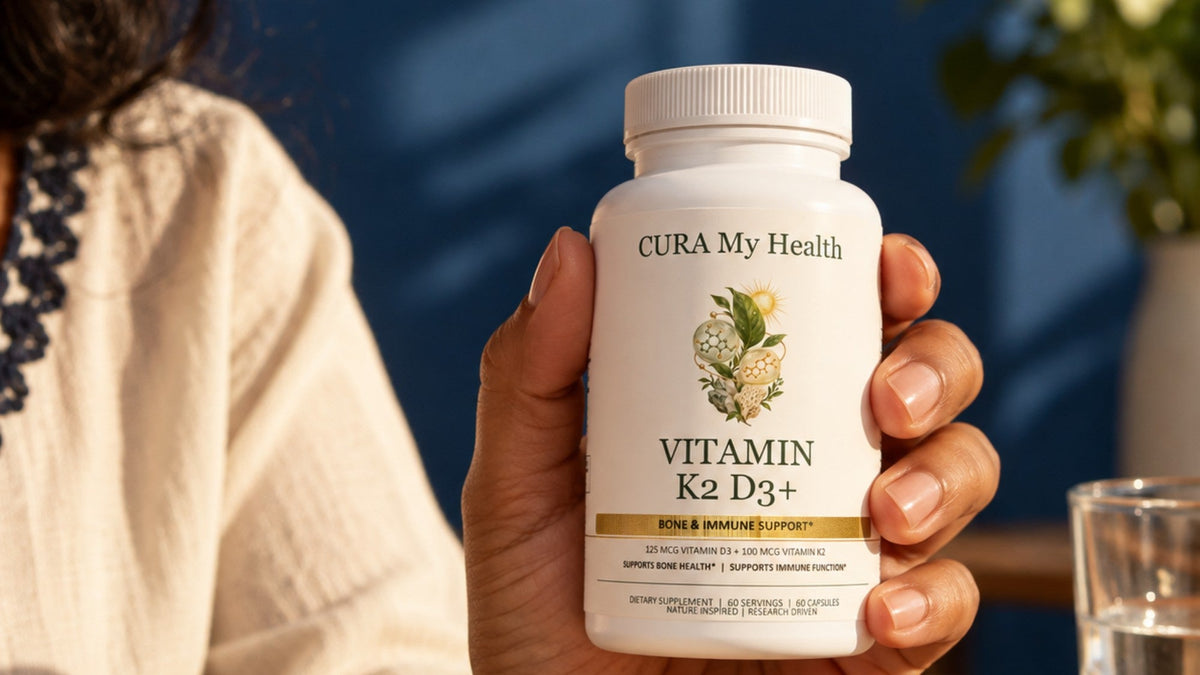
Our Vitamin K2/D3+ was formulated for adults who want that pairing in one clean capsule. Each veggie capsule provides vitamin D3 (cholecalciferol) 125 mcg (5,000 IU), vitamin K2 as MK-7 100 mcg, calcium (as carbonate) 210 mg, and BioPerine® black pepper extract 5 mg to support absorption. The label's suggested use is one capsule a day, 20 to 30 minutes before a meal. Every active is shown on the label with its amount. No proprietary blends.
A plain word on the dose. At the directed one-capsule serving, the daily vitamin D3 comes to 5,000 IU (125 mcg), which is above the 4,000 IU (100 mcg) a day adult upper limit that the Food and Nutrition Board set and the NIH Office of Dietary Supplements lists (NIH ODS, Vitamin D). Some providers do recommend higher amounts for a set period based on a blood test, but that is a decision to make with your provider, not on your own. If you already take vitamin D from another supplement or a multivitamin, or you are not sure how much is right for you, check with your healthcare provider before use. Add up your calcium from food and supplements too: one Vitamin K2/D3+ capsule gives 210 mg, and the NIH Office of Dietary Supplements lists an adult upper limit of 2,500 mg a day for ages 19 to 50 and 2,000 mg for 51 and older (NIH ODS, Calcium).
The label's caution reads: “Do not exceed recommended dose. Pregnant or nursing mothers, children under the age of 18, and individuals with a known medical condition should consult a physician before using this or any dietary supplement.” The label also says: “Keep out of reach of children. Do not use if safety seal is damaged or missing. Store in a cool, dry place.”
Medicine interactions. The NIH Office of Dietary Supplements lists medicine interactions for all three nutrients in Vitamin K2/D3+. Vitamin K can interact with warfarin and other anticoagulants, and antibiotics, bile acid sequestrants and orlistat can affect vitamin K levels (NIH ODS, Vitamin K). For vitamin D, the medicines named are orlistat, statins, steroids and thiazide diuretics; thiazides combined with vitamin D supplements “might lead to hypercalcemia, especially among older adults and individuals with compromised renal function or hyperparathyroidism” (NIH ODS, Vitamin D). For calcium, they are dolutegravir, levothyroxine, lithium and quinolone antibiotics, and “Calcium carbonate supplements can interfere with the absorption of levothyroxine” (NIH ODS, Calcium); Vitamin K2/D3+ uses calcium carbonate. If you take any of these medicines, talk with your healthcare provider before use.
What you can count on with Vitamin K2/D3+:
- Third-party tested, every batch, for purity and potency by an outside lab. We show you how to read those results in How to Read a Supplement Certificate of Analysis (COA).
- Manufactured in the USA with globally sourced materials, in an NSF-certified, GMP-certified, FDA-registered facility.
- Honest labels: every active and its amount are on the label.
- Clean by design: no unnecessary fillers and no synthetic dyes.
- Formulated for adults, and backed by our 60-day guarantee.
You can read the whole standard on the Our Standards page.
Frequently asked questions about keeping bones strong
Is it too late to build bone?
It is never too late to support bone. Peak bone mass is reached in early adulthood, so the goal is to slow loss and keep what you have. Regular strength and weight-bearing exercise, adequate calcium, vitamin D and protein all help maintain bone density at any age.
How much calcium do people need per day?
NIH ODS lists a recommended 1,000 mg per day for adults aged 19 to 50 (and men up to 70) and 1,200 mg per day for women 51 and older and men 71 and older. Food should supply most of it. A supplement is for the gap, and NIH ODS notes that absorption from calcium supplements is highest with doses of 500 mg or less.
Do I need vitamin K2 if I already take vitamin D?
Vitamin D helps you absorb calcium, and vitamin K2 supports the proteins that help bind that calcium into bone.* Many people get vitamin K1 from greens but little K2. NIH ODS notes that vitamin K can interact with warfarin and other anticoagulants, so if you take a blood thinner such as warfarin, talk with your provider before adding vitamin K in any form.
What exercise is best for bone density?
Weight-bearing activity such as brisk walking, jogging, stair climbing and dancing, plus resistance training with weights, bands or bodyweight. NIAMS says a combination of these, plus balance training, is best. Swimming and cycling load bone less, so pair them with something that does.
When should a person get a bone density scan?
USPSTF recommends screening for all women 65 and older, and for younger postmenopausal women with risk factors such as a parent who broke a hip, low body weight, smoking or excess alcohol use. If you are unsure, ask your provider whether an earlier DXA scan makes sense for you.
Related reading from our Wellness Hub
- Why Take Vitamin D3 and K2 Together?
- Menopause Nutrition Basics: Protein, Fiber, Calcium, and Vitamin D
- A Simple Daily Supplement Routine
Sources
- NIAMS (NIH): Osteoporosis — overview and risk factors
- NIAMS (NIH): Exercise for Your Bone Health
- NIH Office of Dietary Supplements: Calcium fact sheet
- NIH Office of Dietary Supplements: Vitamin D fact sheet
- NIH Office of Dietary Supplements: Vitamin K fact sheet
- NIH Office of Dietary Supplements: Magnesium fact sheet
- U.S. Preventive Services Task Force: Osteoporosis to Prevent Fractures — Screening
Individual results vary.
These statements have not been evaluated by the Food and Drug Administration. This product is not intended to diagnose, treat, cure, or prevent any disease.

