
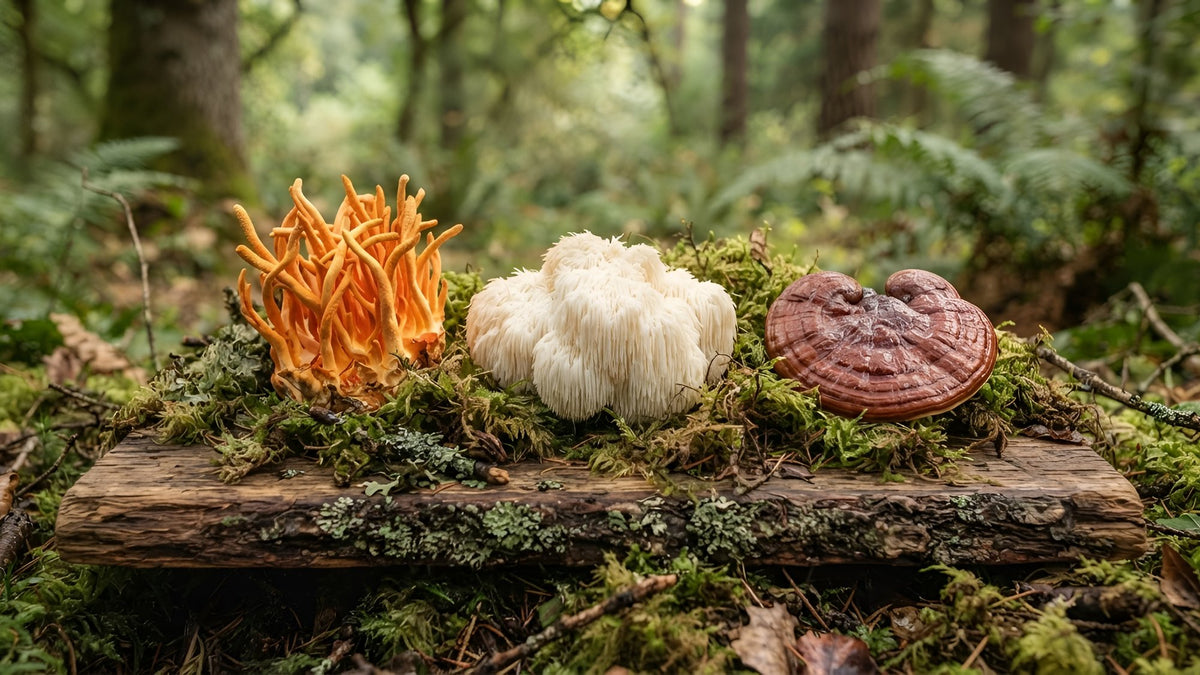
A "mushroom 10x complex" is a blend of ten different functional mushrooms in one formula; the "10x" counts mushrooms, not strength. In Lions Mane 10x+™, that means four named mushrooms (Lion's Mane, Reishi, Shiitake and Cordyceps) plus a six-mushroom blend. The other thing worth reading on any mushroom label is which part of the fungus went into the capsule: the fruiting body (the mushroom you can see) or the mycelium (the root-like network it grows from). This guide explains both, and shows exactly what our label says.
Key takeaways
- The "10x" in a mushroom 10x complex counts the mushrooms in the formula, not an extraction ratio or a multiple of potency.
- Fruiting body means the visible mushroom; mycelium means the root-like network beneath it.
- Most published mushroom research used fruiting bodies or extracts made from them.
- Cordyceps is the exception: wild Cordyceps sinensis is scarce, so cordyceps in supplements is cultivated, very often as mycelium.
- A good label tells you which part of each mushroom you are getting.
What is a mushroom 10x complex?
The "10x" in a mushroom 10x complex counts the mushrooms in the formula, not an extraction ratio or a multiple of potency. Ten-mushroom blends exist because different mushrooms have different traditions behind them. Lion's Mane is traditionally linked with focus and mental clarity, Cordyceps with stamina, and Reishi with long-standing wellness rituals, while culinary mushrooms such as Shiitake and Maitake are naturally rich in beta-glucans, a type of fiber found in mushroom cell walls.
A ten-mushroom formula trades depth for breadth: you get a little of many mushrooms instead of a large amount of one. That is a reasonable choice if you want an all-round daily mushroom routine. If you are interested in a single mushroom for a specific reason, a single-ingredient product will give you more of it.
Fruiting body vs mycelium: what is the difference?
The fruiting body is the mushroom you can see, and the mycelium is the root-like network it grows from. Both are part of the same organism, but they are not identical:
| Fruiting body | Mycelium | |
|---|---|---|
| What it is | The cap and stem (or shelf) that appears above ground or on wood | The thread-like network that grows through soil, wood or a growing medium |
| How supplements use it | Dried and powdered, or extracted with hot water or alcohol | Often grown on grain or in liquid culture, then dried |
| Research base | Most published human studies | Smaller, with Cordyceps the main exception |
| What to check | Whether it is a powder or an extract | Whether the growing medium (such as grain) is part of the powder |
Most published mushroom research used fruiting bodies or extracts made from them. That is one reason many people look for "fruiting body" on the label. There is also a measurement issue: a mycelium powder grown on grain can carry some of that grain into the capsule, and grain starch is a different kind of carbohydrate (an alpha-glucan) from the beta-glucans mushrooms are known for. A 2016 method paper from McCleary and Draga showed how to measure beta-glucans separately from starch, which is why "beta-glucan" and "polysaccharide" figures on labels are not the same thing.
Why Cordyceps is usually mycelium
Cordyceps is the exception: cordyceps in supplements is cultivated, very often as mycelium, though cultivated fruiting bodies are sold too. Wild Cordyceps sinensis grows in a very specific way in high mountain regions and is extremely scarce, so the cordyceps used in supplements and in much of the published research is grown in cultivation. Seeing "mycelium" next to cordyceps on a label is normal and expected.
What is inside Lions Mane 10x+

A good label tells you which part of each mushroom you are getting. Here is what the Lions Mane 10x+ label lists in a two-capsule serving:
- Lion's Mane (Hericium erinaceus), fruiting bodies — 266 mg
- Reishi extract (Ganoderma lucidum), fruiting bodies — 266 mg
- Shiitake extract (Lentinus edodes), fruiting bodies — 266 mg
- Cordyceps powder (Cordyceps sinensis), mycelium — 266 mg
- Six-mushroom blend, fruiting bodies — 266 mg: Maitake, Turkey Tail, Chaga, Royal Sun Agaricus, White Button and Wood Ear
The six-mushroom blend is a proprietary blend: blend totals are on the label; the amounts inside each blend are not. Lions Mane 10x+ is made to support focus, mental clarity and healthy energy levels, and to support a healthy immune system.* It is caffeine-free, vegan and gluten-free.
The suggested use is two vegetable capsules once daily, preferably 20 to 30 minutes before a meal with a glass of water, so a 60-capsule bottle is a 30-day supply. Every batch is third-party tested for purity and potency by an outside lab, and it is made in an NSF-certified, GMP-certified, FDA-registered U.S. facility; read more on our standards page.
How to read any mushroom supplement label
- Find the part used. "Fruiting body," "mycelium," or both should appear for each mushroom.
- Check powder vs extract. An extract is concentrated; a powder is the whole dried mushroom.
- Look for the growing medium. If you see "mycelium on grain" or "myceliated brown rice," part of the powder is grain.
- Read blend totals honestly. A blend lists its total, not each mushroom inside it.
- Look for third-party testing. Mushrooms absorb what they grow in, so batch testing for purity matters.
For the background on what each mushroom is traditionally used for, see Lion's Mane vs Reishi vs Cordyceps: What Each Mushroom Does.
Frequently asked questions about mushroom 10x complexes
Does "10x" mean the formula is ten times stronger?
No. In Lions Mane 10x+ the name describes the ten mushrooms in the formula. It is not an extraction ratio and it is not a multiple of potency.
Is fruiting body better than mycelium?
Most published research used fruiting bodies or their extracts, so fruiting body is the more common choice. Cordyceps is the notable exception, where cultivated mycelium is the standard form used in supplements and studies.
Why is the cordyceps in Lions Mane 10x+ mycelium?
Wild cordyceps fruiting bodies are scarce, so supplement cordyceps is almost always grown in cultivation as mycelium. Our label states this plainly rather than leaving you to guess.
Can I take a ten-mushroom blend every day?
Lions Mane 10x+ is designed for daily use at two capsules once a day. If you take medication, are pregnant or nursing, or have a medical condition, talk with your healthcare provider before starting any new supplement.
When should I take a mushroom complex?
Many people take it in the morning as part of a caffeine-free routine, 20 to 30 minutes before breakfast. Our guide to the best time to take mushroom supplements covers timing in more detail.
Related reading from our Wellness Hub
- Mushrooms for Focus and Immune Support: The Beta-Glucan Connection
- Adaptogens 101: What Is an Adaptogen? Ashwagandha and Mushrooms
Sources
- McCleary BV, Draga A. Measurement of beta-glucan in mushrooms and mycelial products. J AOAC Int. 2016.
- Mori K, et al. Improving effects of the mushroom Yamabushitake (Hericium erinaceus) on mild cognitive impairment: a double-blind placebo-controlled clinical trial. Phytother Res. 2009.
- Docherty S, et al. The acute and chronic effects of Lion's Mane mushroom supplementation on cognitive function, stress and mood. Nutrients. 2023.
Individual results vary.
*These statements have not been evaluated by the Food and Drug Administration. This product is not intended to diagnose, treat, cure, or prevent any disease.

