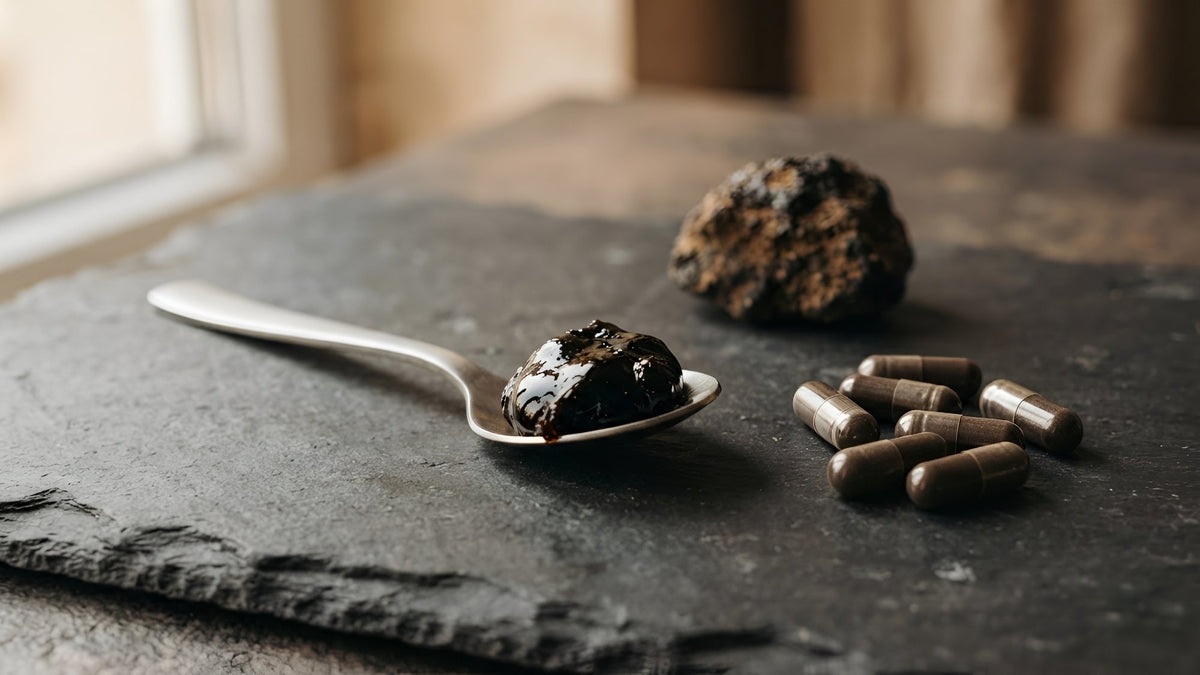
Shilajit capsules vs resin comes down to tradition versus precision. Resin is the traditional form: a thick, dark, sticky material you scoop and dissolve in a warm drink. Capsules hold a dried, measured extract, so every serving is the same amount and there is nothing to taste or measure. No head-to-head human research shows that either form is better. What matters most, whichever you pick, is a clearly stated amount and proof of purity from an outside lab. Shilajit+ is a capsule formula, and below we compare both forms fairly and explain what is inside it.
Key takeaways
- Resin is the traditional form of shilajit, while capsules hold a dried extract in a measured amount.
- Neither form has been shown to be better in head-to-head human research.
- Raw shilajit can carry heavy metals, so purification and third-party testing matter more than the format.
- Shilajit+ provides 500 mg of shilajit extract per two-capsule serving, alongside tongkat ali, ashwagandha, magnesium, zinc and boron.
What is shilajit?
Shilajit is a mineral-rich, tar-like substance that seeps from rock in high mountain ranges, including the Himalayas. It forms over very long periods as plant material breaks down and mixes with minerals. Its best-known natural components are fulvic acid and a range of trace minerals. Shilajit has been used for centuries in traditional practice, and today it is sold as resin, powder, capsules and gummies.
Shilajit capsules vs resin: how they compare
Resin is the traditional form of shilajit, while capsules hold a dried extract in a measured amount. Here is how the two stack up on the things people actually notice:
| Resin | Capsules | |
|---|---|---|
| Form | Purified, semi-solid material | Dried extract in a capsule |
| Dosing | Scooped by eye, often "pea-sized" | Same measured amount every serving |
| Taste | Strong, smoky and bitter | None |
| Routine | Dissolve in warm water or tea | Swallow with water |
| Travel | Sticky; jars can be messy | Easy to pack |
| Formula | Usually shilajit alone | Can combine shilajit with other ingredients |
The case for resin
People who prefer resin like that it is closer to the traditional form and that they can adjust the amount. Some enjoy the ritual of stirring it into a morning drink. The trade-off is that a scoop by eye is not a measured dose, and the taste is an acquired one.
The case for capsules
Capsules give the same amount every time, with no taste, no mess and no measuring. They also make it possible to pair shilajit with other ingredients in one serving. You will often read that resin is "more potent" or "more bioavailable." No head-to-head human studies have settled that question, so be cautious about those claims, whichever way they point.
What about powders and gummies?
Powders are usually the same dried extract found in capsules, without the shell, so they need measuring and they taste like resin. Gummies are easy to take, but they often add sugar and may hold less shilajit per piece, so read the amount per serving carefully. Whatever the format, the label should state how much shilajit you get in each serving.
Why purity matters more than format
Raw shilajit can carry heavy metals, so purification and third-party testing matter more than the format. Because shilajit forms in rock, unprocessed material can contain metals such as lead and arsenic, and a 2024 review in Biological Trace Element Research looked closely at both the minerals and the metals found in shilajit. Commercial shilajit is purified before sale, but the only way to know a product is clean is an outside lab test.
That is true of resin and capsules alike. Ask any brand whether every batch is tested by a third party, and whether you can see what the testing covers. Our guide to how to read a certificate of analysis shows what to look for.
Inside Shilajit+: a capsule formula

We built Shilajit+ as a capsule so each serving is measured and the formula can do more than one thing. Each two-capsule serving of Shilajit+ holds 500 mg of shilajit extract, plus tongkat ali, ashwagandha, magnesium, zinc and boron. Every active is listed by amount on the label:
- Shilajit extract (asphaltum), 500 mg
- Tongkat ali root extract (Eurycoma longifolia), 200 mg
- Ashwagandha root extract (Withania somnifera), 200 mg
- Magnesium (as magnesium bisglycinate), 80 mg
- Zinc (as zinc citrate), 15 mg
- Black pepper fruit extract, 5 mg
- Boron (as boron citrate), 4 mg
Shilajit+ supports cellular health and energy and enhances metabolic health.* The label directs two gelatin capsules once a day, 20 to 30 minutes before a meal with an 8 fl oz glass of water, so the 60-capsule bottle is a 30-day supply. It is caffeine-free. Note that the capsule shell is gelatin, so Shilajit+ is not vegetarian.
Every batch of Shilajit+ is third-party tested for purity and potency and made in an NSF-certified, GMP-certified, FDA-registered U.S. facility. You can read how our testing works on our standards page. If you are curious about the adaptogenic roots in the formula, our guide Adaptogens 101 explains what ashwagandha is.
How to choose between capsules and resin
- Pick resin if you enjoy a warm-drink ritual, do not mind the taste, and want shilajit on its own.
- Pick capsules if you want a measured, repeatable serving, no taste, easy travel, or a formula that pairs shilajit with other ingredients.
- Either way, ask for testing. Third-party testing for purity and potency is the deciding factor, not the format.
- Check with a professional first if you are pregnant or nursing, take medication, or have a medical condition.
Frequently asked questions about shilajit capsules vs resin
Is shilajit resin stronger than capsules?
Not necessarily. Strength depends on how much shilajit you take and how it was purified and extracted, not on whether it is a resin or a powder. Capsules list a measured amount; resin is usually scooped by eye.
What does shilajit resin taste like?
Most people describe it as smoky, earthy and bitter. That is one reason many people prefer capsules.
How do I take Shilajit+?
Follow the label: two gelatin capsules once a day, 20 to 30 minutes before a meal with an 8 fl oz glass of water. Do not exceed the recommended dose.
Is shilajit safe?
Purified shilajit appears to be well tolerated in the small human studies done so far. Raw or unpurified shilajit is a different matter because of possible heavy metals. Choose a product that is third-party tested, and talk with your healthcare provider if you take medication or have a medical condition.
Can I take shilajit in the evening?
Follow your product's label first. Shilajit+ is caffeine-free, and its label directs taking it before a meal, so many people take it before breakfast or lunch as part of a daytime routine.
Related reading from our Wellness Hub
- Adaptogens 101: What Is an Adaptogen? Ashwagandha and Mushrooms
- How to Read a Supplement Certificate of Analysis (COA)
Sources
- A comprehensive review on shilajit: what we know about its chemical composition. Critical Reviews in Analytical Chemistry, 2025
- Hazardous or advantageous: uncovering the roles of heavy metals and humic substances in shilajit. Biological Trace Element Research, 2024
- Keller JL, et al. The effects of shilajit supplementation on fatigue-induced decreases in muscular strength. Journal of the International Society of Sports Nutrition, 2019
Individual results vary.
*These statements have not been evaluated by the Food and Drug Administration. This product is not intended to diagnose, treat, cure, or prevent any disease.