
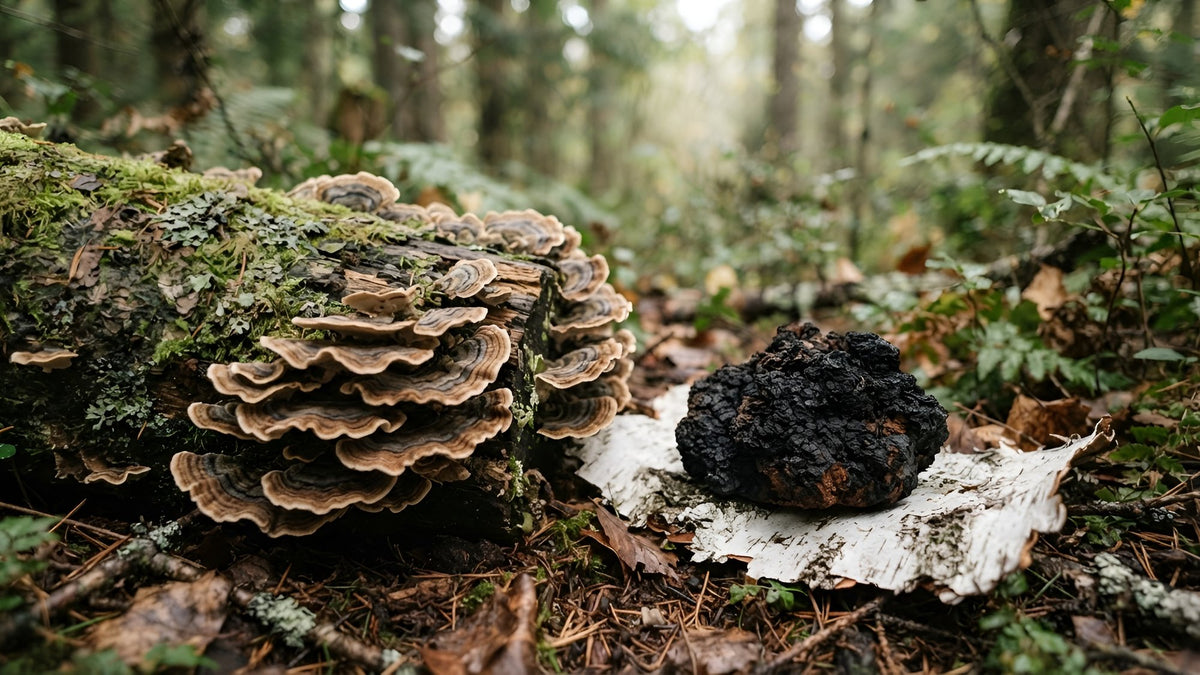
Turkey tail vs. chaga: what is the difference? Turkey tail is a thin, fan-shaped mushroom that grows on dead hardwood and is studied mainly for its polysaccharide-peptide compounds and their role in immune function. Chaga is not a typical mushroom at all but a dark, woody growth on birch trees, valued for its antioxidant compounds. Shiitake and maitake are the two culinary mushrooms in this group, and shiitake has some of the clearest human research on everyday intake and immune markers. This guide compares all four side by side, explains how each is used, and covers the safety points.
Key takeaways
- Turkey tail is a thin, fan-shaped mushroom studied mainly for its polysaccharide-peptide compounds and their role in immune function.
- Chaga is a dark, woody growth on birch trees, valued for its antioxidant compounds.
- In a four-week trial, healthy adults who ate shiitake every day showed changes in several markers of immune function.
- Chaga is naturally very high in oxalates, so it is not a mushroom to drink by the pot every day.
- Turkey tail and chaga are too tough to eat, so they are used as teas and extracts.
What is turkey tail?
Turkey tail (Trametes versicolor, also called Coriolus versicolor) gets its name from its banded brown, tan and rust rings, which look like a fanned turkey tail. It is one of the most common mushrooms in the world and grows in overlapping shelves on fallen logs and stumps.
- Key compounds. Polysaccharide-peptides, often called PSP and PSK, along with beta-glucans.
- Research. Turkey tail is studied mainly for immune function. In one small trial in healthy volunteers, a turkey tail polysaccharide-peptide shifted the gut microbiome in a way the researchers described as prebiotic.
- How it is used. Turkey tail is far too tough to eat, so it is taken as a hot-water extract, a tea or a powder.
What is chaga?
Chaga (Inonotus obliquus) grows mainly on birch trees in cold northern forests. What people harvest is a black, cracked, charcoal-like mass called a sclerotium, with a rust-orange interior. It has been brewed as a tea in Russia, Scandinavia and other northern regions for centuries.
- Key compounds. Polyphenols, melanin pigments, triterpenes and polysaccharides, including beta-glucans.
- Research. Reviews describe chaga's strong antioxidant activity, but most of the evidence so far comes from lab and animal studies rather than human trials.
- How it is used. As a tea, a hot-water extract or a powder. Wild chaga grows slowly, so sustainable sourcing matters.
What are shiitake and maitake?
These two are familiar from the kitchen as well as the supplement aisle.
- Shiitake (Lentinula edodes) is the brown-capped mushroom common in East Asian cooking. It contains beta-glucans, including one called lentinan. In a four-week trial, healthy adults who ate shiitake every day showed changes in several markers of immune function, including more active immune cells and higher levels of a gut-lining antibody called secretory IgA.
- Maitake (Grifola frondosa), also called hen of the woods, grows in large ruffled clusters at the base of oak trees. It is prized for its flavor and is rich in beta-glucans, which researchers study for their role in immune function.
Turkey tail vs. chaga vs. shiitake vs. maitake: side by side
| Turkey tail | Chaga | Shiitake | Maitake | |
|---|---|---|---|---|
| Grows on | Dead hardwood | Living birch trees | Hardwood logs (widely cultivated) | Base of oak trees (cultivated too) |
| Edible as food? | No, too tough | No, woody | Yes, cooked | Yes, cooked |
| Known for | Polysaccharide-peptides (PSP, PSK) | Antioxidant polyphenols | Beta-glucans, including lentinan | Beta-glucans |
| Main research area | Immune function, gut microbiome | Antioxidant activity (mostly lab studies) | Immune markers in healthy adults | Immune function |
| Common forms | Extract, tea, powder | Tea, extract, powder | Food, extract, powder | Food, extract, powder |
Which is better, turkey tail or chaga?
They do different jobs, so "better" depends on what you are after. Turkey tail has more human research tied to immune function and the gut. Chaga is better known for antioxidant activity, though most of that evidence is from the lab. Shiitake and maitake add culinary mushrooms with beta-glucans and, for shiitake, a clear human study in healthy adults. Many people simply combine them rather than choosing one.
Food or extract: how to get these mushrooms
Turkey tail and chaga are too tough to eat, so they are used as teas and extracts. Hot-water extraction pulls out the water-soluble polysaccharides, including beta-glucans, which is how these mushrooms have been used traditionally.
Shiitake and maitake are easy to eat. Sauté them, add them to soups and stir-fries, or roast them. Always cook shiitake well; raw or undercooked shiitake causes a temporary itchy skin rash in a small number of people.
If you want all four in one daily routine, Mushroom Vitality+™ includes turkey tail, chaga, shiitake and maitake extracts alongside lion's mane, reishi and cordyceps, plus an adaptogen blend of ashwagandha, Asian ginseng and rhodiola. Each 1.96 g scoop lists the seven mushroom extracts by amount, including 125 mg of turkey tail, 150 mg of chaga, 200 mg of shiitake and 125 mg of maitake; for the adaptogens, blend totals are on the label; the amounts inside each blend are not. It supports immune system function and natural energy and stamina,* and it is third-party tested, every batch, for purity and potency; see our standards.
Safety: what to know before using medicinal mushrooms
- Chaga and oxalates. Because chaga is naturally very high in oxalates, it should not be brewed by the pot and drunk every day. Anyone told to limit oxalates or with kidney concerns should ask a doctor first.
- Medications. Chaga may affect blood clotting and blood sugar, so check with your doctor if you take blood thinners or blood-sugar medicines. Anyone taking medicines that affect the immune system should ask before using mushroom extracts.
- Allergies. People allergic to mushrooms or molds should avoid them.
- Pregnancy and nursing. Medicinal mushroom extracts are not well studied here; ask your healthcare provider.
- Foraging. Leave wild harvesting to experts. Several inedible mushrooms look similar to turkey tail.
Frequently asked questions about turkey tail vs. chaga
Can you take turkey tail and chaga together?
Yes, many mushroom blends combine them. Follow the product label and check with your doctor if you take blood thinners, blood-sugar medicines or medicines that affect the immune system.
Is chaga a mushroom?
Chaga is a fungus, but what people harvest is a woody sclerotium growing on birch, not a typical cap-and-stem mushroom. It is usually brewed as a tea or taken as an extract.
What is turkey tail mushroom good for?
Turkey tail is studied mainly for immune function, and one small trial in healthy volunteers found prebiotic-like effects on the gut microbiome. It is used as an extract or tea because it is too tough to eat.
Are shiitake and maitake as good as supplements?
Eating them is a healthy habit, and the shiitake trial used whole dried mushrooms as food. Extracts concentrate the compounds and are convenient if you do not eat mushrooms often.
Is it safe to drink chaga tea every day?
Occasional chaga tea is common, but chaga is very high in oxalates, so large daily amounts are not a good idea. Ask your doctor if you have kidney concerns or take medication.
Related reading from our Wellness Hub
- Lion's Mane vs Reishi vs Cordyceps: What Each Mushroom Does
- Mushrooms for Focus and Immune Support: The Beta-Glucan Connection
- Best Time to Take Mushroom Supplements: Morning Routine
Sources
- Dai X et al. Consuming Lentinula edodes (shiitake) mushrooms daily improves human immunity: a randomized dietary intervention in healthy young adults. Journal of the American College of Nutrition, 2015.
- Pallav K et al. Effects of polysaccharopeptide from Trametes versicolor and amoxicillin on the gut microbiome of healthy volunteers: a randomized clinical trial. Gut Microbes, 2014.
- A brief overview of the medicinal and nutraceutical importance of Inonotus obliquus (chaga) mushrooms. 2024 review.
Individual results vary.
*These statements have not been evaluated by the Food and Drug Administration. This product is not intended to diagnose, treat, cure, or prevent any disease.

