
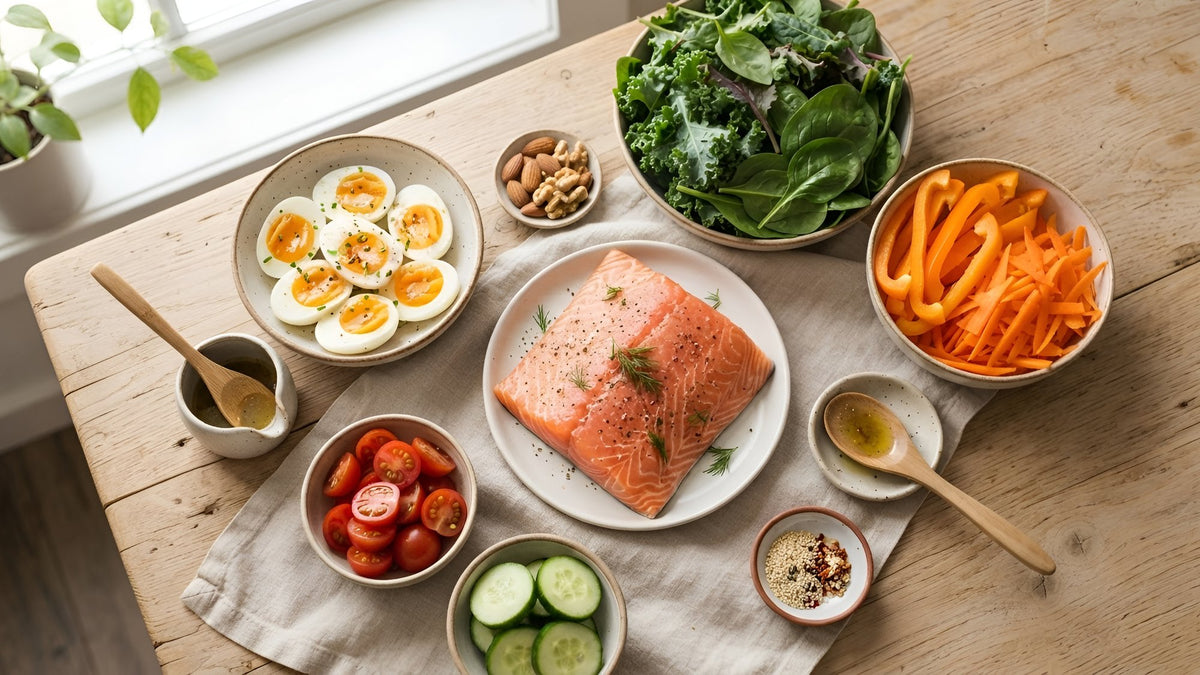
The best foods for eye health are dark leafy greens, eggs, oily fish, orange and yellow vegetables, citrus and berries, and nuts and seeds. Together they supply nutrients your eyes rely on: lutein and zeaxanthin, omega-3 fats, vitamin A, vitamin C, vitamin E and zinc. No single "superfood" does the job; a plate that includes several of these groups most days does. Here is what each food brings and simple ways to eat more of it.
Key takeaways
- Kale, spinach and other dark greens are rich in lutein and zeaxanthin.
- Eat greens with a little olive oil or alongside eggs, because their carotenoids are absorbed better with fat.
- Salmon, sardines and trout supply DHA, an omega-3 fat the retina holds in large amounts.
- Carrots and squash, citrus fruit, and nuts and seeds round out vitamins A, C and E.
- Zinc from seafood, eggs and beans helps carry vitamin A to the retina.
What are the best foods for eye health?
| Food | Key nutrient for the eyes | Easy way to eat it |
|---|---|---|
| Kale, spinach, collards | Lutein and zeaxanthin | Sauteed in olive oil, stirred into soups or eggs |
| Eggs | Lutein, zeaxanthin and zinc | Scrambled with greens for breakfast |
| Salmon, sardines, trout | Omega-3 fats (DHA and EPA) | Baked or grilled for dinner |
| Carrots, sweet potatoes, squash | Beta-carotene (vitamin A) | Roasted as a side dish |
| Oranges, kiwi, bell peppers | Vitamin C | Snacks and salads |
| Almonds, sunflower seeds | Vitamin E | A small handful a day |
| Beans, lentils, oysters | Zinc | Soups, chili and salads |
| Blueberries, bilberries | Anthocyanins (antioxidants) | On oats or yogurt |
Leafy greens: lutein and zeaxanthin
Dark leafy greens such as kale and spinach are rich food sources of lutein and zeaxanthin. These two carotenoids collect in the macula, the small central part of the retina responsible for sharp, detailed vision, where they filter blue light and act as antioxidants. The body cannot make them, so they must come from food or supplements. Corn, peas, orange peppers and pistachios add smaller amounts.
Lutein and zeaxanthin are fat-soluble, so eating them with a little fat helps absorption. A spinach salad with olive oil, or eggs cooked with greens, is a better source than greens eaten plain. Egg yolk is a modest source in amount, but its natural fat makes it very well absorbed.
Oily fish: omega-3 for the retina
Oily fish such as salmon and sardines supply DHA, an omega-3 fat found in high levels in the retina. DHA is part of the structure of the light-sensing cells. For heart health, the American Heart Association recommends one to two servings of seafood a week, the NIH Office of Dietary Supplements notes. If you rarely eat fish, a fish oil supplement is one option; Pure Omega+™ is our fish oil, which supports vision health and brain function.* It contains fish (anchovy) in a gelatin softgel that may contain porcine, so it does not suit anyone who avoids fish for allergy or diet. The full Pure Omega+ label warning is quoted below, under "Where a supplement fits." Read EPA vs. DHA for the difference between the two.
Orange vegetables, citrus, nuts and seeds
Orange vegetables, citrus, nuts and seeds cover vitamins A, C and E. Vitamin A is needed to make rhodopsin, the pigment that lets you see in dim light; the body makes it from the beta-carotene in carrots, sweet potatoes and squash. Vitamin C is concentrated in the fluid at the front of the eye, and vitamin E protects the fatty membranes of eye cells.
- Vitamin A: carrots, sweet potatoes, pumpkin, cantaloupe
- Vitamin C: oranges, kiwi, strawberries, red peppers, broccoli
- Vitamin E: almonds, sunflower seeds, hazelnuts, avocado
Zinc: the quiet helper
Eggs, beans and seafood supply zinc, which helps move vitamin A to the retina. Oysters have very high amounts of zinc, according to the NIH Office of Dietary Supplements. Beef, poultry, beans, lentils, pumpkin seeds and whole grains add more. Plant sources of zinc are absorbed less well, so people who eat little meat or seafood should pay attention to beans, seeds and whole grains.
Habits that help your eyes beyond the plate
Food is one part of everyday eye care. The National Eye Institute suggests a few more habits:
- Wear sunglasses outdoors that block UVA and UVB light.
- Follow the 20-20-20 rule at screens: every 20 minutes, look at something 20 feet away for 20 seconds.
- Do not smoke. Smoking raises the risk of eye diseases and can harm the optic nerve.
- Keep regular eye exams, even when your vision feels fine.
A sample day of eye-friendly eating
- Breakfast: two eggs scrambled with spinach, a kiwi on the side.
- Lunch: kale and chickpea salad with olive oil, pumpkin seeds and orange slices.
- Snack: a small handful of almonds and some blueberries.
- Dinner: baked salmon, roasted sweet potato and steamed broccoli.
Where a supplement fits
Food comes first. Many people do not eat leafy greens or fish most days, though, and that is where a daily formula can fill the gap. Vision+™ combines lutein, zeaxanthin and bilberry in a 481 mg blend with fourteen vitamins and minerals, including vitamins C and E, copper and 32 mg of zinc in its two-capsule serving. Vision+ supports reading clarity and color perception and provides retina defense.* Blend totals are on the label; the amounts inside each blend are not. Every batch is third-party tested for purity and potency by an outside lab; see our standards. Our guide What to look for in an eye vitamin explains each ingredient.
Vision+ and Pure Omega+ carry the same label warning: "Do not exceed recommended dose. Pregnant or nursing mothers, children under the age of 18, and individuals with a known medical condition should consult a physician before using this or any dietary supplement. Keep out of reach of children. Do not use if safety seal is damaged or missing. Store in a cool, dry place." Their directions differ on food timing: take two Vision+ veggie capsules once a day, 20 to 30 minutes before a meal with an 8 fl oz glass of water or as your healthcare professional directs, and take two Pure Omega+ softgels daily with meals. Pure Omega+ gives 1,440 mg of omega-3s per serving. The NIH Office of Dietary Supplements notes that "high doses of omega-3s may cause bleeding problems when taken with warfarin (Coumadin) or other anticoagulant medicines," so talk with your healthcare provider before using it if you take a blood thinner.
Some nutrients in Vision+ have an adult upper limit or a medicine caution on the NIH Office of Dietary Supplements fact sheets:
- Zinc: Vision+ gives 32 mg of zinc per serving. The NIH Office of Dietary Supplements lists 40 mg of zinc a day as the upper limit for adults, and that limit counts zinc from all sources: foods, beverages, supplements and medications. If you take Vision+ and also eat zinc-rich foods such as oysters, or take another product with zinc, add up the total. The same fact sheet notes that quinolone antibiotics (such as Cipro) and tetracycline antibiotics "might reduce the amount of both zinc and the antibiotic that your body absorbs"; it advises taking the antibiotic at least 2 hours before, or 4 to 6 hours after, a zinc supplement. It also notes that zinc supplements can reduce the amount of penicillamine your body absorbs, so take the two at least 1 hour apart.
- Niacin: One serving of Vision+ gives 40 mg of niacin. The NIH Office of Dietary Supplements lists 35 mg a day as the adult upper limit for niacin from dietary supplements, so Vision+ alone is above that limit. The same fact sheet notes that "dietary supplements with 30 mg or more of nicotinic acid can make the skin on your face, arms, and chest turn red and burn, tingle, and itch." Ask your healthcare provider whether this amount is right for you, and before adding any other product that contains niacin.
- Vitamin C: Vision+ gives 200 mg of vitamin C per serving. The NIH Office of Dietary Supplements lists 2,000 mg a day as the adult upper limit for vitamin C, counting food, beverages and supplements, so add up vitamin C from food and from any other product you take. The same fact sheet notes that in people with hemochromatosis, "high doses of vitamin C could worsen iron overload and damage body tissues," that vitamin C supplements "might interact with cancer treatments, such as chemotherapy and radiation therapy," and that in one study vitamin C plus other antioxidants (such as vitamin E, selenium and beta-carotene) reduced the heart-protective effects of a statin and niacin taken together.
- Vitamin A: Vision+ gives its vitamin A as beta-carotene (100 mcg RAE per serving). The NIH Office of Dietary Supplements notes that taking acitretin (Soriatane) or bexarotene (Targretin) "together with a vitamin A supplement could cause dangerously high levels of vitamin A in the blood," and that "several studies have shown that smokers, former smokers, and people exposed to asbestos who take high-dose beta-carotene supplements have a higher risk of lung cancer and death."
Frequently asked questions about the best foods for eye health
Are carrots really good for your eyes?
Yes, in a specific way. Carrots supply beta-carotene, which the body turns into vitamin A, a nutrient needed for seeing in dim light. They will not sharpen eyesight that is already well nourished, but they help keep vitamin A intake steady.
What fruit is best for your eyes?
Citrus fruits and kiwi are rich in vitamin C, berries supply anthocyanins, and avocado and cantaloupe add carotenoids. A mix of colors across the week works better than one favorite.
How much leafy greens should I eat for eye health?
There is no official target, but a daily serving of dark greens, cooked or raw with a little fat, is a practical goal. Cooking shrinks greens, so a cooked half cup is easier than it sounds.
Can you get enough lutein from food alone?
It is possible with consistent effort, especially from kale, spinach and eggs. Many people's typical diets supply less than the amounts used in research, which is why some choose a supplement.
Do eye-healthy foods replace an eye exam?
No. Good nutrition supports everyday eye health, but regular eye exams find changes you cannot feel or see yourself. Keep your scheduled checkups.
Related reading from our Wellness Hub
- Lutein and Zeaxanthin for Eye Health and Screen Time
- What to Look for in an Eye Vitamin: Vision+ Ingredients Explained
- Zinc Explained: What It Does, Food Sources and Where Immune+ Fits
Sources
- National Eye Institute: Keep your eyes healthy
- NIH Office of Dietary Supplements: Vitamin A and carotenoids
- NIH Office of Dietary Supplements: Zinc
- NIH Office of Dietary Supplements: Omega-3 fatty acids
- NIH Office of Dietary Supplements: Niacin, updated 2021
- NIH Office of Dietary Supplements: Vitamin C, updated 2021
Individual results vary.
*These statements have not been evaluated by the Food and Drug Administration. This product is not intended to diagnose, treat, cure, or prevent any disease.

