
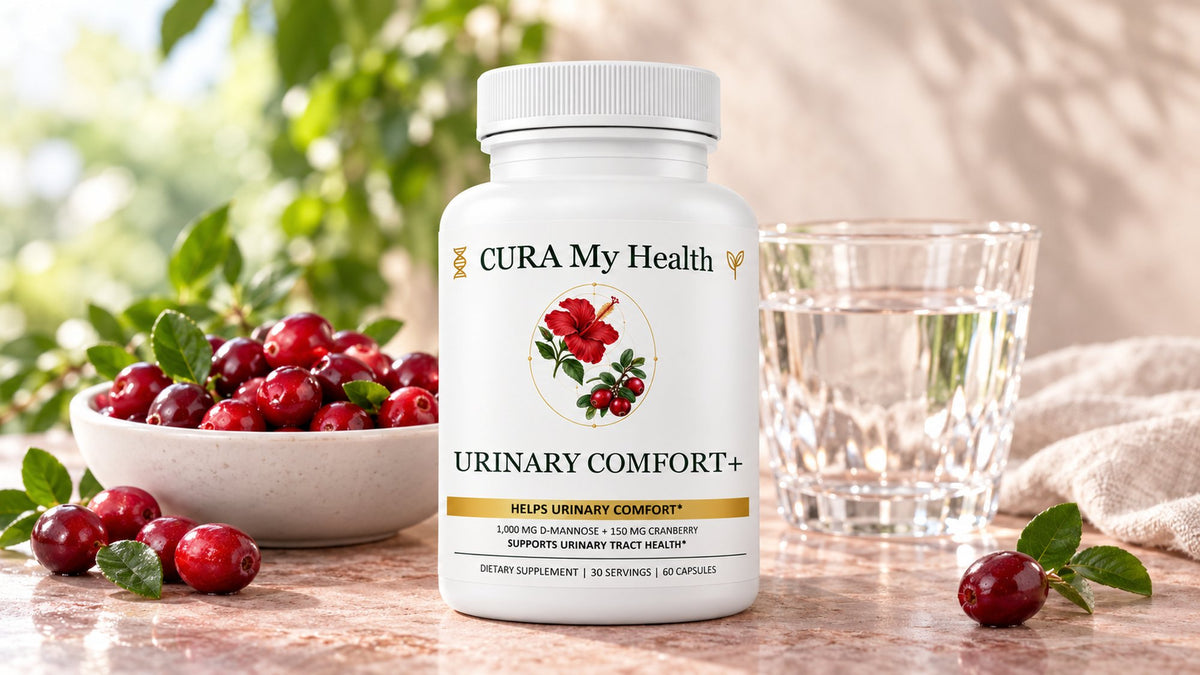
Cranberry pills vs. cranberry juice: both come from the same fruit, but they fit a routine very differently. Juice is easy to find and counts toward your fluids, yet Cleveland Clinic notes that the common cranberry juice cocktail "has very little cranberry juice" and that "juice has a high sugar content." Capsules made from cranberry juice powder deliver a measured amount of cranberry without the added sugar of a juice drink, the tart taste, or anything to refrigerate. For a daily routine, many people find a capsule simpler. Here is how the two compare, and why Urinary Comfort+™ uses cranberry powder.
Key takeaways
- Cleveland Clinic notes that the common cranberry juice cocktail "has very little cranberry juice" and that "juice has a high sugar content."
- Capsules made from cranberry juice powder deliver a measured amount of cranberry without the added sugar of a juice drink.
- The National Center for Complementary and Integrative Health says the proanthocyanidins (PACs) in cranberries are thought to keep bacteria from sticking to the bladder wall, though findings on cranberry have been inconsistent.
- Each two-capsule serving of Urinary Comfort+ provides 150 mg of cranberry juice powder alongside 1,000 mg of D-mannose.
- The Urinary Comfort+ label says not to exceed the recommended dose, and that pregnant or nursing mothers, children under the age of 18, and individuals with a known medical condition should consult a physician before using this or any dietary supplement. For the cranberry in it, the National Center for Complementary and Integrative Health says there is conflicting evidence about whether cranberry interacts with the blood thinner warfarin, and Cleveland Clinic says to talk to a healthcare provider if you take blood thinners, allergy medications, proton pump inhibitors or statins, and to "be cautious" about using cranberries if you have kidney stones, diabetes, high cholesterol, interstitial cystitis (bladder pain syndrome) or gastrointestinal issues like irritable bowel syndrome (IBS).
- Whichever form you choose, plain water does the heavy lifting for daily hydration.
Why cranberry is linked to urinary health
Cranberries have been part of urinary wellness routines for generations. The fruit contains proanthocyanidins (PACs), which the National Center for Complementary and Integrative Health (NCCIH) says are thought to keep bacteria from sticking to the bladder wall. Human studies have been mixed: NCCIH says the effectiveness of cranberry "is still in question because of inconsistent findings," and notes that "processing cranberries into various products, like tablets or capsules, can reduce the concentration of PACs, which can reduce the potential effectiveness of a product."
Cranberry pills vs. cranberry juice: side by side
| Cranberry juice | Cranberry capsules | |
|---|---|---|
| Sugar | Juice cocktails are sweetened; 100% juice is very tart | Essentially none from the cranberry |
| How much cranberry | Varies; Cleveland Clinic notes the common cocktail has very little cranberry juice | A stated amount per serving on the label |
| Calories | Adds up, especially in sweetened cocktails | Negligible |
| Convenience | Needs refrigeration once opened | Shelf-stable and portable |
| Hydration | Counts toward fluids | Taken with a glass of water |
The sugar problem with cranberry juice
Pure cranberry juice is so tart that few people drink it straight. That is why most bottles on the shelf are "cocktails" or blends. Cleveland Clinic notes that the common cocktail "has very little cranberry juice" and that "juice has a high sugar content." A daily glass adds up over weeks, which matters if you are watching sugar or calories. If you enjoy juice, look for 100% cranberry juice and dilute it with water or sparkling water.
Is cranberry juice a bladder irritant?
For some people, yes. Cranberry juice is acidic, and it appears on many lists of drinks that can bother a sensitive bladder, along with coffee, citrus juice and fizzy drinks. A small amount of cranberry powder inside a capsule, taken with water, is a very different serving size from a large glass of juice, but everyone's sensitivities differ. If you notice discomfort, talk with your provider. Our guide to foods and drinks that irritate the bladder goes deeper.
Why Urinary Comfort+ uses cranberry powder
Urinary Comfort+ is a focused four-ingredient formula built around 1,000 mg of D-mannose, the simple sugar best known for urinary tract support, with cranberry juice powder, hibiscus and dandelion.* Using cranberry juice powder lets us put a stated amount of cranberry in every serving without the sugar of a juice drink. D-mannose itself is a simple sugar, though, so Urinary Comfort+ is not sugar-free.

Each two-capsule serving of Urinary Comfort+ provides 150 mg of cranberry juice powder alongside 1,000 mg of D-mannose. The four actives on the label:
- D-mannose: 1,000 mg
- Cranberry juice powder (fruit): 150 mg
- Hibiscus extract (flower): 100 mg
- Dandelion extract (root): 100 mg
That is 1,350 mg in total, with every ingredient printed separately and no proprietary blend. It supports urinary tract health, promotes a healthy bladder environment and helps maintain urinary comfort, and it encourages natural detoxification and fluid balance.* To be clear about what the label does and does not say: it lists the amount of cranberry juice powder, not a separate PAC figure, so we do not claim a PAC amount.
The direction is two veggie capsules once a day, 20-30 minutes before a meal with an 8 fl oz glass of water, so each serving comes with a glass of water built in. The Urinary Comfort+ label warning reads: "Do not exceed recommended dose. Pregnant or nursing mothers, children under the age of 18, and individuals with a known medical condition should consult a physician before using this or any dietary supplement. Keep out of reach of children. Do not use if safety seal is damaged or missing. Store in a cool, dry place." For the cranberry in it, NCCIH says there is conflicting evidence about whether cranberry interacts with the blood thinner warfarin, and Cleveland Clinic says to talk to a healthcare provider if you take blood thinners, allergy medications, proton pump inhibitors or statins, and to "be cautious" about using cranberries if you have kidney stones, diabetes, high cholesterol, interstitial cystitis (bladder pain syndrome) or gastrointestinal issues like irritable bowel syndrome (IBS).
Every batch is third-party tested for purity and potency by an outside lab; see our standards.
How to read a cranberry label
Cranberry products are labeled in several different ways, which makes comparing them harder than it should be. A few pointers:
- Juice: look for "100% juice" and check the ingredient list for which juice comes first. "Cocktail," "drink" or "beverage" usually means a sweetened blend.
- Powder or extract: the label should state milligrams per serving and the plant part (fruit). Some products also state a PAC amount, measured by a specific lab method.
- Serving size: check how many capsules make one serving before comparing two products.
Whatever the form, a product is only as good as its testing. Ask whether the brand tests each batch with an outside lab.
How to choose for your routine
- You love juice and are not watching sugar: a small glass of 100% cranberry juice, diluted, can be part of your fluids.
- You want no added sugar and no fuss: a capsule with a stated amount is simpler.
- You want more than cranberry: a formula such as Urinary Comfort+ pairs it with D-mannose, hibiscus and dandelion in one serving.
In either form, plain water still does the heavy lifting for daily hydration. Cranberry in any form is an add-on to drinking enough, not a replacement for it.
Frequently asked questions about cranberry pills vs. cranberry juice
Are cranberry pills better than cranberry juice?
Neither is better for everyone. Capsules give a measured amount without the added sugar of a juice drink; juice adds fluids but often adds sugar too. Choose the form you can use consistently, and check the label for how much cranberry you actually get.
How much cranberry juice equals a cranberry capsule?
It depends on the product, because juices and powders vary in concentration. Labels rarely give a reliable juice equivalent, so compare the stated cranberry amount per serving rather than marketing claims.
Can I take Urinary Comfort+ with cranberry juice?
Yes, but there is little reason to drink large amounts of sweetened juice on top. Water is the better daily drink. If you enjoy juice, keep it small and unsweetened. The Urinary Comfort+ label says not to exceed the recommended dose, and that pregnant or nursing mothers, children under the age of 18, and individuals with a known medical condition should consult a physician before using this or any dietary supplement. For cranberry, the National Center for Complementary and Integrative Health says there is conflicting evidence about whether it interacts with the blood thinner warfarin, and Cleveland Clinic says to talk to a healthcare provider if you take blood thinners, allergy medications, proton pump inhibitors or statins, and to "be cautious" about using cranberries if you have kidney stones, diabetes, high cholesterol, interstitial cystitis (bladder pain syndrome) or gastrointestinal issues like irritable bowel syndrome (IBS).
Does cranberry interact with medicines?
The National Center for Complementary and Integrative Health says there is conflicting evidence about whether cranberry interacts with the blood thinner warfarin. Cleveland Clinic adds that you should talk to a healthcare provider if you take blood thinners, allergy medications, proton pump inhibitors or statins, and that you should "be cautious" about using cranberries if you have kidney stones, diabetes, high cholesterol, interstitial cystitis (bladder pain syndrome) or gastrointestinal issues like irritable bowel syndrome (IBS). If you take warfarin or any other medicine, ask your provider or pharmacist before adding cranberry products.
When should I see a provider instead?
Burning when you urinate, fever, back or side pain, or blood in the urine need prompt medical attention. Cranberry products support everyday urinary health; they are not a substitute for care.
Related reading from our Wellness Hub
- D-Mannose and Cranberry Supplement: Inside Urinary Comfort+
- D-Mannose vs. Cranberry: How They Differ for Urinary Wellness
- Foods and Drinks That Irritate the Bladder: A Practical List
Sources
- NCCIH: Cranberry: Usefulness and Safety, updated November 2024
- Cleveland Clinic: Cranberry Juice for UTIs: Does It Actually Work? (June 30, 2025)
- NIDDK: Prevention of Bladder Control Problems (Urinary Incontinence) & Bladder Health, last reviewed July 2021
- Moro C, et al. Cranberry Juice, Cranberry Tablets, or Liquid Therapies for Urinary Tract Infection: A Systematic Review and Network Meta-analysis. Eur Urol Focus, 2024 (PubMed)
Individual results vary.
*These statements have not been evaluated by the Food and Drug Administration. This product is not intended to diagnose, treat, cure, or prevent any disease.

