Digestive enzymes vs. probiotics: both sit on the same shelf, but they do very different jobs. Digestive enzymes are proteins that break food down into nutrients your body can absorb; they are not alive and they do not settle in your gut. Probiotics are live microorganisms that join the community of bacteria already living in your digestive tract. Put simply, enzymes work on your meal, and probiotics work with your microbiome. Here is how to tell them apart, when each one is used, and whether it makes sense to take both.
Key takeaways
- Digestive enzymes are proteins that break food down; probiotics are live microorganisms.
- Enzymes act on a meal and are timed around food, while probiotics are taken as a daily habit.
- Your body makes its own digestive enzymes, but it relies on food and its surroundings for its bacteria.
- The two can share a routine because they do different jobs.
Digestive enzymes vs. probiotics at a glance
| Digestive enzymes | Probiotics | |
|---|---|---|
| What they are | Proteins that speed up the breakdown of food | Live bacteria (and some yeasts) |
| Alive? | No | Yes |
| Main job | Break proteins, fats and sugars into absorbable pieces | Help replenish healthy bacteria in the gut |
| Timing | Around a meal, usually just before | A consistent daily habit |
| Measured by | Activity units, such as HUT for protease | CFU (colony-forming units) and named strains |
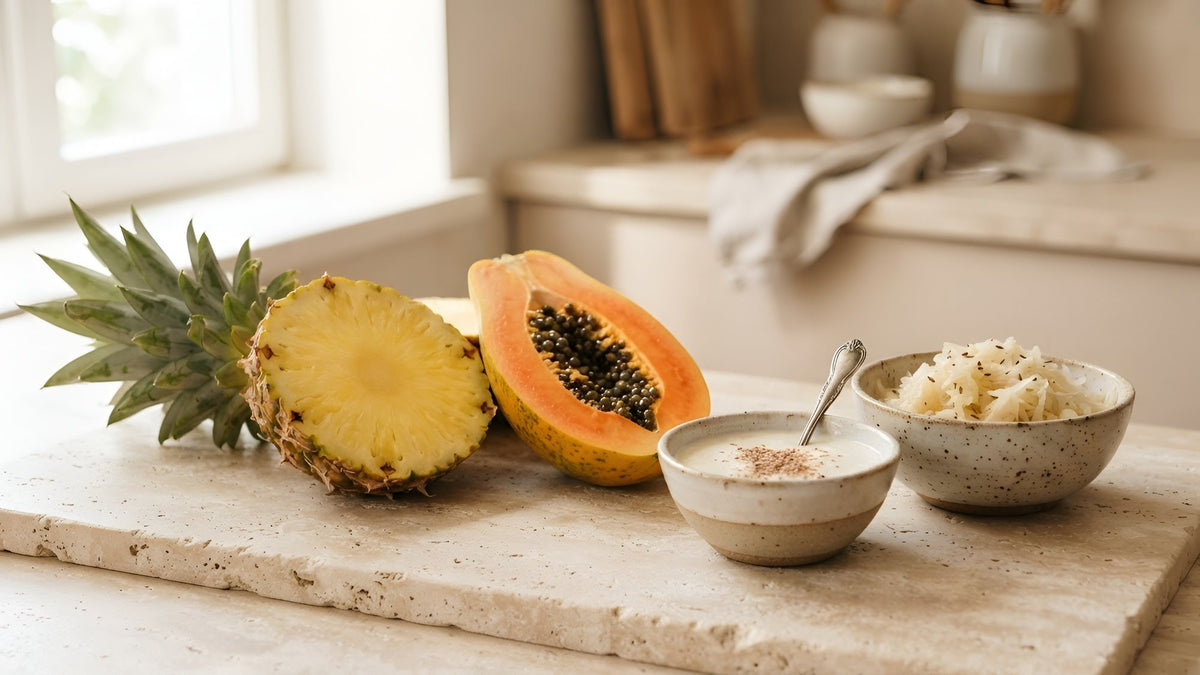
| Food sources | Pineapple (bromelain), papaya (papain) | Yogurt, kefir, sauerkraut, kimchi with live cultures |
What do digestive enzymes do?
Every meal is a mix of large molecules: proteins, fats and starches. Your body cannot absorb them whole, so it uses enzymes to cut them into smaller pieces. According to the NIDDK, your mouth, stomach, pancreas and small intestine all release enzymes as food moves along. Amylase works on starches, protease on proteins, lipase on fats and lactase on lactose, the natural sugar in milk.
The body produces digestive enzymes on its own; its gut bacteria, by contrast, come from food and the world around it. A supplemental enzyme simply adds a little extra help at mealtime. That is why enzyme labels talk about timing around food, and why an enzyme taken long after a meal has little left to work on.
What do probiotics do?
The National Center for Complementary and Integrative Health (NCCIH) describes probiotics as live microorganisms intended to have health benefits when consumed or applied to the body. Your gut already hosts trillions of microbes, often called the gut microbiome. Probiotic supplements and fermented foods add specific strains to that community.
Unlike an enzyme, a probiotic does not do one job on one meal. Its role is ongoing, which is why probiotics are usually taken every day for weeks. Effects depend on the strain, the amount and the person, so the strain list on a label matters as much as the headline CFU number. Our guide to the gut microbiome explains the bigger picture.
Do you need digestive enzymes, probiotics, or both?
Many people need neither, and food comes first either way. Fiber from vegetables, fruit, beans and whole grains feeds your gut bacteria, and fermented foods add live cultures. Unhurried meals and chewing well give your own enzymes a head start. Supplements are there to support those habits, not replace them.
When people do add a supplement, they often think about it this way:
- A digestive enzyme fits someone who wants mealtime support, especially around larger, protein-rich or dairy-containing meals.
- A probiotic fits someone who wants a steady, daily habit focused on healthy gut bacteria.
- Both can make sense, since each one has a different job.
If digestive discomfort is frequent, lasts more than a couple of weeks or comes with changes in weight, appetite or bowel habits, talk to your healthcare provider before reaching for any supplement.
Can you take digestive enzymes and probiotics together?
Yes, for most people the two fit into the same day, because they do not compete: enzymes work on the meal in front of you, and probiotics are a steady daily habit. The simplest approach is to follow each label exactly as written.
Our own two gut formulas show the difference in practice. Digest Ease+™ is an enzyme formula: one capsule once a day, 20-30 minutes before a meal, with six digestive enzymes and three Lactobacillus strains in the Makzyme-Pro™ blend. It enhances nutrient absorption and supports healthy digestion.* Probiotic 40+ is a dedicated probiotic with four named strains; its label directs one capsule during the day and one capsule in the evening. It helps replenish healthy bacteria and helps boost digestive health.* Both are third-party tested every batch, and both are manufactured in USA with globally sourced materials in an NSF-certified, GMP-certified, FDA-registered facility. Read more on Our Standards.
How to read the labels
The two categories use different yardsticks, so it helps to know what to look for:
- Enzymes: look for activity units, not just milligrams. HUT measures protein-digesting activity; other enzymes have their own units. A blend that shows activity tells you more than weight alone.
- Probiotics: look for the CFU count and the full strain names, including the strain code (for example, La-14). Check the storage line too.
- Both: check whether the product is third-party tested, and whether it is a blend. If it is a blend, the total is on the label even when the amount of each ingredient is not.
Frequently asked questions about digestive enzymes vs. probiotics
Are digestive enzymes the same as probiotics?
No. Digestive enzymes are proteins that break food down; probiotics are live microorganisms. Enzymes are not alive, while probiotics add to the bacteria in your gut. Some formulas contain both, but they are still two different ingredients doing two different jobs.
Can I take a probiotic and a digestive enzyme at the same time of day?
Usually, yes. The simplest approach is to follow each product's own label. An enzyme is taken around a meal, while a probiotic is taken on a consistent daily schedule, so they often end up at different times anyway.
Does my body already make digestive enzymes?
Yes. Your saliva, stomach, pancreas and small intestine all release enzymes during digestion. A supplement adds a little more at mealtime; it does not replace the enzymes your body makes.
Which foods contain natural digestive enzymes or probiotics?
Pineapple contains bromelain and papaya contains papain, two well-known plant enzymes. For live cultures, look to yogurt, kefir, sauerkraut and kimchi labeled with live and active cultures.
Should I start with an enzyme or a probiotic?
Start with food habits, then think about what you want support with: mealtime digestion points toward an enzyme, and a daily gut-bacteria habit points toward a probiotic. If you are unsure, or you have a medical condition or take medication, ask your healthcare provider first.
Related reading from our Wellness Hub
- Prebiotics vs. Probiotics vs. Synbiotics: A Plain-English Guide
- How Long Do Probiotics Take to Work?
- Bloating: Why It Happens and What Actually Helps
Sources
- NCCIH: Probiotics — What You Need To Know
- NIDDK: Your Digestive System & How It Works
- Cleveland Clinic: Digestive Enzymes 101
- Live Science: Probiotics vs digestive enzymes — what's the difference?
Individual results vary.
*These statements have not been evaluated by the Food and Drug Administration. This product is not intended to diagnose, treat, cure, or prevent any disease.