
How much calcium per day do you need? For adults, the NIH Office of Dietary Supplements lists a target of 1,000 to 1,200 mg a day, from food and supplements combined, depending on life stage. Most of that can come from food: a cup of yogurt, a glass of milk or fortified soymilk, and a serving of canned salmon or calcium-set tofu already cover a large share. Below, we walk through the numbers, the best food sources, how absorption works, and where vitamin D3 and K2 fit in a simple daily routine.
Key takeaways
- The NIH lists calcium targets for adults at 1,000 to 1,200 mg a day, from food and supplements combined, depending on life stage.
- Your body absorbs calcium from supplements best in amounts of 500 mg or less at one time.
- Vitamin D helps your body absorb calcium, and vitamin K is needed to activate proteins that bind calcium in bone.
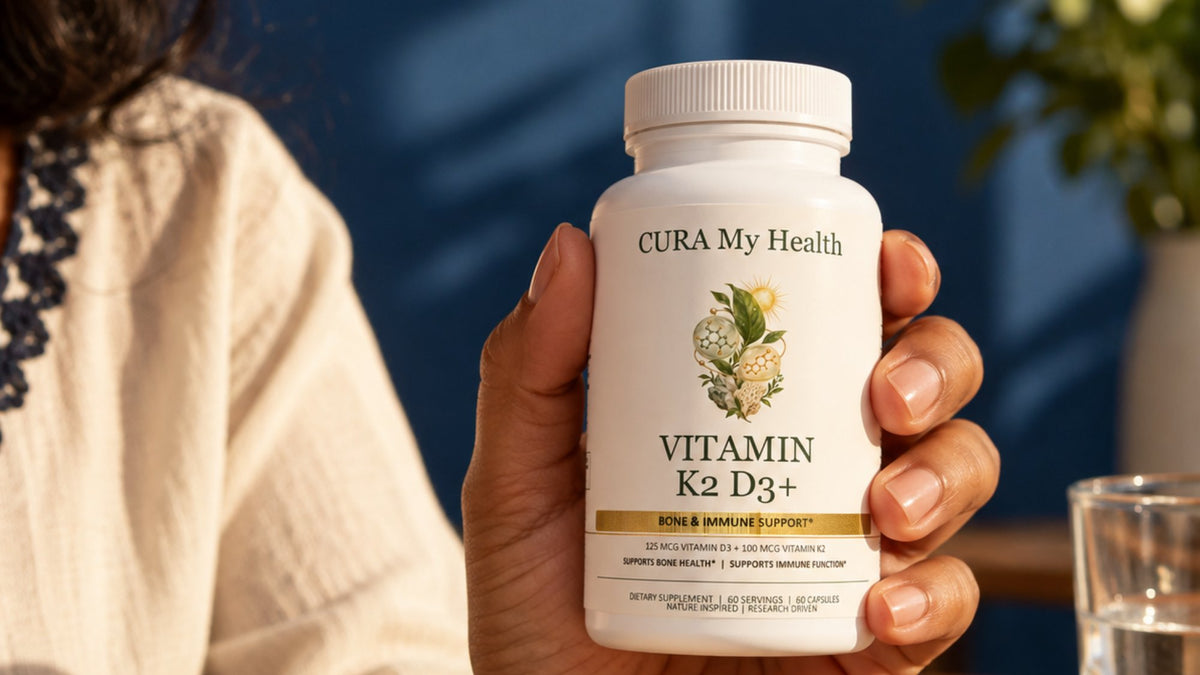
- Each Vitamin K2/D3+ capsule adds 210 mg of calcium, 5,000 IU of vitamin D3 and 100 mcg of vitamin K2 to the calcium you get from food.
How much calcium per day do adults need?
The NIH lists calcium targets for adults at 1,000 to 1,200 mg a day, from food and supplements combined, depending on life stage. These targets are Recommended Dietary Allowances (RDAs), set by the Food and Nutrition Board of the National Academies. The NIH table shows the exact number for you, and your healthcare provider can help you place yourself in it.
There is also a ceiling. The Tolerable Upper Intake Level (UL) for adults is 2,000 to 2,500 mg a day from all sources, again depending on life stage. More is not better with calcium: the NIH notes that higher intakes of supplemental calcium might raise the risk of kidney stones, which is one reason to count food first and fill only the gap.
One label detail can confuse people. The Daily Value (DV) printed on food and supplement labels is 1,300 mg for adults. So "16% DV" on a label means 16% of 1,300 mg, not 16% of your personal RDA.
What are the best food sources of calcium?
Dairy foods and calcium-fortified foods are the richest everyday sources. Fish eaten with their soft bones, calcium-set tofu and some greens add more. These figures come from the NIH calcium fact sheet:
| Food and serving | Calcium (mg) |
|---|---|
| Yogurt, plain, low fat, 8 ounces | 415 |
| Orange juice, calcium fortified, 1 cup | 349 |
| Mozzarella, part skim, 1.5 ounces | 333 |
| Sardines, canned in oil, with bones, 3 ounces | 325 |
| Milk, nonfat, 1 cup | 299 |
| Soymilk, calcium fortified, 1 cup | 299 |
| Tofu, firm, made with calcium sulfate, ½ cup | 253 |
| Salmon, pink, canned, with bones, 3 ounces | 181 |
| Kale, fresh, cooked, 1 cup | 94 |
| Chia seeds, 1 tablespoon | 76 |
A simple day might look like yogurt at breakfast, a glass of milk or fortified soymilk at lunch, and salmon or tofu at dinner. That alone lands near 1,000 mg before you count the smaller amounts in bread, beans and vegetables.
Why spinach is not a top calcium source
Spinach lists a fair amount of calcium on paper, but it also holds oxalic acid, which binds calcium. The NIH notes that the body absorbs only about 5% of the calcium in spinach, compared with about 27% from milk. Kale, bok choy and turnip greens are lower-oxalate greens that also add calcium.
Calcium absorption: why the amount you take at once matters
Your body does not absorb every milligram you swallow, and the share it absorbs drops as the amount goes up. Your body absorbs calcium from supplements best in amounts of 500 mg or less at one time. The NIH gives an example: the body absorbs about 36% of a 300 mg dose but about 28% of a 1,000 mg dose. If you do need a larger supplement amount, splitting it across the day works better than one big dose.
Form matters too. Calcium carbonate is 40% calcium by weight and calcium citrate is 21%. The NIH notes that calcium carbonate depends more on stomach acid, so people with low stomach acid absorb it better with a meal, while calcium citrate can be taken without food. Vitamin K2/D3+ uses calcium carbonate; follow its label, which directs one capsule 20-30 minutes before a meal. Some people get gas, bloating or constipation from calcium supplements, and smaller amounts spread through the day can help with that.
Calcium, vitamin D3 and K2: how they work together
Calcium does not work alone. Vitamin D helps your body absorb calcium, and vitamin K is needed to activate proteins that bind calcium in bone. One of those bone proteins is osteocalcin, according to the NIH vitamin K fact sheet. That is why many people look at calcium, vitamin D and vitamin K as one group rather than three separate nutrients.
Vitamin D is hard to get from food alone. Fatty fish, fortified milk and egg yolks supply some, and sunlight on skin makes some, but amounts vary a lot with season, skin and time outdoors. Vitamin K2 comes from fermented and animal foods: natto (fermented soybeans) is rich in it, while cheese, meat, dairy foods and eggs supply modest amounts, according to the NIH vitamin K fact sheet. Our guide Why Vitamin K2 and D3 Work Better Together goes deeper into the pairing.
Meet Vitamin K2/D3+: a daily capsule with calcium, D3 and K2

Vitamin K2/D3+ is built for this calcium routine. Each Vitamin K2/D3+ capsule adds 210 mg of calcium, 5,000 IU of vitamin D3 and 100 mcg of vitamin K2 to the calcium you get from food. Here is what the label lists per 1-capsule serving:
- Vitamin D3 (cholecalciferol): 125 mcg (5,000 IU)
- Vitamin K2 (MK-7, as menaquinone): 100 mcg
- Calcium (as calcium carbonate): 210 mg (16% DV)
- BioPerine® black pepper extract (fruit): 5 mg
Vitamin K2/D3+ supports bone health, promotes calcium absorption and supports immune system health.* That calcium is a modest top-up, not a full day's amount. Suggested use is one (1) capsule daily, preferably 20-30 minutes before a meal, or as directed by your healthcare professional. The 60-capsule bottle is a 60-day supply, and it is backed by our 60-day guarantee.
Quality comes first. Every batch is third-party tested by an outside lab for purity and potency. Vitamin K2/D3+ is manufactured in USA with globally sourced materials, in an NSF-certified, GMP-certified, FDA-registered U.S. facility, and every active amount is printed on the label. It is gluten-free, non-GMO, sugar-free and lactose-free, in a vegetable capsule. You can read how we test on our standards page.
Safety notes before you start
- Vitamin D adds up. One capsule gives 125 mcg (5,000 IU) of vitamin D3. That is above the 100 mcg (4,000 IU) daily upper limit for adults listed by the NIH Office of Dietary Supplements. If you already take vitamin D from a multivitamin or another supplement, add up the total and check with your healthcare provider before use.
- Vitamin K and blood thinners. Vitamin K can affect how blood-thinning medication works. If you take an anticoagulant such as warfarin, talk with your healthcare provider before use.
- Calcium and medicines. The NIH notes that calcium carbonate can interfere with the absorption of levothyroxine (thyroid hormone), and calcium supplements can also interact with some antibiotics and other medicines. Ask your pharmacist how far apart to space them.
- Label warnings: Do not exceed recommended dose. Pregnant or nursing mothers, children under the age of 18, and individuals with a known medical condition should consult a physician before using this or any dietary supplement. Keep out of reach of children. Do not use if safety seal is damaged or missing. Store in a cool, dry place.
A simple daily calcium routine
- Count your food first. For two or three ordinary days, add up the calcium from dairy, fortified drinks, tofu, canned fish and greens using the table above.
- Find the gap. Compare your total with the 1,000 to 1,200 mg target for your life stage.
- Fill only the gap. If you add a supplement, keep each dose at 500 mg of calcium or less, and stay under the upper limit from all sources.
- Cover vitamin D and K. If you use Vitamin K2/D3+, take one capsule a day as the label directs, and count its 210 mg of calcium in your total.
- Keep moving. Regular weight-bearing activity, such as walking and strength training, belongs in a bone-friendly routine alongside calcium.
For more on the vitamin D side of this routine, see How Much Vitamin D Do You Need Per Day?
Frequently asked questions about calcium per day
How much calcium per day should I aim for?
The NIH lists 1,000 to 1,200 mg a day for adults, depending on life stage, from food and supplements combined. Your healthcare provider can help you confirm your target.
Is it better to get calcium from food or supplements?
Food is the best place to start, and many people can reach most of their target with dairy, fortified drinks, tofu and canned fish. A supplement is a way to fill a gap, not to replace food. Count your food first, then add only what you need.
Can you take too much calcium?
Yes. The upper limit for adults is 2,000 to 2,500 mg a day from all sources, depending on life stage. The NIH notes that higher supplemental intakes might raise the risk of kidney stones. Add up food and supplements so you stay under the limit.
Why is vitamin D paired with calcium?
Vitamin D helps your body absorb calcium from food and supplements. Without enough vitamin D, the body absorbs a smaller share of the calcium you eat. That is why many calcium plans include vitamin D.
How much calcium is in Vitamin K2/D3+?
Each capsule has 210 mg of calcium as calcium carbonate, which is 16% of the 1,300 mg Daily Value. It also has 125 mcg (5,000 IU) of vitamin D3 and 100 mcg of vitamin K2. Take one capsule daily as the label directs.
Related reading from our Wellness Hub
- Why Vitamin K2 and D3 Work Better Together: The Calcium Connection
- How Much Vitamin D Do You Need Per Day? A Clear Guide
- How to Take Vitamin D3 and K2: A Simple Daily Serving Guide
Sources
- NIH Office of Dietary Supplements: Calcium, Fact Sheet for Health Professionals. Updated June 22, 2026.
- NIH Office of Dietary Supplements: Vitamin D, Fact Sheet for Health Professionals. Updated June 27, 2025.
- NIH Office of Dietary Supplements: Vitamin K, Fact Sheet for Health Professionals. Updated March 29, 2021.
- Harvard Health Publishing: How much calcium do you really need? Updated April 16, 2026.
Individual results vary.
These statements have not been evaluated by the Food and Drug Administration. This product is not intended to diagnose, treat, cure, or prevent any disease.

