
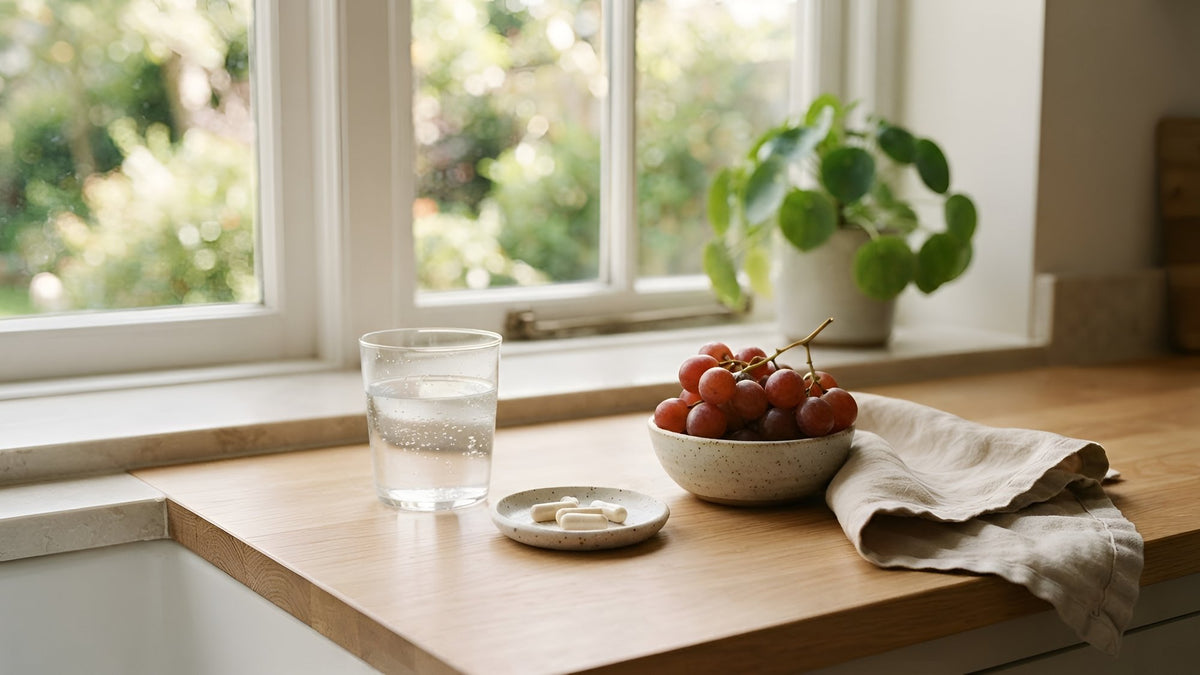
How to take resveratrol, in short: take it the same way every day, as the label directs. For Resveratrol+, that is one capsule a day, 20–30 minutes before a meal. Resveratrol is absorbed well but broken down quickly, so a steady routine matters more than the exact hour. Food can slow absorption, and one study at a much higher dose found that more fat in the meal lowered it. If you take a blood thinner, an NSAID pain reliever such as aspirin or ibuprofen, or another daily medicine, talk with your healthcare professional first; the Linus Pauling Institute and Memorial Sloan Kettering Cancer Center both list medicine interactions, covered in the safety section below.
Below, we walk through what resveratrol is, why timing questions come up so often, how to build an easy once-a-day routine, and the safety points we never skip. We also explain why the testing behind a resveratrol capsule matters as much as the milligrams on the front of the bottle.
What is resveratrol, and where does it come from?
Resveratrol is a polyphenol, a plant compound that plants make to protect themselves from stress. You find small amounts in grape skins, red wine, peanuts, cocoa and berries. The amounts in food are tiny: the Linus Pauling Institute notes that a 5 oz glass of red wine holds well under one milligram. That is why supplements use a concentrated source.
Most resveratrol supplements sold in the US contain extracts of Japanese knotweed root (Polygonum cuspidatum), the Linus Pauling Institute notes; Resveratrol+ does too. If you want the longer background story, read our guide Resveratrol and antioxidants: the longevity molecule explained.
How should you take resveratrol each day?
Start with the label. It is the one set of directions written for the exact product in your hand. Here is what the Resveratrol+ label says, and how that turns into a daily routine.
| Question | Resveratrol+ label direction |
|---|---|
| How much per serving? | 1 capsule (600 mg resveratrol blend) |
| How often? | Once a day (600 mg blend per day) |
| With or without food? | 20–30 minutes before a meal |
| How long does a bottle last? | 60 capsules = 60 days at the directed use |
A simple way to remember it: one capsule before the same meal every day. A meal you already eat becomes a reminder you do not need to set.
A sample once-a-day routine
- Morning: pour a glass of water while the coffee or tea brews. Take one capsule. Eat breakfast 20–30 minutes later.
- Or evening: if breakfast is rushed, take it with water while you start cooking dinner instead. Pick one time and keep it.
- Keep the bottle where the routine happens, such as next to the kettle, but away from heat, steam and direct sun. The label asks for a cool, dry place.
Is it better to take resveratrol with food or on an empty stomach?
This is the question we hear most. Two studies help answer it. In a study published in the International Journal of Clinical Pharmacology and Therapeutics, 24 healthy volunteers took one 400 mg dose of trans-resveratrol (more than the trans-resveratrol in one Resveratrol+ capsule), fasting or after a high-fat meal. Food slowed how fast resveratrol reached the blood, but the total amount absorbed was similar. The Linus Pauling Institute also describes a study in eight people taking a much higher dose, 2,000 mg twice a day, in which more fat in the diet lowered the amount absorbed.
So why does our label say 20–30 minutes before a meal? It gives a clear, repeatable window that fits into the day, and it keeps the capsule close to a meal without sitting on top of a heavy one. If a capsule before a meal ever bothers your stomach, speak with your healthcare professional about what works for you, rather than changing the dose on your own.
Why does consistency matter more than the exact hour?
Researchers describe resveratrol as having "high absorption but very low bioavailability." A classic study in Drug Metabolism and Disposition found that most of an oral dose is absorbed, but the body converts it quickly into other compounds (called metabolites). In that study, six volunteers took one 25 mg dose (less than the trans-resveratrol in one Resveratrol+ capsule), and only trace amounts of the original molecule showed up in the blood.
What this means for you, in plain terms:
- A steady daily time matters more than the exact hour. Take your one capsule at the same point in your day, every day.
- Daily use is the point. Resveratrol is studied as a steady, everyday habit, not a one-off.
- More is not better. The Linus Pauling Institute notes mild-to-moderate digestive side effects, such as nausea, gas and diarrhea, in study participants who took more than 1,000 mg of resveratrol a day for up to 29 days. One Resveratrol+ capsule a day is less than that. Do not exceed the recommended dose.
Meet Resveratrol+
Resveratrol+ is our antioxidant formula for daily support of heart and vascular health, cellular health and healthy aging.* Each capsule gives a 600 mg resveratrol blend from two Japanese knotweed root extracts: one standardized to 10% trans-resveratrol and one standardized to 50%.

We want the label to be easy to read honestly. The 600 mg on the front is the blend weight. The label shows the blend total, not the split between the two extracts, so read 600 mg as the weight of the knotweed blend, not as 600 mg of pure trans-resveratrol. We would rather tell you that than let a big number do the talking.
What the formula is made to do:*
- Promotes heart and vascular health.*
- Supports cellular health and longevity.*
Other ingredients are only a vegetable capsule (hypromellose) and microcrystalline cellulose. It is caffeine-free, vegan, gluten-free, non-GMO and sugar-free.
What should you look for in a resveratrol supplement?
Resveratrol is a crowded category, and many labels look alike. The difference is in what you cannot see on the shelf. Here is the checklist Resveratrol+ meets:
- Third-party tested, every batch. An outside lab checks each batch for purity and potency. Not one test at launch, but every batch. Learn how to read the results in How to read a supplement certificate of analysis.
- Manufactured in the USA with globally sourced materials, in an NSF-certified, GMP-certified, FDA-registered facility.
- Blend totals shown; the amounts inside each blend are not. The source (Japanese knotweed root), the standardization (10% and 50% trans-resveratrol) and the serving are all on the label.
- Clean by design. No synthetic dyes and no long list of fillers.
- A guarantee you can use. Every CuraMyHealth order comes with our 60-day guarantee.
You can read the full detail on our Our Standards page.
Who should check with a healthcare professional first?
Resveratrol is a plant compound, but it is still active in the body. Please read these points before you start. They are not small print.
- Blood thinners and NSAID pain relievers: resveratrol may slow blood clotting. Memorial Sloan Kettering Cancer Center notes a possible higher risk of bleeding with warfarin or antiplatelet medicines. The Linus Pauling Institute adds that, in theory, high intakes of resveratrol from supplements "could increase the risk of bruising and bleeding" when taken with anticoagulants such as warfarin and heparin, antiplatelet drugs such as clopidogrel and dipyridamole, and NSAIDs, including aspirin, ibuprofen, diclofenac and naproxen. Talk to your doctor first.
- Other daily medicines: resveratrol can affect the liver enzymes that process many common medicines. The Linus Pauling Institute says resveratrol has been reported to slow CYP3A4, the enzyme that processes about half of all marketed drugs in the US, which could raise the levels and the risk of side effects of drugs such as statins, calcium channel blockers (for example felodipine, nifedipine and verapamil), amiodarone, cyclosporine, tacrolimus, midazolam, triazolam and sildenafil. It adds that resveratrol may lower the levels of drugs processed by CYP1A2, such as acetaminophen and the antidepressants clomipramine and imipramine. Memorial Sloan Kettering Cancer Center notes that in an animal study in rats, Polygonum cuspidatum (Japanese knotweed, the source in Resveratrol+) raised blood levels of carbamazepine, a seizure medicine, and that the clinical relevance has yet to be determined. Ask your pharmacist or doctor before you add it.
- Hormone-sensitive conditions: resveratrol has shown estrogen-like activity in laboratory studies. Until more is known about this activity in people, the Linus Pauling Institute advises women with a history of estrogen-sensitive cancers, such as breast, ovarian or uterine cancer, to avoid resveratrol supplements. If you have any other hormone-sensitive condition, talk to your doctor before you start.
- Pregnancy and nursing: the Linus Pauling Institute at Oregon State University says "the safety of resveratrol-containing supplements during pregnancy and lactation has not been established." The Resveratrol+ label says pregnant or nursing mothers should consult a physician before using this or any dietary supplement.
- From the Resveratrol+ label: Do not exceed recommended dose. Pregnant or nursing mothers, children under the age of 18, and individuals with a known medical condition should consult a physician before using this or any dietary supplement. Keep out of reach of children. Do not use if safety seal is damaged or missing. Store in a cool, dry place.
Frequently asked questions about how to take resveratrol
What is the best time of day to take resveratrol?
There is no single best hour. What matters most is a steady routine. For Resveratrol+, the label directs one capsule a day, 20–30 minutes before a meal, so before breakfast or before dinner, at the same time each day, is an easy pattern to follow.
Should resveratrol be taken with food?
In one study, food slowed how fast resveratrol was absorbed without lowering the total amount; in another, at a much higher dose, more fat in the meal lowered the amount absorbed. The Resveratrol+ label directs taking the capsule 20–30 minutes before a meal. Follow the label for the product you use.
Can I take more than one capsule a day?
The label directs one capsule a day. Do not exceed the recommended dose, and ask your healthcare professional if you want to change how you take it.
Is 600 mg of resveratrol blend the same as 600 mg of trans-resveratrol?
No. The 600 mg on the Resveratrol+ label is the weight of the Japanese knotweed root blend, standardized to 10% and 50% trans-resveratrol. The label does not list the split between the two extracts, so the amount of pure trans-resveratrol is less than 600 mg.
Can I take resveratrol with a blood thinner?
Speak with your doctor before you do. Memorial Sloan Kettering Cancer Center notes a possible higher risk of bleeding with warfarin or antiplatelet medicines, and the Linus Pauling Institute adds NSAID pain relievers such as aspirin, ibuprofen and naproxen. Both sources also say resveratrol may affect the liver enzymes that process many medicines. Your doctor or pharmacist can tell you whether it is right for you.
Related reading from our Wellness Hub
- Resveratrol and Antioxidants: The "Longevity" Molecule, Explained
- How to Read a Supplement Certificate of Analysis (COA)
- How to Take Beetroot Capsules: A Daily Routine With Beetroot+™
Sources
- Linus Pauling Institute, Oregon State University. Resveratrol. Micronutrient Information Center.
- Walle T, et al. High absorption but very low bioavailability of oral resveratrol in humans. Drug Metabolism and Disposition. 2004.
- Vaz-da-Silva M, et al. Effect of food on the pharmacokinetic profile of trans-resveratrol. International Journal of Clinical Pharmacology and Therapeutics. 2008.
- Memorial Sloan Kettering Cancer Center. Resveratrol. About Herbs, Botanicals and Other Products.
Individual results vary.
These statements have not been evaluated by the Food and Drug Administration. This product is not intended to diagnose, treat, cure, or prevent any disease.

