
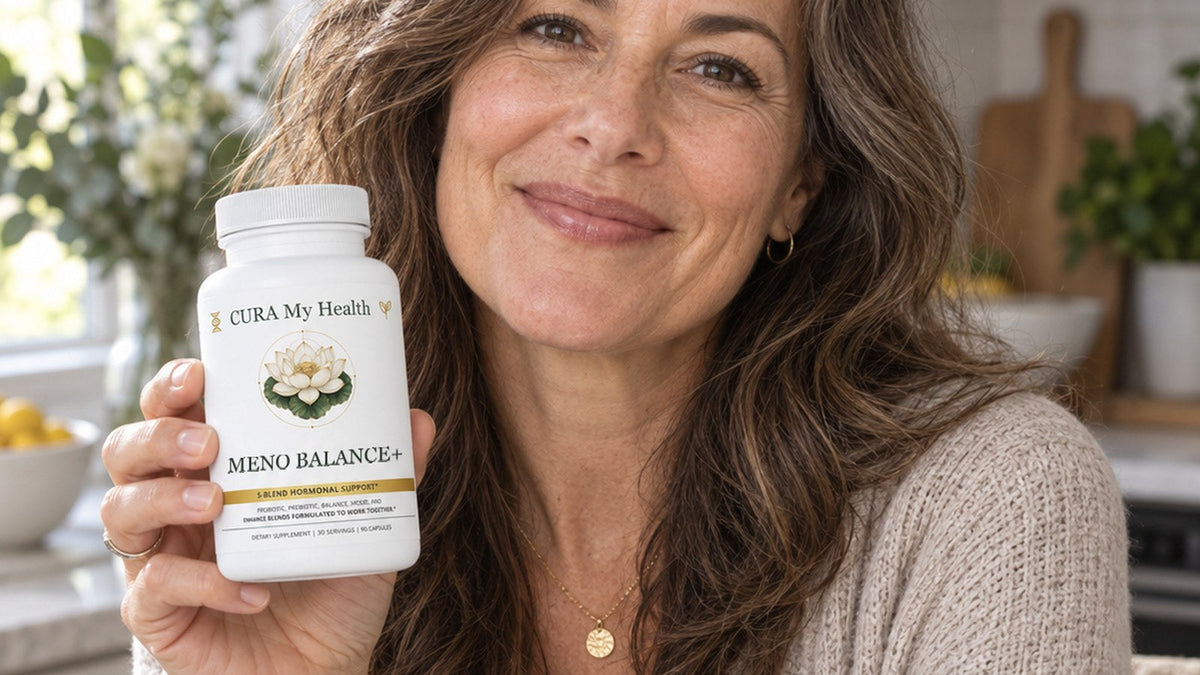
What ingredients are in a menopause supplement like Meno Balance+™? Our formula lists three vitamins with exact amounts (vitamin D, vitamin E and vitamin B6), then five proprietary blends: a 7 billion CFU probiotic blend, a prebiotic fiber blend, and three botanical blends called Balance, Mood and Enhance. The totals for each blend are printed, but not the amount of each herb inside. Below is every line of the label, what each ingredient is, what the research says, and the safety warning that comes with it.
Use this guide with the Meno Balance+ product page open beside it, so you can follow along line by line.
Key takeaways
- Meno Balance+ lists three vitamins with exact amounts: vitamin D, vitamin E and vitamin B6.
- The other five rows are proprietary blends: probiotic, prebiotic, Balance, Mood and Enhance.
- Blend totals are on the label; the amounts inside each blend are not.
- Several botanicals in the formula are hormone-active, which is why the label carries a do-not-use warning.
- Each serving is three delayed-release capsules taken 20 to 30 minutes before a meal.
Menopause supplement ingredients at a glance
The first three rows are vitamins. The other five rows are proprietary blends: probiotic, prebiotic, Balance, Mood and Enhance. Here is the full Supplement Facts panel, per 3-capsule serving:
| Label row | Amount | What is in it |
|---|---|---|
| Vitamin D (as cholecalciferol) | 60 mcg (300% DV) | Vitamin D3, sourced from lanolin |
| Vitamin E (as dl-alpha tocopheryl acetate) | 13 mg (87% DV) | Vitamin E |
| Vitamin B6 (as pyridoxine HCl) | 7.5 mg (441% DV) | Vitamin B6 |
| Probiotic Blend | 75 mg (7 billion CFU) | MAKTREK® Bi-pass Technology; L. acidophilus LA-14; B. lactis BI-04; L. plantarum Lp-115; L. paracasei Lpc-37; complex marine polysaccharide |
| Prebiotic Blend | 300 mg | Artichoke leaf, chicory root, fructooligosaccharides |
| Balance Blend | 600 mg | Black cohosh extract, turmeric extract, DIM, wild yam extract, red clover extract, dong quai |
| Mood Blend | 495 mg | Ashwagandha root, chaste berry fruit, rhodiola extract |
| Enhance Blend | 450 mg | Panax ginseng root, ginkgo leaf, maca root, flaxseed, and a hormone precursor named in the label warning below |
Other ingredients: hypromellose (vegetable capsule) and gellan gum (delayed-release capsule).
The three vitamins: D, E and B6
Meno Balance+ lists three vitamins with exact amounts: vitamin D, vitamin E and vitamin B6.
- Vitamin D (60 mcg). Vitamin D helps the body absorb calcium and supports bone health, according to the NIH Office of Dietary Supplements (ODS). That 60 mcg equals 2,400 IU. ODS sets the adult upper limit at 100 mcg (4,000 IU) a day, so count any other vitamin D you take. Because this vitamin D comes from lanolin (sheep's wool), the formula is not suitable for a plant-based diet.
- Vitamin E (13 mg). Vitamin E is a fat-soluble antioxidant that helps protect cells from oxidative stress.
- Vitamin B6 (7.5 mg). B6 helps the body use protein and is involved in more than 100 enzyme reactions. The amount is well below the 100 mg adult upper limit ODS lists for B6.
The probiotic and prebiotic blends
The probiotic blend names four strains down to the strain code, which matters because research on probiotics is specific to the strain, as the National Center for Complementary and Integrative Health (NCCIH) points out. The label also lists MAKTREK® Bi-pass Technology and a complex marine polysaccharide as part of the blend.
The prebiotic blend pairs artichoke leaf and chicory root with fructooligosaccharides (FOS), a naturally sweet plant fiber. Prebiotic fibers are food for beneficial gut bacteria. Together, these two blends are why Meno Balance+ is formulated to promote digestive and gut health.*
The Balance Blend
This is the botanical core of the formula, at 600 mg per serving:
- Black cohosh extract (listed as Cimicifuga foetida root): the most studied menopause herb, with mixed results. See our summary of what the research says about black cohosh, red clover and dong quai.
- Turmeric extract: the golden root used in cooking and traditional practice.
- DIM (diindolylmethane): a compound the body forms from indole-3-carbinol, found in cruciferous vegetables such as broccoli and cabbage. Research in people is limited.
- Wild yam extract: a traditional herb; NCCIH notes little research on it for menopause symptoms.
- Red clover extract: a source of isoflavones, plant compounds that can interact with estrogen receptors.
- Dong quai: a root used in traditional Chinese herbal practice; it may interact with warfarin.
The Mood Blend
At 495 mg per serving, this blend combines three herbs with long traditional use:
- Ashwagandha root: an adaptogen traditionally used for stress and calm. NCCIH notes some preparations have been studied for stress and sleep, and that it should be avoided in pregnancy and by people with thyroid disorders.
- Chaste berry fruit: also called vitex, studied mainly for premenstrual symptoms. NCCIH says it may not be safe for people with hormone-sensitive conditions.
- Rhodiola extract: an adaptogen promoted for energy and stress; NCCIH rates the evidence as weak so far.
The Enhance Blend
The Enhance Blend (450 mg) adds Panax ginseng, ginkgo leaf, maca root and flaxseed. Ginseng and maca are traditional energy herbs; flaxseed supplies lignans, another type of phytoestrogen. Ginkgo may raise bleeding risk in people who take blood thinners. The fifth ingredient in this blend is a hormone precursor, named in the label warning below, and it is one more reason this formula is not for everyone.
What a proprietary blend means for you
Blend totals are on the label; the amounts inside each blend are not. So you can see that the Balance Blend weighs 600 mg, but not how much of that is black cohosh versus red clover. Two practical points follow. First, you cannot compare one herb's amount directly with a dose used in a study. Second, the full ingredient list still matters for safety: if an herb on the list is wrong for you, the whole formula is. We print each blend total, name every ingredient, and test every batch for purity and potency.
Who should not use Meno Balance+
Several botanicals in the formula are hormone-active, which is why the label carries a do-not-use warning. It reads:
Warning: Meno Balance+ contains DHEA (dehydroepiandrosterone), a hormone precursor, together with black cohosh, red clover, dong quai, wild yam and chaste berry — all hormone-active botanicals. Talk with your healthcare provider before starting Meno Balance+, and do not use it if you are pregnant or nursing, if you have or have had a hormone-sensitive condition such as breast, uterine or ovarian cancer or endometriosis, or if you take hormone therapy, tamoxifen, or a blood thinner. Black cohosh has also been associated with liver problems in rare cases; stop use and contact your provider if you notice symptoms such as unusual fatigue, abdominal pain, dark urine or yellowing of the skin or eyes.
How to take it, and how it is made

Each serving is three delayed-release capsules taken 20 to 30 minutes before a meal. A bottle holds 90 capsules, enough for 30 days. The formula is non-GMO, lactose free, free of the top 9 allergens and corn free. It is third-party tested, every batch, for purity and potency, and manufactured in USA with globally sourced materials in an NSF-certified, GMP-certified, FDA-registered facility. Read about that process on our standards page, and see our guide on how to take menopause supplements for a simple daily routine.
Frequently asked questions about menopause supplement ingredients
Does Meno Balance+ contain estrogen or progesterone?
No. It contains neither hormone. It does contain a hormone precursor and several hormone-active botanicals, which is why the label warning says not to use it with hormone therapy, tamoxifen or a hormone-sensitive condition.
Is Meno Balance+ vegan?
No. The capsule shell is plant-based, but the vitamin D comes from lanolin, which is derived from sheep's wool. The label notes it is not suitable for a plant-based diet.
Is it free of common allergens?
The label lists it as free of the top 9 allergens, lactose free, corn free and non-GMO. If you have a less common allergy, such as to a plant in the daisy family like artichoke or chicory, check the full ingredient list with your clinician.
Why are the amounts inside each blend not listed?
Proprietary blends are common in multi-herb formulas, and labeling rules allow a blend to be listed by its total weight. We print each blend's total and every ingredient in it. If knowing the exact amount of a single herb matters to you, a single-ingredient product is the better fit.
Can I take Meno Balance+ with a separate probiotic?
It already includes a 7 billion CFU probiotic blend with four named strains, so a second probiotic is usually unnecessary. If you want to add one, ask your clinician whether it makes sense for you.
Related reading from our Wellness Hub
- Menopause Supplements: What to Look For, and Meet Meno Balance+
- How to Read a Supplement Facts Label: A Step-by-Step Guide
- How Long Do Menopause Supplements Take to Work? A Meno Balance+ Guide
Sources
- NIH Office of Dietary Supplements: Vitamin D Fact Sheet
- NIH Office of Dietary Supplements: Vitamin E Fact Sheet
- NIH Office of Dietary Supplements: Vitamin B6 Fact Sheet
- NCCIH: Probiotics: What You Need To Know
- NCCIH: Menopausal Symptoms and Complementary Health Approaches
- NCCIH: Ashwagandha
- NCCIH: Chasteberry
- NCCIH: Rhodiola
- NCCIH: Ginkgo
- NCCIH: Flaxseed and Flaxseed Oil
Individual results vary.
These statements have not been evaluated by the Food and Drug Administration. This product is not intended to diagnose, treat, cure, or prevent any disease.

