
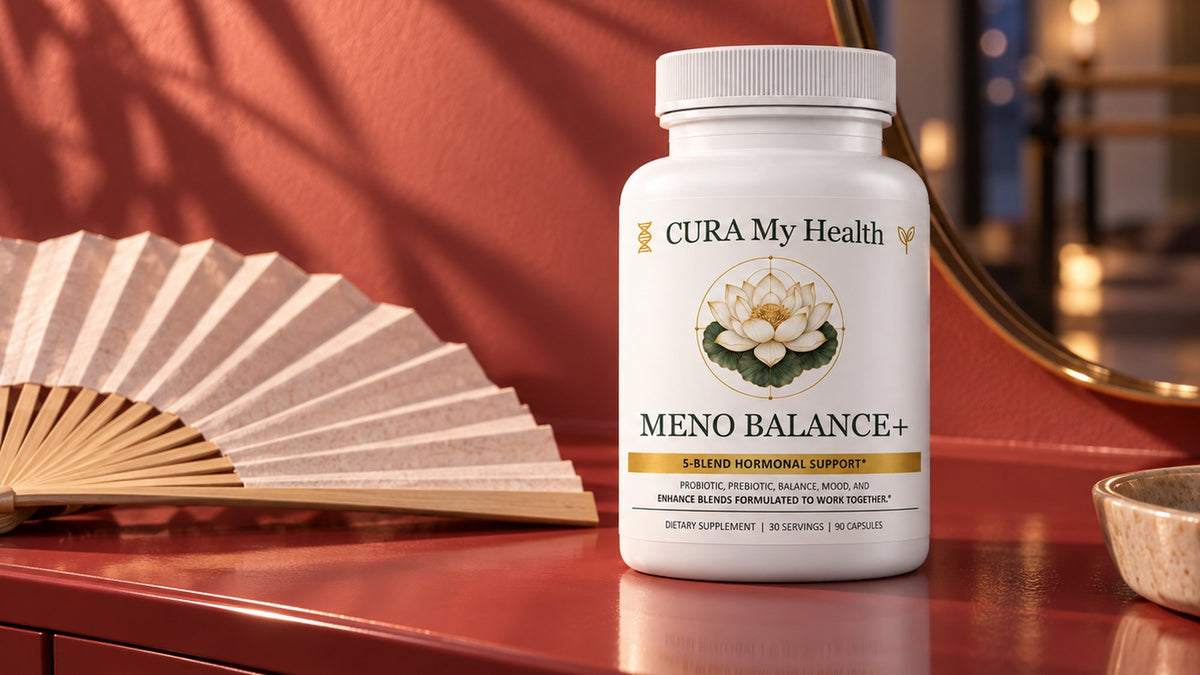
What should you look for in menopause supplements? Look for independent testing of every batch, a label that names every ingredient with its amount or blend total, careful "supports" language rather than big promises, a clear safety warning, and an ingredient list your clinician has checked against your medications. Then keep expectations honest: research on most menopause herbs is mixed, and none has been clearly shown to relieve symptoms the way hormone therapy can.
Below is a practical checklist for comparing menopause supplements, followed by a closer look at our own formula, Meno Balance+™, measured against that same checklist.
Key takeaways
- Look for third-party testing of every batch, not just a facility certificate.
- Read the whole ingredient list, including what is inside any proprietary blend.
- A responsible menopause supplement prints clear safety warnings, especially for hormone-active herbs.
- Evidence for most menopause herbs is mixed, so set modest expectations and a review date.
- Meno Balance+ combines vitamins D, E and B6, a probiotic and prebiotic blend, and three botanical blends; its product page says do not use it if you are pregnant or nursing, have or have had a hormone-sensitive condition, or take hormone therapy, tamoxifen or a blood thinner. Black cohosh has also been associated with liver problems in rare cases; stop use and contact your provider if you notice unusual fatigue, abdominal pain, dark urine or yellowing of the skin or eyes.
What are menopause supplements?
"Menopause supplement" covers a wide range of products. Some are single herbs such as black cohosh. Some are phytoestrogen products made from soy, red clover or flaxseed. Some are nutrients that matter more around menopause, such as calcium and vitamin D. And many, like ours, are multi-ingredient blends that combine herbs, vitamins and probiotics.
In the United States these are regulated as dietary supplements, not drugs. The FDA does not approve dietary supplements for safety or effectiveness before they are sold, which puts more of the checking on you and on the brands that choose to test.
How to choose menopause supplements: a checklist
| What to check | Why it matters |
|---|---|
| Third-party testing, every batch | Confirms each batch matches its label for purity and potency |
| GMP-certified facility | Shows the factory follows manufacturing standards; it is a different thing from batch testing |
| Every ingredient named | You and your clinician can check each one for interactions |
| Amounts or blend totals | Tells you how much of each vitamin, and how much each blend weighs |
| Careful claims | "Supports" language is honest; promises to fix symptoms are a red flag |
| A printed safety warning | Hormone-active herbs are not right for everyone |
| Overlap with what you already take | Vitamin D, probiotics and herbs add up across products |
Look for third-party testing of every batch, not just a facility certificate. Read the whole ingredient list, including what is inside any proprietary blend. And read the warning section as part of the product, not fine print. A responsible menopause supplement prints clear safety warnings, especially for hormone-active herbs.
What can menopause supplements realistically do?
Evidence for most menopause herbs is mixed, so set modest expectations and a review date. The National Center for Complementary and Integrative Health (NCCIH) says phytoestrogens, herbs and other dietary supplements have not been clearly shown to relieve menopause symptoms, and that little is known about their long-term safety. The North American Menopause Society's 2023 position statement does not recommend supplements or herbal remedies for hot flashes and names hormone therapy as the most effective option for those symptoms.
That is why we describe what a formula is designed to support rather than promising relief. If hot flashes, night sweats or mood changes are disrupting your life, talk with your clinician about every option. Our article on what the research says about black cohosh, red clover and dong quai goes through the trials herb by herb.
Meet Meno Balance+

Meno Balance+ combines vitamins D, E and B6, a probiotic and prebiotic blend, and three botanical blends. It is formulated to support hormonal balance and female health, promote digestive and gut health, and support energy and mental clarity; it also encourages healthy skin, hair and aging.*
- Vitamins: vitamin D 60 mcg, vitamin E 13 mg and vitamin B6 7.5 mg per 3-capsule serving.
- Probiotic blend: 7 billion CFU from four named strains, with MAKTREK® Bi-pass Technology.
- Prebiotic blend: artichoke leaf, chicory root and fructooligosaccharides.
- Balance Blend: black cohosh, turmeric, DIM, wild yam, red clover and dong quai.
- Mood Blend: ashwagandha, chaste berry and rhodiola.
- Enhance Blend: ginseng, ginkgo, maca, flaxseed and a hormone precursor named in the label warning below.
The serving is three delayed-release capsules taken 20 to 30 minutes before a meal, and a bottle lasts 30 days. The formula is non-GMO, lactose free and free of the top 9 allergens; its vitamin D comes from lanolin, so it is not suitable for a plant-based diet. Our guide on how to take menopause supplements shows how to fit it into a day.
How Meno Balance+ measures up to the checklist
- Testing: third-party tested, every batch, for purity and potency. See our standards.
- Manufacturing: manufactured in USA with globally sourced materials in an NSF-certified, GMP-certified, FDA-registered facility.
- Ingredients: every ingredient is named, and the three vitamins carry exact amounts. Blend totals are on the label; the amounts inside each blend are not. If you need the exact amount of one herb, a single-ingredient product is a better fit.
- Claims: structure and function language only, with the FDA disclaimer.
- Safety: the printed label caution and the product page's fuller do-not-use warning are both quoted below.
- Overlap: it already supplies 60 mcg of vitamin D per serving and a probiotic. The NIH Office of Dietary Supplements lists 100 mcg (4,000 IU) a day as the upper limit for adults 19 and older, counting food, beverages and supplements together, so add up your vitamin D before adding another product. The same sheet notes that vitamin D supplements may interact with orlistat, with statins at high vitamin D doses, with steroids such as prednisone and with thiazide diuretics.
- Guarantee: backed by our 60-day guarantee.
Who should not use Meno Balance+
The printed label caution reads: "Do not exceed recommended dose. Pregnant or nursing mothers, children under the age of 18, and individuals with a known medical condition should consult a physician before using this or any dietary supplement. Contains black cohosh, dong quai, red clover and DHEA: consult your healthcare professional before use if you have a hormone-sensitive condition or take hormone therapy." The label also reads: "Keep out of reach of children. Do not use if safety seal is damaged or missing. Store in a cool, dry place." The product page adds this fuller do-not-use warning:
Warning: Meno Balance+ contains DHEA (dehydroepiandrosterone), a hormone precursor, together with black cohosh, red clover, dong quai, wild yam and chaste berry — all hormone-active botanicals. Talk with your healthcare provider before starting Meno Balance+, and do not use it if you are pregnant or nursing, if you have or have had a hormone-sensitive condition such as breast, uterine or ovarian cancer or endometriosis, or if you take hormone therapy, tamoxifen, or a blood thinner. Black cohosh has also been associated with liver problems in rare cases; stop use and contact your provider if you notice symptoms such as unusual fatigue, abdominal pain, dark urine or yellowing of the skin or eyes.
NCCIH adds that people with liver disorders should consult a health care provider before taking black cohosh products, and its black cohosh page says anyone who takes any type of medicine should talk with a health care provider before using black cohosh. NCCIH also says the long-term safety of the hormone precursor in the Enhance Blend is unknown and that even short-term use may have harmful effects, including liver damage. It notes that phytoestrogen supplements, such as red clover and flaxseed, may not be safe for women who shouldn't take estrogen; that dong quai may interact with the blood thinner warfarin; and that vitamin E, in the high doses found in supplements, may increase the risk of bleeding and interact with blood thinners such as warfarin (Meno Balance+ gives 13 mg of vitamin E per serving). The NIH Office of Dietary Supplements notes that antioxidant supplements, such as vitamins C and E, might reduce the effectiveness of some types of cancer chemotherapy.
Frequently asked questions about menopause supplements
What is the best supplement for menopause?
There is no single best one, because needs differ. Some people mainly need calcium and vitamin D from food or a supplement; others want a botanical formula. Start with your goal, check the label for batch testing, every ingredient with its amount or blend total, and a printed safety warning, and review it with your clinician.
Are menopause supplements safe?
Many are well tolerated, but "natural" does not always mean safe, as NCCIH notes. Hormone-active herbs are not suitable for everyone, black cohosh has rare reports of liver injury, and some herbs interact with blood thinners. Read the product's label warning and talk with your clinician first.
Do menopause supplements help with hot flashes?
The research is mixed at best. NCCIH reports inconsistent results for black cohosh and red clover and too little research on dong quai to draw conclusions, though its black cohosh page describes a 2023 review of 22 studies that found black cohosh products, alone or combined with other herbs, potentially beneficial for overall menopause symptoms, with improvements in hot flashes but not in anxiety or depressive symptoms. Those NCCIH pages describe North American black cohosh (Actaea racemosa); the Meno Balance+ label lists a related species, Cimicifuga foetida. The North American Menopause Society's 2023 position statement does not recommend supplements or herbal remedies for hot flashes. Hormone therapy and some prescription options have stronger evidence, so discuss hot flashes with your clinician.
Can I take a menopause supplement with hormone therapy?
Check with your prescriber first. For Meno Balance+ the answer is no: its product page warning says do not use it if you take hormone therapy, tamoxifen or a blood thinner, if you are pregnant or nursing, or if you have or have had a hormone-sensitive condition such as breast, uterine or ovarian cancer or endometriosis. Its printed label also says to consult your healthcare professional before use if you take hormone therapy. Because black cohosh has been associated with liver problems in rare cases, stop use and contact your provider if you notice unusual fatigue, abdominal pain, dark urine or yellowing of the skin or eyes.
How long do menopause supplements take to work?
There is no set timeline, so agree a fair trial period with your clinician and keep a simple log. Our guide on how long menopause supplements take to work covers realistic timelines.
Related reading from our Wellness Hub
- Menopause Supplement Ingredients: Inside the Meno Balance+ Label
- Perimenopause vs. Menopause: What's the Difference?
- Third-Party Tested, Every Batch: Here’s the Receipt
Sources
- NCCIH: Menopausal Symptoms: In Depth, last updated May 2017
- The 2023 nonhormone therapy position statement of The North American Menopause Society. Menopause. 2023.
- FDA: Questions and Answers on Dietary Supplements, content current as of August 27, 2026
- NIH Office of Dietary Supplements: Dietary Supplements: What You Need to Know, updated January 4, 2023
- NCCIH: Using Dietary Supplements Wisely, last updated January 2019
- NCCIH: Black Cohosh, last updated November 2024
- NIH Office of Dietary Supplements: Vitamin D, Fact Sheet for Consumers, updated November 8, 2022
Individual results vary.
*These statements have not been evaluated by the Food and Drug Administration. This product is not intended to diagnose, treat, cure, or prevent any disease.

