
The gut-immune connection is the close, everyday partnership between your digestive tract and your immune system. The gut lining is one of the body's largest surfaces in contact with the outside world, so a large share of immune tissue sits right beneath it, and the trillions of microbes living in the gut help train and steady that tissue. That link is why some immune formulas include a probiotic. Below, we explain how the connection works, what Lactobacillus acidophilus is, and what the research can and cannot yet say.
Key takeaways
- The gut lining is a single layer of cells that lets nutrients in while keeping most other things out.
- Gut-associated lymphoid tissue is the largest collection of immune tissue in the body.
- Gut microbes help train immune cells, and fibre-fed microbes make short-chain fatty acids that help keep the system balanced.
- Probiotic effects are specific to the strain and the amount, so one product's results do not carry over to another.
What is the gut-immune connection?
Every day your gut handles a huge mix of food, water, microbes and everything else you swallow. Its job is to absorb what you need and keep the rest out. Three layers work together to make that happen:
- The gut barrier. The gut lining is a single layer of cells that lets nutrients in while keeping most other things out. The cells are joined by tight junctions and covered by a protective layer of mucus.
- Gut immune tissue. Just beneath the lining sits gut-associated lymphoid tissue, often shortened to GALT. It includes patches of immune cells called Peyer's patches and a large population of cells that make secretory IgA, an antibody that coats the gut surface.
- The microbiome. Trillions of bacteria and other microbes live in the gut, mostly in the large intestine, and they constantly interact with the barrier and the immune cells below it.
Gut-associated lymphoid tissue is the largest collection of immune tissue in the body. One widely cited review estimated it at close to 70% of the immune system, though exact figures vary by how they are counted. Either way, the point stands: much of your immune activity happens along the digestive tract.
How do gut microbes talk to the immune system?
Gut microbes help train immune cells, and fibre-fed microbes make short-chain fatty acids that help keep the system balanced. Researchers have learned a great deal from animals raised without any microbes at all. Those animals develop smaller, less mature gut immune tissue, which shows how much the microbiome shapes the system from early life.
In everyday terms, the conversation runs both ways:
- Friendly microbes take up space and nutrients, leaving less room for unwelcome ones.
- When gut bacteria ferment fibre, they produce short-chain fatty acids such as butyrate. Butyrate is a main fuel for the cells lining the colon and helps regulate certain immune cells.
- Immune cells, in turn, help decide which microbes can live close to the lining and which are kept at a distance.
Diet, sleep, stress, medicines such as antibiotics and simple ageing can all shift the mix of microbes, which is one reason the gut-immune link gets so much research attention.
What is Lactobacillus acidophilus?
Lactobacillus acidophilus is a lactic acid bacterium, a type of microbe that turns sugars into lactic acid. It lives naturally in the human gut and has long been used to make fermented foods such as some yogurts and kefir. It is one of the most widely studied probiotic species.
A probiotic, by the expert definition used by the International Scientific Association for Probiotics and Prebiotics, is a live microorganism that gives a health benefit when taken in adequate amounts. Two words in that definition matter. "Live" means the count printed on a label is measured in colony-forming units, or CFU, the number of bacteria able to grow. "Adequate" means the amount counts. Our guide to CFU count vs. strains explains how to read those numbers.
Probiotic effects are specific to the strain and the amount, so one product's results do not carry over to another. NCCIH makes the same point: different types of probiotics may have different effects, and research has not yet sorted out which ones help with what.
Why does an immune formula include a probiotic?
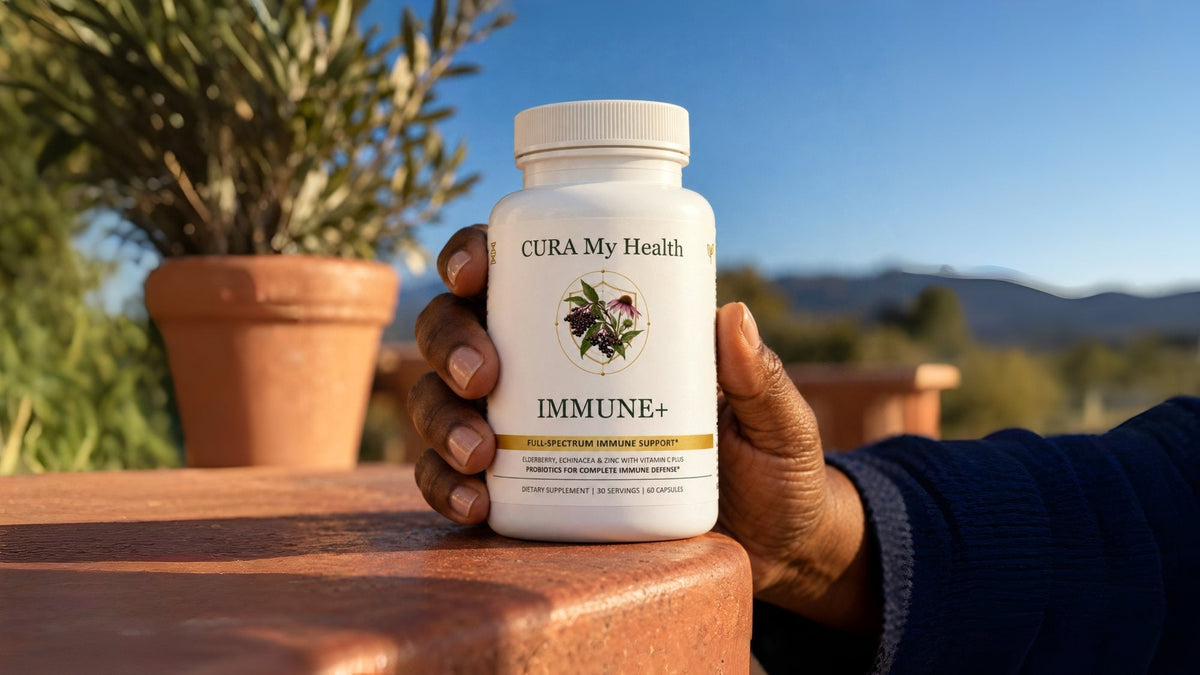
Because so much immune tissue lines the gut, a growing number of immune formulas now look beyond vitamins and minerals. Our Immune+ formula is one of them. Each 2-capsule serving of Immune+ includes 4.8 Billion CFU of Lactobacillus acidophilus and 200 mg of L-glutamine, alongside 300 mg of European elderberry extract, vitamin C, zinc, vitamins E and B6, echinacea, garlic and turmeric.
The two gut-focused ingredients each have a reason to be there:
- Lactobacillus acidophilus brings a well-known lactic acid bacterium into a daily routine.
- L-glutamine is the most abundant amino acid in the body. Cells lining the gut and many immune cells use it as a fuel, especially when the body is under strain.
Immune+ supports a healthy immune system and provides daily nutrient support.* It is not a replacement for a dedicated probiotic, and we do not claim that its probiotic produces any particular gut result. Every amount is on the label, with no proprietary blend, and every batch is third-party tested by an outside lab for purity and potency. You can read how we test on our Our Standards page.
What can the research say, and what can it not?
The gut-immune connection is well established as biology. The leap from that biology to "this capsule will change your immune system" is much harder to make, and honest companies should say so. Here is where things stand:
- Solid: the gut lining, GALT and the microbiome work closely with the rest of the immune system.
- Promising: some probiotic strains have shown effects on immune markers in human studies, often small and short.
- Not settled: which strains, at what amounts, help healthy adults, and for how long. NCCIH notes that probiotics might influence the body's immune response, but research is still working out the details.
That is why we see a probiotic as one supporting part of a broad daily formula, not as the headline.
How can you support your gut every day?
Food and habits shape the microbiome far more than any single supplement. A few steady habits go a long way:
- Eat more fibre. Beans, lentils, oats, whole grains, vegetables, fruit, nuts and seeds feed the bacteria that make short-chain fatty acids.
- Aim for variety. A wide range of plant foods across the week supports a wider range of microbes.
- Add fermented foods. Yogurt with live cultures, kefir, sauerkraut and kimchi bring live microbes of their own.
- Sleep and move. Regular sleep and daily movement are linked with a healthier gut and a steadier immune system.
- Use antibiotics only as prescribed. They are vital when you need them, and they also affect gut bacteria.
For more ideas, read our guide to daily gut health habits and our plain-English look at prebiotics, probiotics and synbiotics.
Who should be careful with probiotics?
Probiotics have a good safety record in healthy people. NCCIH notes the risk of harmful effects is greater in people with severe illnesses or weakened immune systems, so anyone in that group should talk with a doctor before taking any probiotic product. The Immune+ label also advises: Pregnant or nursing mothers, children under the age of 18, and individuals with a known medical condition should consult a physician before using this or any dietary supplement. Do not exceed recommended dose.
Frequently asked questions about the gut-immune connection
How are the gut and immune system connected?
The gut lining is a barrier between the outside world and the body, and a large amount of immune tissue sits just beneath it. Gut microbes constantly interact with that tissue, helping train immune cells and keep responses balanced.
How much of the immune system is in the gut?
A large share. A widely cited review put gut-associated lymphoid tissue at close to 70% of the immune system, although estimates vary.
Do probiotics help the immune system?
Some probiotic strains have shown effects on immune markers in studies, but results depend on the strain, the amount and the person. Research has not yet settled which probiotics help healthy adults and how much.
What does Lactobacillus acidophilus do?
Lactobacillus acidophilus is a lactic acid bacterium that lives naturally in the gut and is used in fermented foods. It is one of the most studied probiotic species. Immune+ includes 4.8 Billion CFU of it per 2-capsule serving.
Can I take Immune+ with a separate probiotic?
Many people do, but check with your healthcare professional if you have a medical condition or a weakened immune system. The suggested use for Immune+ is two veggie capsules once a day, 20 to 30 minutes before a meal with a glass of water.
Related reading from our Wellness Hub
- Immune+ Ingredients: What Each of the Ten Actives Does
- Does Sleep Affect Your Immune System? What the Research Shows
- What Is Colostrum? Gut and Immune Support, Explained
Sources
- Belkaid Y, Hand TW. Role of the microbiota in immunity and inflammation. Cell. 2014.
- Vighi G, et al. Allergy and the gastrointestinal system. Clin Exp Immunol. 2008.
- Hill C, et al. Expert consensus document: The International Scientific Association for Probiotics and Prebiotics consensus statement on the scope and appropriate use of the term probiotic. Nat Rev Gastroenterol Hepatol. 2014.
- Cruzat V, et al. Glutamine: Metabolism and Immune Function, Supplementation and Clinical Translation. Nutrients. 2018.
- NCCIH - Probiotics: What You Need To Know
Individual results vary.
These statements have not been evaluated by the Food and Drug Administration. This product is not intended to diagnose, treat, cure, or prevent any disease.

