
Trans-resveratrol vs resveratrol is not a choice between two different ingredients. "Resveratrol" is the general name of a plant compound that exists in two shapes, trans and cis. Trans-resveratrol is the more stable shape and the one most research has studied, so it is the number careful labels report. When a label says "resveratrol," the question to ask is how much of it is trans-resveratrol, and whether the label tells you. This guide explains how to read those numbers, and what the label on Resveratrol+ does and does not tell you.
Key takeaways
- Resveratrol exists in two shapes, trans and cis, and trans-resveratrol is the form most research has studied.
- A percentage such as "50% trans-resveratrol" tells you how much of an extract's weight is trans-resveratrol.
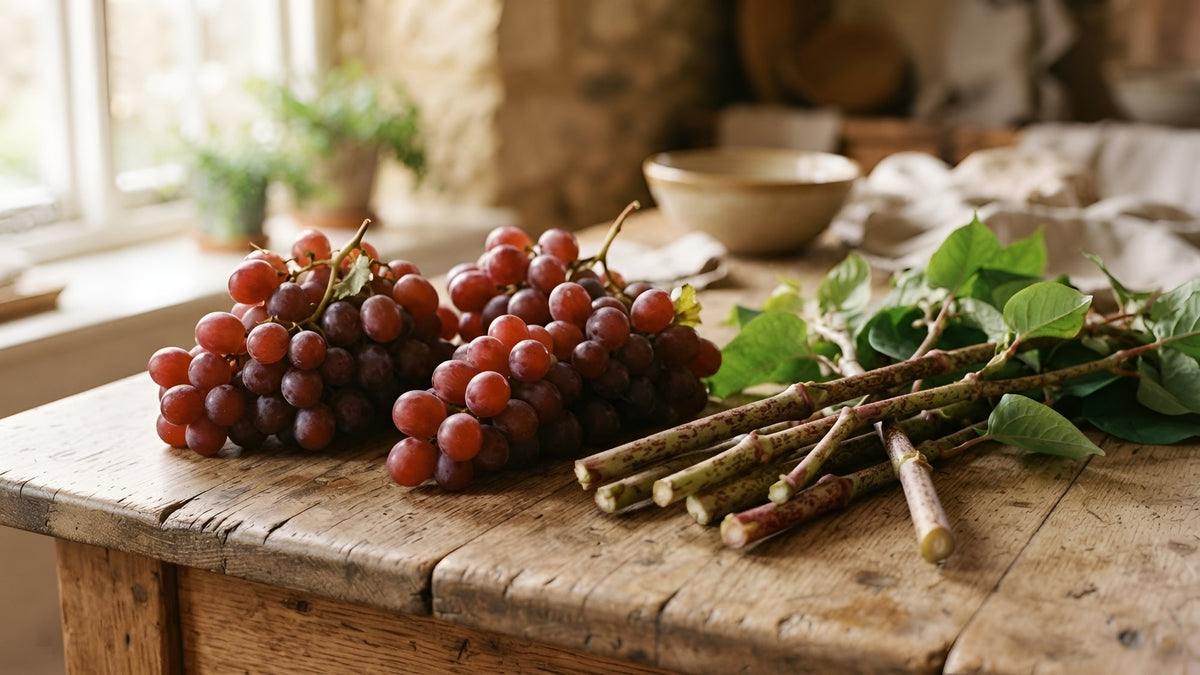
- Supplement resveratrol mostly comes from Japanese knotweed root rather than grapes.
- Resveratrol+ lists a 600 mg resveratrol blend of two Japanese knotweed extracts per capsule, taken once a day.
Trans-resveratrol vs resveratrol: what is the difference?
Resveratrol exists in two shapes, trans and cis, and trans-resveratrol is the form most research has studied. The two shapes, called isomers, contain the same atoms arranged differently around a central double bond. In the trans shape the two ring structures sit on opposite sides; in the cis shape they sit on the same side.
That small difference matters in practice:
- Stability: trans-resveratrol is the more stable form. Light, especially ultraviolet light, can convert trans into cis, which is one reason resveratrol is stored away from light.
- Research: most laboratory and human studies have used trans-resveratrol, so it is the form with the most data behind it.
- Nature: plants make mostly trans-resveratrol, with smaller amounts of cis.
So a well-written label reports trans-resveratrol, either as an amount or as a percentage of an extract.
How to read a resveratrol label
Resveratrol labels usually use one of three formats. Here is what each one tells you:
| Label wording | What it means |
|---|---|
| "Trans-resveratrol" with an amount | The amount of the trans form per serving, stated directly |
| An extract "standardized to X% trans-resveratrol" | X% of the extract's weight is trans-resveratrol; the rest is other plant material |
| A "resveratrol blend" with a total | The combined weight of the extracts in the blend, not the weight of pure trans-resveratrol |
A percentage such as "50% trans-resveratrol" tells you how much of an extract's weight is trans-resveratrol. For example, 100 parts of a 50% extract contain 50 parts trans-resveratrol, while 100 parts of a 10% extract contain 10 parts. Higher-percentage extracts are more refined; lower-percentage extracts keep more of the root's other natural compounds.
Where does supplement resveratrol come from?
Most resveratrol supplements come from Japanese knotweed root, not from grapes or wine. Japanese knotweed (Polygonum cuspidatum) is one of the richest natural sources, which makes it practical to standardize. Grapes and red wine get the headlines, but the amount in a glass of wine is tiny compared with an extract.
Free resveratrol vs piceid
There is one more term you may meet. In grapes and grape juice, much of the resveratrol is bound to a sugar molecule, a form called piceid, according to the Linus Pauling Institute. Wine contains more of the unbound, or "free," form because fermentation releases some of it. Extracts made for supplements are processed and standardized so the label can report the trans-resveratrol content, which is why a percentage of trans-resveratrol is the number to look for, rather than a vague claim about where the plant was grown.
What the Resveratrol+ label tells you

Resveratrol+ lists a 600 mg resveratrol blend of two Japanese knotweed extracts per capsule, taken once a day. One extract is standardized to 10% trans-resveratrol and the other to 50%.
Here is the honest reading. Blend totals are on the label; the amounts inside each blend are not. The 600 mg is the combined weight of the two extracts, so it should be read as the blend weight rather than as 600 mg of pure trans-resveratrol. The trans-resveratrol content depends on how the blend is split between the 10% and 50% extracts, and that split is not printed. Pairing a more refined extract with a less refined one is a common way to combine concentrated trans-resveratrol with more of the whole root.
What the label does give you:
- The source plant and plant part: Japanese knotweed root.
- The standardization of each extract: 10% and 50% trans-resveratrol.
- The blend total per capsule, and the directions: one capsule daily, preferably 20 to 30 minutes before a meal.
- A 60-capsule bottle, which is a 60-day supply at the directed use.
Resveratrol+ promotes heart and vascular health, supports a healthy inflammatory response, and supports cellular health and longevity.* It comes in a vegetable capsule, is caffeine-free, and every batch is third-party tested for purity and potency in an NSF-certified, GMP-certified, FDA-registered U.S. facility. Testing confirms that what is on the label is in the capsule; you can read more on our standards page. For timing and routine tips, see how to take resveratrol.
Five questions to ask any resveratrol label
- Does it say trans-resveratrol? Look for the trans form named as an amount or a percentage.
- Is it a single extract or a blend? A blend total is a combined weight; read it that way.
- What is the source? Japanese knotweed root is the most common; the label should name it.
- How many capsules per serving? Compare products per serving, not per bottle.
- Is it tested by an outside lab? Third-party testing for purity and potency is the check that the label is true.
Frequently asked questions about trans-resveratrol vs resveratrol
Is trans-resveratrol better than resveratrol?
Trans-resveratrol is a form of resveratrol, not a competitor to it. It is the more stable form and the one most research has used, which is why good labels report it. A product labelled only "resveratrol" may contain mostly trans; the label simply may not say.
What does "50% trans-resveratrol" mean?
It means half of that extract's weight is trans-resveratrol and the other half is other compounds from the plant. It describes the extract, not the whole capsule.
Why does Resveratrol+ use two extracts?
Combining a 50% extract with a 10% extract pairs a concentrated source of trans-resveratrol with more of the whole knotweed root. The label lists both extracts and the blend total.
Does light damage resveratrol?
Ultraviolet light can convert trans-resveratrol into the cis form. Keep any resveratrol supplement closed, in a cool, dry place, and away from direct sunlight.
Who should talk to a doctor before taking resveratrol?
Anyone who is pregnant or nursing, takes medication (especially blood thinners), or has a medical condition should check with a healthcare professional first. Do not exceed the recommended dose.
Related reading from our Wellness Hub
Sources
- Linus Pauling Institute, Oregon State University: Resveratrol
- National Center for Complementary and Integrative Health: Antioxidant Supplements, What You Need to Know
- Howitz KT, et al. Small molecule activators of sirtuins extend Saccharomyces cerevisiae lifespan. Nature, 2003
Individual results vary.
*These statements have not been evaluated by the Food and Drug Administration. This product is not intended to diagnose, treat, cure, or prevent any disease.

