
What do B vitamins do? The eight B vitamins help your body turn the food you eat into usable energy, and each one also has its own job: thiamin, riboflavin, niacin and pantothenic acid run energy pathways, B6 helps build proteins and brain messengers, biotin handles fats and amino acids, and folate and B12 work together to make DNA and healthy red blood cells. They do not act like caffeine. They are the helpers your cells use to release energy that is already in your food.
Below, we walk through all eight B vitamins one by one, then open up our own B-complex, Energy+™: what is in each serving, how to take it, and which upper limits to watch.
Key takeaways
- The eight B vitamins work as helpers (coenzymes) that let your cells release energy from carbohydrates, fats and protein.
- Folate and B12 work as a pair to make DNA and healthy red blood cells.
- B vitamins are water-soluble, so your body stores little of most of them and needs a steady supply from food.
- Biotin can change the results of some lab tests, so tell your clinician and the lab before any blood draw.
What do B vitamins do in the body?
The B vitamins are not the fuel; they are the tools. The eight B vitamins work as helpers (coenzymes) that let your cells release energy from carbohydrates, fats and protein. Without enough of them, those chemical steps slow down.
Beyond energy, several B vitamins have second jobs. B6, folate and B12 take part in making brain messengers and in keeping a compound called homocysteine in a normal range. Folate and B12 work as a pair to make DNA and healthy red blood cells. Biotin helps the body use fats and amino acids.
B vitamins are water-soluble, so your body stores little of most of them and needs a steady supply from food. B12 is the main exception: the liver keeps a reserve that can last a long time.
The eight B vitamins, one by one
Here is each B vitamin in plain words, with the daily targets the NIH Office of Dietary Supplements lists for adults (RDA or Adequate Intake; the range covers the different adult targets).
B1 (thiamin)
Thiamin helps turn glucose into energy and supports normal nerve function. Good sources are whole grains, fortified bread and cereal, pork, fish, beans and lentils. Adults need about 1.1 to 1.2 mg a day.
B2 (riboflavin)
Riboflavin is part of two coenzymes (FAD and FMN) that drive energy production and help the body use other B vitamins, including B6 and folate. Eggs, milk, yogurt, lean meat, mushrooms and fortified cereal are common sources. Adults need about 1.1 to 1.3 mg a day.
B3 (niacin)
Niacin becomes NAD and NADP, two molecules that take part in more than 400 reactions in the body, from energy production to cell repair. You get it from poultry, beef, fish, peanuts and fortified grains. Adults need about 14 to 16 mg NE (niacin equivalents) a day. Large supplement doses can cause skin flushing.
B5 (pantothenic acid)
Pantothenic acid is used to make coenzyme A, which the body needs to build and break down fats. It is found in almost every food, especially beef, chicken, eggs, mushrooms, avocado and whole grains. The Adequate Intake for adults is 5 mg a day.
B6 (pyridoxine)
B6 takes part in more than 100 enzyme reactions, most of them in protein metabolism. It helps make brain messengers such as serotonin and supports normal immune function. Chickpeas, fish, poultry, potatoes and bananas are good sources. Adults need about 1.3 to 1.7 mg a day.
B7 (biotin)
Biotin helps enzymes that break down fats, carbohydrates and amino acids. Eggs, fish, meat, seeds, nuts and sweet potatoes supply it. The Adequate Intake for adults is 30 mcg a day. High-dose biotin can affect some lab tests (see the safety section below).
B9 (folate)
Folate is needed to make DNA and to divide cells, and it works with B12 to form red blood cells. Leafy greens, beans, peas, asparagus and fortified grains are the best food sources. Folic acid is the form used in many supplements and fortified foods. Adults need 400 mcg DFE (dietary folate equivalents) a day. Our guide to folate vs. folic acid explains the label units.
B12 (cobalamin)
B12 supports normal nerve function, red blood cell formation and DNA synthesis. It occurs naturally only in animal foods (fish, meat, eggs, dairy) and in fortified foods such as some cereals and nutritional yeast, so people who eat little or no animal food need a reliable source. Adults need 2.4 mcg a day. The body absorbs only a small share of a large oral dose, which is why supplements carry amounts far above the RDA.
B vitamins at a glance: jobs, foods and daily targets
| Vitamin | Main job | Food sources | Adult daily target |
|---|---|---|---|
| B1 thiamin | Glucose to energy | Whole grains, pork, beans | 1.1-1.2 mg |
| B2 riboflavin | Energy coenzymes | Eggs, dairy, mushrooms | 1.1-1.3 mg |
| B3 niacin | NAD for energy and repair | Poultry, fish, peanuts | 14-16 mg NE |
| B5 pantothenic acid | Coenzyme A, fat use | Beef, eggs, avocado | 5 mg |
| B6 | Protein use, brain messengers | Chickpeas, fish, potatoes | 1.3-1.7 mg |
| B7 biotin | Fat and amino acid use | Eggs, seeds, sweet potato | 30 mcg |
| B9 folate | DNA, red blood cells | Leafy greens, beans | 400 mcg DFE |
| B12 | Nerves, red blood cells | Fish, meat, eggs, dairy | 2.4 mcg |
Choline and inositol often travel with the B vitamins. Choline is an essential nutrient but not a B vitamin; inositol is a compound the body can make on its own. (See Is inositol a B vitamin?)
Meet Energy+: what is in each serving

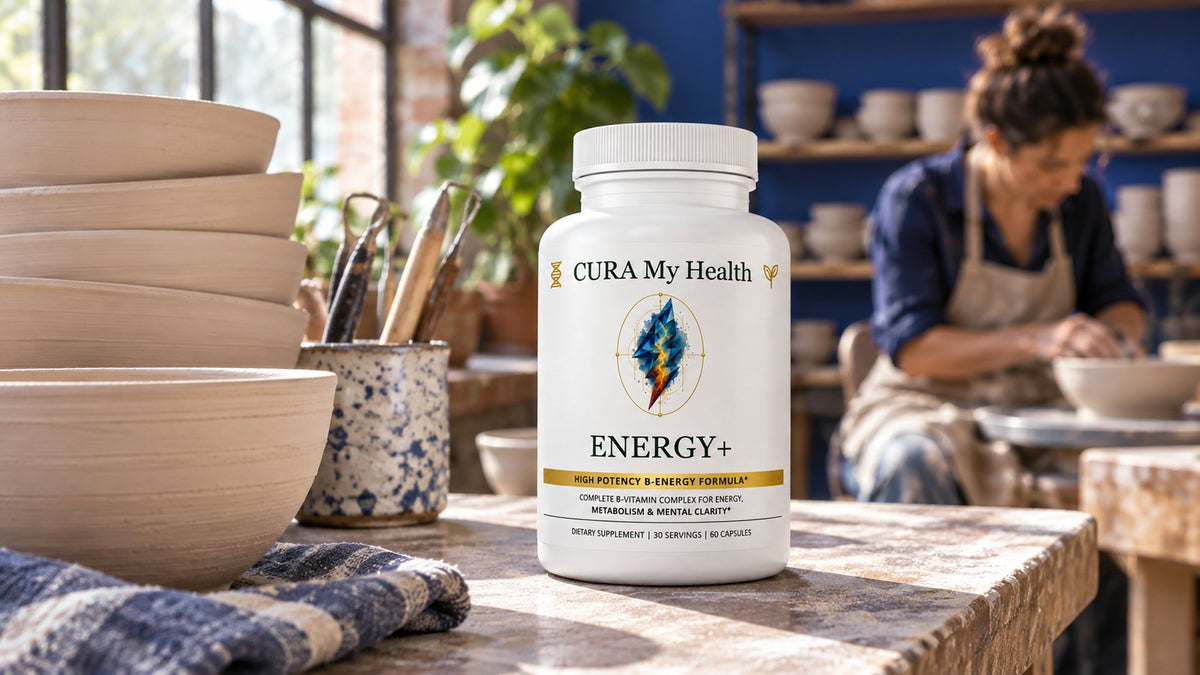
Energy+ is our B-complex: all eight B vitamins in one two-capsule serving, plus vitamin C, choline and inositol, with no caffeine. It is built to support cellular energy production and healthy nerve tissue as part of a daily routine.*
Per two-capsule serving, the label lists: vitamin C 150 mg; thiamin (B1) 100 mg; riboflavin (B2) 100 mg; niacin 20 mg NE; vitamin B6 30 mg; folate 1,190 mcg DFE (700 mcg folic acid); vitamin B12 (as cyanocobalamin) 2,000 mcg; biotin 1,000 mcg; pantothenic acid 100 mg; choline 100 mg; inositol 150 mg. Every amount is printed on the label, so you can add it up against the rest of your routine.
Quality comes first. Every batch of Energy+ is third-party tested by an outside lab for purity and potency. It is manufactured in USA with globally sourced materials, in an NSF-certified, GMP-certified, FDA-registered U.S. facility. The capsules are vegetable capsules; the product is listed as gluten-free, non-GMO, vegan and sugar-free. Read more on our standards page.
How to take Energy+
- Dose: take two (2) capsules once daily with food and an 8 fl oz glass of water, or as directed by your healthcare professional.
- Supply: 60 capsules per bottle, 30 servings, which is a 30-day supply at two capsules a day.
- Timing: the label sets no time of day. Many people take it with breakfast or lunch.
- Do not exceed the recommended dose.
Upper limits and safety: what to add up
Most B vitamins have no set upper limit because no harm has been reported from high intakes. A few do, and the limits count every source, not one bottle: for niacin and folic acid the limit covers supplements and fortified foods; for vitamin B6 it covers food and supplements together. If you take Energy+ with a multivitamin or another B product, add up these four:
- Niacin: upper limit 35 mg a day from supplements and fortified foods. Energy+ provides 20 mg NE.
- Vitamin B6: upper limit 100 mg a day. Very high intakes taken for long periods have been linked to nerve problems such as numbness or tingling. Energy+ provides 30 mg. If you notice numbness or tingling, stop and talk with your clinician.
- Folic acid: upper limit 1,000 mcg a day from supplements and fortified foods. Energy+ provides 700 mcg folic acid. High folic acid can hide the signs of a low B12 level, which is one reason a B-complex pairs folic acid with B12.
- Biotin: no upper limit, but the FDA warns that it can make a heart test called troponin read falsely low, and other lab tests read falsely high or falsely low. Biotin can change the results of some lab tests, so tell your clinician and the lab before any blood draw. More in Does biotin affect blood tests?
The Energy+ label warning, word for word: "Do not exceed the recommended dose. Keep out of reach of children. Pregnant or nursing mothers, children under age 18, and individuals with a known medical condition should consult a physician before use. Do not use if the safety seal is damaged or missing. Store in a cool, dry place." If you take medication, talk with your healthcare provider before starting any new supplement. Some common medicines, such as metformin and acid-reducing drugs, can lower how much B12 the body absorbs from food, so your clinician may want to check your level.
What does the research say about B vitamins and energy?
Two reviews in the journal Nutrients sum up the science. Kennedy (2016) describes the eight B vitamins as a closely linked group of coenzymes for energy production, DNA synthesis and brain chemicals, and notes that most human studies have looked at only B6, folate and B12. Tardy and colleagues (2020) describe how B vitamins, vitamin C, iron, magnesium and zinc take part in energy metabolism, and how fatigue can show up when their supply is not adequate. Both are reviews, not trials, and neither tested Energy+. The plain reading: B vitamins are essential for normal energy metabolism, and a supplement matters most when the diet falls short.
Frequently asked questions about what B vitamins do
Do B vitamins give you energy right away?
No. B vitamins are not stimulants and do not work like caffeine. They help your cells release energy from food, which is steady support, not a quick lift.
What is the difference between B12 and a B-complex?
A B12 supplement contains one vitamin. A B-complex such as Energy+ contains all eight B vitamins, because they work together in the same energy pathways. Energy+ also adds vitamin C, choline and inositol.
Why does a B-complex turn urine bright yellow?
That color comes from riboflavin (B2). The body clears the extra in urine. It is harmless; see why B vitamins make urine bright yellow.
Can I take Energy+ with a multivitamin?
Add up the B vitamins on both labels first. Keep niacin under 35 mg and folic acid under 1,000 mcg a day from all supplements and fortified foods, and keep total vitamin B6 from food and supplements under 100 mg a day.
When is the best time to take a B-complex?
The Energy+ label says to take two capsules once daily with food and an 8 fl oz glass of water, and it sets no required time of day. Many people prefer the morning or midday, alongside a meal.
Related reading from our Wellness Hub
- Folate vs. Folic Acid: What's the Difference on a Label?
- Do B Vitamins Help With Stress? What the Research Says
- Cyanocobalamin vs Methylcobalamin: Which B12 Form Is in Energy+?
Sources
- NIH Office of Dietary Supplements: Thiamin fact sheet. Updated February 9, 2023.
- NIH Office of Dietary Supplements: Riboflavin fact sheet. Updated May 11, 2022.
- NIH Office of Dietary Supplements: Niacin fact sheet. Updated November 18, 2022.
- NIH Office of Dietary Supplements: Pantothenic Acid fact sheet. Updated May 1, 2026.
- NIH Office of Dietary Supplements: Vitamin B6 fact sheet. Updated June 16, 2023.
- NIH Office of Dietary Supplements: Biotin fact sheet. Updated January 10, 2022.
- NIH Office of Dietary Supplements: Folate fact sheet. Updated November 30, 2022.
- NIH Office of Dietary Supplements: Vitamin B12 fact sheet. Updated July 2, 2025.
- NIH Office of Dietary Supplements: Choline fact sheet. Updated June 2, 2022.
- FDA: Biotin interference with troponin lab tests. Content current as of June 21, 2022.
- Kennedy DO. B Vitamins and the Brain: Mechanisms, Dose and Efficacy - A Review. Nutrients. 2016.
- Tardy AL, et al. Vitamins and Minerals for Energy, Fatigue and Cognition: A Narrative Review of the Biochemical and Clinical Evidence. Nutrients. 2020.
Individual results vary.
These statements have not been evaluated by the Food and Drug Administration. This product is not intended to diagnose, treat, cure, or prevent any disease.

