
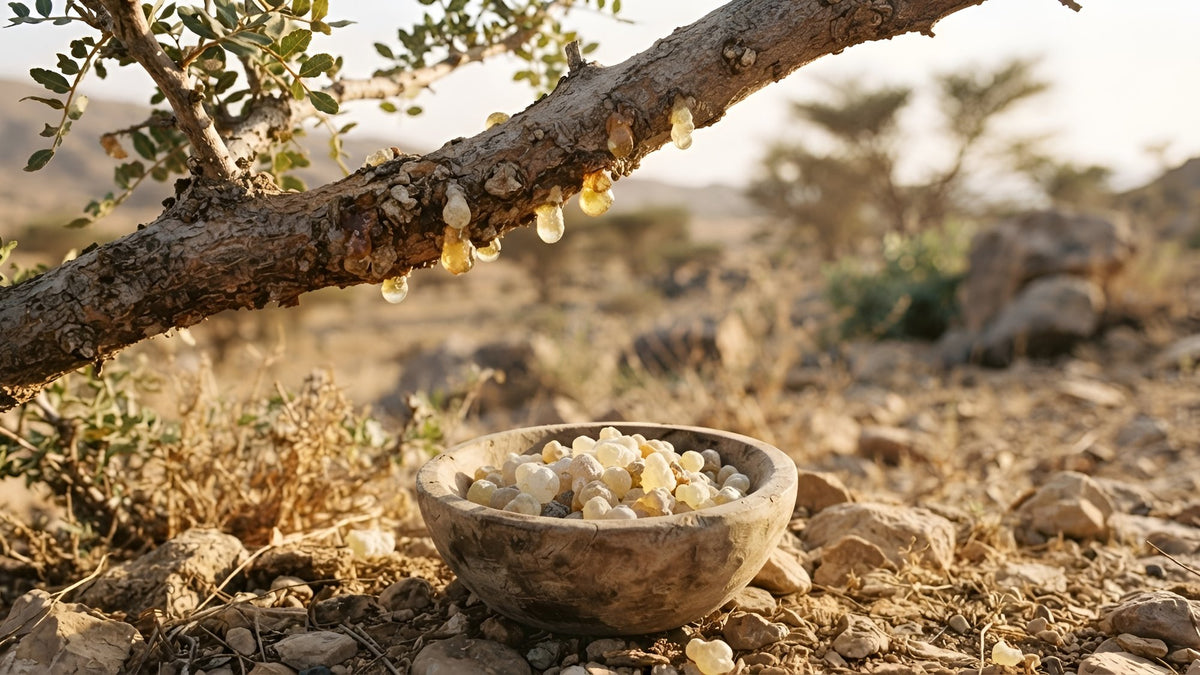
What is Boswellia serrata? It is a tree native to India, and the gum resin from its bark is known as Indian frankincense. The resin has been used in Ayurvedic tradition for centuries, and today it appears in joint supplements because researchers have studied its compounds, called boswellic acids, for joint comfort and mobility. The evidence is promising but still developing. Here is what boswellia is, what the research has looked at, how it is used in supplements, and who should be careful with it.
Key takeaways
- Boswellia serrata is a tree native to India, and the gum resin from its bark is known as Indian frankincense.
- Its active compounds are called boswellic acids, and a 2020 review singles out one of them, AKBA, for its strong activity in lab research.
- A 2020 meta-analysis of seven trials in people with knee osteoarthritis reported less pain and stiffness and better function, though the trials were small and generally of medium to low quality.
- Boswellia is generally well tolerated. The National Center for Complementary and Integrative Health says Boswellia serrata extract "in doses up to 1,000 mg daily has been safely used in several clinical trials lasting up to 6 months" and has been used "with apparent safety at a dose of 2,400 mg for up to 1 month." Anyone who is pregnant or takes medication should check with a healthcare provider first.
What is Boswellia serrata?
Boswellia serrata belongs to the same plant family as the trees that produce the frankincense used in incense and perfume. When the bark is cut, it releases a fragrant gum resin. That resin has a long history in Ayurveda, the traditional medicine of India, where it is known as salai guggul.
In supplements, boswellia usually appears in one of two forms:
- Whole herb or resin powder, which contains the plant's natural mix of compounds.
- Standardized extracts, which are processed to contain a stated percentage of boswellic acids or of AKBA specifically.
Both are sold as dietary supplements. Labels should tell you which form you are getting.
What are boswellic acids?
Boswellic acids are the compounds researchers credit for most of boswellia's activity. Several have been identified, and a 2020 review singles out one, 3-O-acetyl-11-keto-beta-boswellic acid (AKBA), for its strong activity in laboratory research. In those lab studies, boswellic acids interact with an enzyme called 5-lipoxygenase, which helps make signaling molecules involved in the body's normal response to stress on tissues. That mechanism is why boswellia keeps turning up in joint research, though lab findings do not automatically translate into effects in people.
What does the research say about boswellia for joint comfort?
A 2020 systematic review and meta-analysis pooled seven randomized trials with 545 adults with knee osteoarthritis and reported less pain and stiffness and better physical function compared with control groups. The review's trials ran 4 to 24 weeks, and the trials that tested boswellia on its own used 100 to 250 mg of a standardized extract. The authors cautioned that the trials were small and generally of medium to low quality, and called for larger, double-blind trials, including ones that report results before week 4.
The National Center for Complementary and Integrative Health says several studies have shown that taking boswellia orally may help reduce inflammation and pain associated with osteoarthritis, but most studies of boswellia are small and of low quality, and larger, higher-quality studies are needed.
| Question | What the research shows |
|---|---|
| Who was studied? | Adults with knee osteoarthritis (all seven trials in the 2020 review) |
| How long? | 4 to 24 weeks in the 2020 review |
| What form? | Mostly standardized extracts, at many different doses |
| How strong is the evidence? | Promising but limited; more research is needed. |
How is boswellia used in joint supplements?
Boswellia is rarely sold alone in joint formulas. It is usually combined with ingredients that support cartilage and mobility in different ways, such as glucosamine, chondroitin, turmeric and MSM. The idea is that each ingredient brings something different to a daily routine.
Agility+™ is one example. Its three-capsule daily serving includes 200 mg of Indian frankincense (Boswellia serrata) herb alongside 1,500 mg of glucosamine sulfate, 150 mg of chondroitin sulfate, 150 mg of turmeric root, and 25 mg each of quercetin, methionine, MSM and bromelain. Every amount is printed on the label. Together, the formula supports healthy cartilage, promotes joint mobility and provides flexibility support.* The label direction is three capsules daily before a meal.
If turmeric is the ingredient you are most curious about, our guide to curcumin for joint comfort covers that research, and Golden Turmeric+™ is our turmeric-led joint formula (it also contains 40 mg of frankincense from Boswellia carteri and shellfish-derived glucosamine, so it is not for anyone with a shellfish allergy). Agility+ and Golden Turmeric+ share their main actives: both contain glucosamine sulfate, chondroitin sulfate, turmeric and frankincense, plus MSM, quercetin, methionine and bromelain. Their label directions differ: Agility+ is three capsules daily before a meal, and Golden Turmeric+ is two capsules once a day, 20 to 30 minutes before a meal with an 8 fl oz glass of water. If you are thinking of taking both, add up the totals from the two labels first, and check with your healthcare provider.
These formulas differ from the trials above. Agility+ lists 200 mg of Boswellia serrata herb rather than a standardized extract, and Golden Turmeric+ lists 40 mg of extract from a different species, Boswellia carteri, less than the 100 to 250 mg in the 2020 review's trials that tested boswellia on its own. The trial results do not carry over to either one directly.
Is boswellia safe?
In studies, boswellia has generally been well tolerated. The National Center for Complementary and Integrative Health says boswellia is likely to be safe when taken orally, and adds: "Boswellia serrata extract in doses up to 1,000 mg daily has been safely used in several clinical trials lasting up to 6 months. It has also been used with apparent safety at a dose of 2,400 mg for up to 1 month." Memorial Sloan Kettering Cancer Center lists allergic skin reactions as a possible side effect. A few practical cautions:
- Pregnancy and nursing. There is not enough safety research, so check with your healthcare provider.
- Medications. Boswellia may interact with some medications. Memorial Sloan Kettering Cancer Center says to talk to your doctor if you take a blood thinner such as warfarin, because boswellia may increase your risk of bleeding. Its section for healthcare professionals adds that boswellia extracts "can inhibit platelet aggregation and may increase risk of bleeding" when used with anticoagulant or antiplatelet drugs, and says the clinical significance has yet to be determined. Tell your provider and pharmacist about every supplement you take.
- Allergies and medical conditions. In combination products, read every ingredient. Agility+ (crayfish) and Golden Turmeric+ (crab, lobster and crawfish) contain shellfish because their glucosamine is derived from shellfish, so people allergic to shellfish should not use them. Both labels also say to consult with a physician prior to use if you have any medical conditions.
- Quality. Choose products with a clear label and third-party testing. Every batch of our formulas is tested for purity and potency; see our standards.
Frequently asked questions about Boswellia serrata
Is boswellia the same as frankincense?
Boswellia serrata produces Indian frankincense. Other Boswellia species, such as Boswellia sacra, produce the frankincense used in incense and essential oils. Supplements for joint support usually use Boswellia serrata.
How long does boswellia take to work?
In a 2020 review of seven trials in adults with knee osteoarthritis, the trials ran 4 to 24 weeks, and pain and stiffness scores were already lower than in the control groups at week 4, the earliest point the review analyzed. The authors tied that timeline to doses of 100 to 250 mg of boswellia extract. A 2024 trial in adults with knee osteoarthritis, led by employees of the company that supplied the extract, gave 300 or 600 mg a day of a standardized extract. In that trial, pain scores began to improve from day 5, but pain was significantly lower than with placebo only from day 60. On safety, the National Center for Complementary and Integrative Health notes that Boswellia serrata extract "in doses up to 1,000 mg daily has been safely used in several clinical trials lasting up to 6 months" and has been used "with apparent safety at a dose of 2,400 mg for up to 1 month."
Can I take boswellia with turmeric?
Many joint formulas combine the two, and they are generally considered compatible. If you take a separate turmeric product as well, add up the totals and check with your healthcare provider if you take medication.
What is AKBA?
AKBA, or 3-O-acetyl-11-keto-beta-boswellic acid, is a boswellic acid that a 2020 review singles out for its strong activity in laboratory research. Some extracts are standardized to a stated percentage of AKBA.
Does boswellia work on its own or only in combinations?
Both have been studied. Many trials used boswellia extract alone, while many products combine it with glucosamine, chondroitin or turmeric. Research on specific combinations is more limited.
Related reading from our Wellness Hub
Sources
- National Center for Complementary and Integrative Health (NCCIH): Boswellia, updated April 2025
- Memorial Sloan Kettering Cancer Center: Boswellia (About Herbs), updated September 2026
- Yu G et al. Effectiveness of Boswellia and Boswellia extract for osteoarthritis patients: a systematic review and meta-analysis. BMC Complementary Medicine and Therapies, 2020.
- Majeed A et al. A standardized Boswellia serrata extract shows improvements in knee osteoarthritis within five days: a double-blind, randomized, three-arm, parallel-group, multi-center, placebo-controlled trial. Frontiers in Pharmacology, 2024.
Individual results vary.
*These statements have not been evaluated by the Food and Drug Administration. This product is not intended to diagnose, treat, cure, or prevent any disease.

