
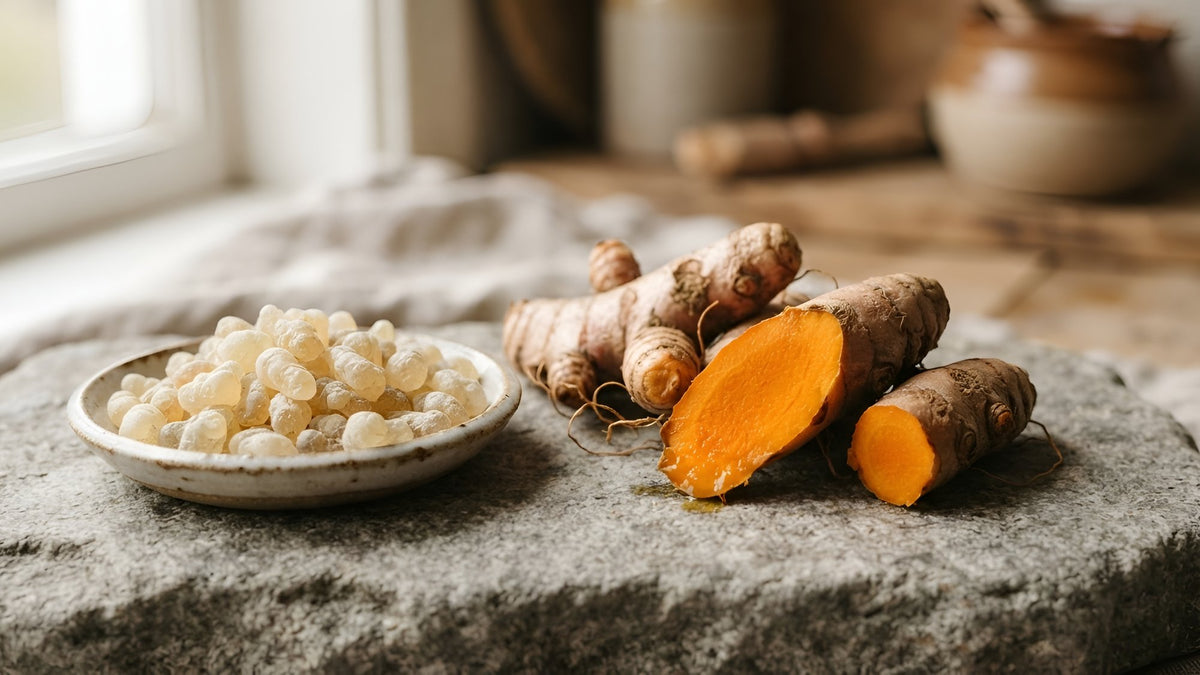
Boswellia vs. turmeric: which is better for joints? Neither is simply "better." Boswellia and turmeric are two different botanicals that research suggests work on different parts of the body's normal inflammatory signalling, and in at least one controlled trial the two together did more for joint comfort than curcumin alone. Boswellia is a tree resin, also known as frankincense, valued for its boswellic acids. Turmeric is a root, valued for its curcuminoids. This guide compares them side by side, explains what the research does and does not show, and covers the safety points for each.
Key takeaways
- Boswellia (frankincense) is a tree resin; its key compounds are boswellic acids.
- Turmeric is a root; its key compounds are curcuminoids.
- In one 12-week trial in people with knee osteoarthritis, curcumin plus boswellic acids beat curcumin alone on joint pain and function scores.
- Curcuminoids absorb poorly alone, so turmeric formulas often add black pepper extract.
- Taking blood-thinning medication? Check with your doctor before using either one.
What is Boswellia?
Boswellia is a genus of trees that grow in India, the Arabian Peninsula and the Horn of Africa. When the bark is cut, the trees release a fragrant resin, which is the frankincense used for thousands of years in incense and in traditional Ayurvedic and Middle Eastern practice.
- Species. Boswellia serrata (Indian frankincense) is the species used in most supplement research. Boswellia carteri and Boswellia sacra are related species from Africa and Arabia.
- Active compounds. Boswellic acids, including one called AKBA, are the compounds researchers focus on. Supplements are often standardized to a percentage of boswellic acids.
- Research. A 2020 systematic review of seven randomized trials in people with osteoarthritis concluded that Boswellia extracts may ease pain and stiffness and improve joint function, in trials lasting at least four weeks.
What is turmeric?
Turmeric (Curcuma longa) is the bright orange root of a plant in the ginger family. It has a long history in South Asian cooking and in Ayurvedic tradition.
- Active compounds. Curcuminoids, mainly curcumin, make up only a few percent of turmeric root by weight. Supplements often use extracts standardized to 95% curcuminoids.
- Research. A 2016 meta-analysis of randomized trials in people with arthritis found that turmeric extracts (about 1,000 mg of curcumin a day) were linked with improvements in joint symptoms, while noting that more and larger studies are needed.
- Absorption. Curcuminoids are poorly absorbed on their own, which is why turmeric supplements often add black pepper extract. Piperine from black pepper raised curcumin levels well above curcumin alone in an early human study.
Boswellia vs. turmeric: side-by-side comparison
| Boswellia | Turmeric | |
|---|---|---|
| Part used | Resin from the bark | Root (rhizome) |
| Key compounds | Boswellic acids (including AKBA) | Curcuminoids (mainly curcumin) |
| Common name | Frankincense, Indian frankincense | Haldi, Indian saffron |
| Absorption note | Often taken with food | Usually paired with black pepper extract |
| Typical research length | 4 to 12 weeks | 4 to 12 weeks |
| Also found in the kitchen? | No | Yes, as a spice |
Is it better to take Boswellia and turmeric together?
The research that compares them directly points toward the pair. In a 12-week controlled trial in adults with osteoarthritis, those taking curcumin with boswellic acids improved more on joint pain and function scores than those taking curcumin alone. The study, published in 2018 by Haroyan and colleagues, compared a curcumin extract, a curcumin-plus-Boswellia combination and a placebo. Only the combination group improved significantly more than placebo on the main joint score.
That fits the idea that the two botanicals act on different parts of the same picture, so combining them may cover more ground than either alone. It is one trial with specific extracts, so it is a reason to be interested, not a guarantee. Many people still take only one of them, and that is a reasonable choice too.
How Golden Turmeric+™ combines the two
Golden Turmeric+ is a turmeric-led joint formula that includes both. Each two-capsule serving provides 800 mg of turmeric root powder and 100 mg of turmeric extract standardized to 95% curcuminoids, with 40 mg of frankincense extract from Boswellia carteri resin in a supporting role. It also includes glucosamine, chondroitin, ginger, MSM, quercetin, bromelain and BioPerine® black pepper extract, and it promotes joint mobility and digestive health.
Two honest notes. First, most Boswellia research used Boswellia serrata extracts at larger amounts; the Boswellia here is a smaller, supporting ingredient from a related species. Second, the glucosamine is derived from shellfish, so anyone with a shellfish allergy should not take it. For turmeric without glucosamine, Turmeric with BioPerine+ is a turmeric-only option. Both are third-party tested, every batch, for purity and potency; read more on our standards page.
Safety: what to know before taking Boswellia or turmeric
- Blood thinners. Both are generally well tolerated, but check with your doctor before using either if you take blood-thinning medication.
- Digestion. Boswellia can cause mild stomach upset in some people. Turmeric at high doses can do the same.
- Gallbladder. People with gallbladder problems are usually advised to check with a doctor before taking concentrated turmeric.
- Pregnancy and nursing. Concentrated supplements of either are not well studied in pregnancy or while nursing; ask your healthcare provider.
- Stacking. If you combine several joint products, add up the turmeric across all of them rather than doubling up by accident.
Frequently asked questions about Boswellia vs. turmeric
Which works faster, Boswellia or turmeric?
Studies of both usually measure results after four to twelve weeks of daily use, so neither is a quick fix. Give any joint routine at least a month before judging it, alongside regular movement.
Can you take Boswellia and turmeric together?
Yes, for most healthy adults; many joint formulas combine them, and one controlled trial found the pair outperformed curcumin alone on a joint-function score. Check with your doctor first if you take blood thinners or have a medical condition.
Is frankincense the same as Boswellia?
Frankincense is the resin of Boswellia trees. Supplements use extracts of that resin, usually standardized to boswellic acids, rather than the raw incense resin.
Does Boswellia need black pepper like turmeric does?
Black pepper extract is mainly used to help absorb curcuminoids. Boswellia is often taken with a meal instead, and some products use specialized extract forms for absorption.
Is turmeric or Boswellia better for digestion?
Turmeric has the longer history as a digestive spice, and turmeric-based formulas such as Golden Turmeric+ are designed to promote digestive health. Boswellia is studied mainly for joint comfort.
Related reading from our Wellness Hub
- Curcumin for Joint Comfort: What the Research Shows
- Why Add Black Pepper to Turmeric? BioPerine and Absorption Explained
- Glucosamine, Chondroitin & MSM for Joints: What Each Does
Sources
- Haroyan A et al. Efficacy and safety of curcumin and its combination with boswellic acid in osteoarthritis: a comparative, randomized, double-blind, placebo-controlled study. BMC Complementary and Alternative Medicine, 2018.
- Yu G et al. Effectiveness of Boswellia and Boswellia extract for osteoarthritis patients: a systematic review and meta-analysis. BMC Complementary Medicine and Therapies, 2020.
- Daily JW, Yang M, Park S. Efficacy of turmeric extracts and curcumin for alleviating the symptoms of joint arthritis: a systematic review and meta-analysis of randomized clinical trials. Journal of Medicinal Food, 2016.
- NCCIH: Turmeric
- Shoba G et al. Influence of piperine on the pharmacokinetics of curcumin. Planta Medica, 1998.
Individual results vary.
These statements have not been evaluated by the Food and Drug Administration. This product is not intended to diagnose, treat, cure, or prevent any disease.

