
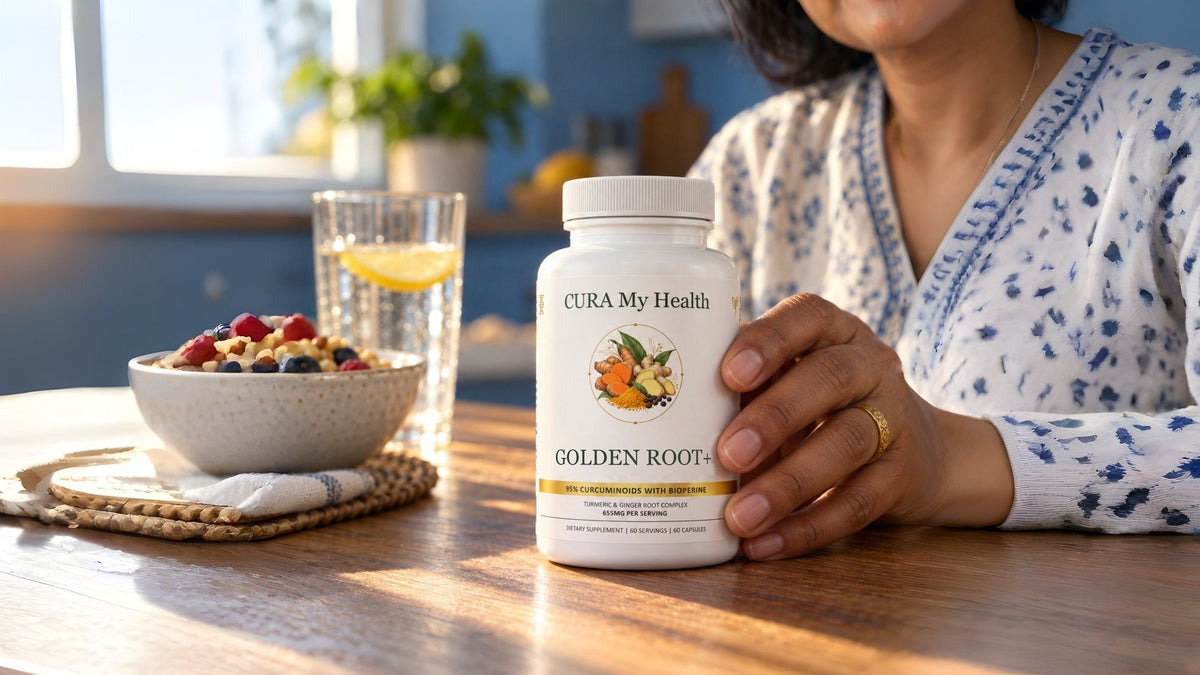
Why add black pepper to turmeric? Because curcumin, the compound most turmeric research focuses on, is poorly absorbed and quickly broken down in the gut and liver. Piperine, the compound that gives black pepper its bite, slows part of that breakdown so more curcumin reaches the bloodstream. That is why Golden Root+™ includes 5 mg of BioPerine black pepper extract in every capsule. The same effect on the body's processing enzymes is also why piperine deserves a quick medication check.
Key takeaways
- Curcumin on its own is poorly absorbed, quickly broken down and quickly cleared from the body.
- Piperine slows glucuronidation, one of the main ways the gut and liver break curcumin down.
- In a small 1998 study, 20 mg of piperine taken with 2 g of curcumin raised curcumin blood levels about twentyfold compared with curcumin alone.
- A study result at one dose is not a promise for a different product or a different dose.
- Because piperine also affects how some medicines are processed, check with your pharmacist if you take prescriptions.
Why add black pepper to turmeric? The absorption problem
Curcumin has a well-known weakness. Curcumin on its own is poorly absorbed, quickly broken down and quickly cleared from the body. A 2007 review of curcumin bioavailability named three reasons: poor absorption from the gut, rapid metabolism and rapid elimination. In practice, much of what is swallowed never reaches the blood as curcumin.
The 1998 study described below shows how stark this can be. When healthy volunteers took 2 g of curcumin on its own, their blood levels were either undetectable or very low. That is the gap black pepper extract is meant to close.
How does piperine increase curcumin absorption?
A major part of curcumin's breakdown happens through a process called glucuronidation, in which the intestinal wall and the liver attach a sugar-like tag to curcumin so it can be flushed out. Piperine slows glucuronidation, one of the main ways the gut and liver break curcumin down. With that step slowed, more curcumin stays intact long enough to enter the bloodstream. Researchers have proposed other effects too, such as changes in how the gut wall handles curcumin, but slower breakdown is the best-documented one.
The 1998 study, and its limits
The study most often quoted on this question was published in Planta Medica. In a small 1998 study, 20 mg of piperine taken with 2 g of curcumin raised curcumin blood levels about twentyfold compared with curcumin alone. The often-repeated "2,000%" figure comes from that result. It is a real finding, but a narrow one:
- it was a small group of healthy volunteers, given a single dose;
- the higher levels were seen in the first hour or so after the dose;
- the curcumin amount, 2 g, was far larger than a typical capsule provides;
- it measured blood levels, not any health outcome.
A study result at one dose is not a promise for a different product or a different dose. It does explain why black pepper extract has become the standard partner for turmeric.
What is BioPerine, and is kitchen pepper the same?
BioPerine is a branded black pepper extract standardized for piperine; BioPerine® is a trademark of Sabinsa Corporation, USA. Standardization means each batch is made to a set piperine content, so the amount on the label means the same thing every time.
Ground black pepper also contains piperine, and adding it to turmeric when you cook is a sensible habit. A sprinkle is not measured, though, and its piperine content varies with the pepper and how fresh it is. That is the main practical difference between a spice-rack pairing and a labeled extract. For more on cooking versus capsules, see Turmeric Spice vs. Supplement.
Black pepper and turmeric in Golden Root+
Each Golden Root+ capsule lists 5 mg of BioPerine black pepper extract alongside 500 mg of turmeric root, 50 mg of turmeric extract standardized to 95% curcuminoids and 100 mg of ginger extract. The label directs one capsule twice a day, 20-30 minutes before a meal, which comes to 10 mg of BioPerine a day. Every amount is printed on the label, with no proprietary blend.
We include black pepper extract for the reason above: to help curcumin absorption. We do not claim that the 1998 study's numbers apply to our formula, which uses different amounts. Golden Root+ is formulated to promote digestive health and joint mobility.* For how the two turmeric forms on the label differ, read Turmeric vs. Curcumin: What Is the Difference on a Supplement Label?
Other ways formulas approach curcumin absorption
Black pepper extract is one of several approaches. The 2007 review also describes phospholipid complexes, liposomes and nanoparticles, and many general guides suggest taking turmeric around a meal because curcumin dissolves in fat. Each approach has its own research and its own trade-offs, and none has been shown to be the single best way. What matters most on any label is that the method is stated and the amounts are clear.
Piperine, medicines and safety
The effect that helps curcumin can also affect medicines. In a 2002 laboratory study, piperine slowed CYP3A4, an enzyme that processes many prescription drugs, and P-glycoprotein, a transporter that moves drugs out of cells; earlier human data had shown piperine raising blood levels of some drugs. Because piperine also affects how some medicines are processed, check with your pharmacist if you take prescriptions. Turmeric and ginger are also commonly flagged for medicines that slow blood clotting.
NCCIH notes that liver injury has been reported in some people taking turmeric products, including formulations made to be more absorbable, and that turmeric supplements during pregnancy may be unsafe. Stop and call your provider if you notice unusual tiredness, dark urine or yellowing of the skin or eyes. The Golden Root+ label warns: "Do not exceed recommended dose. Pregnant or nursing mothers, children under the age of 18, and individuals with a known medical condition should consult a physician before using this or any dietary supplement."
Every batch is third-party tested for purity and potency, in an NSF-certified, GMP-certified, FDA-registered U.S. facility. See our standards for how that works.
Frequently asked questions about black pepper and turmeric
Does black pepper really help turmeric absorb?
Research suggests it helps curcumin, the main studied compound. In a small human study, piperine with curcumin produced much higher curcumin blood levels than curcumin alone. The size of the effect at other doses is less certain.
How much black pepper extract is in Golden Root+?
The label lists 5 mg of BioPerine per capsule. At one capsule twice a day, that is 10 mg a day.
Can I just add black pepper to turmeric at home?
Yes, and it is a good cooking habit. A sprinkle is not a measured amount of piperine, so it is not the same as a standardized extract on a label.
Is piperine safe to take every day?
Follow the label and do not exceed the recommended dose. Piperine can change how some medicines are processed, so ask your pharmacist first if you take any prescriptions, and talk with your physician if you are pregnant, nursing or have a medical condition.
What is the difference between piperine and BioPerine?
Piperine is the natural compound in black pepper. BioPerine is a branded black pepper extract standardized for piperine content.
Related reading from our Wellness Hub
- Inside Golden Root+: Turmeric Curcumin With BioPerine and Ginger
- Turmeric Every Day: Absorption, Timing, and Who Should Be Careful
- Best Time to Take Turmeric and Ginger: A Twice-Daily Routine
Sources
- Shoba G, et al. Influence of piperine on the pharmacokinetics of curcumin in animals and human volunteers. Planta Med. 1998.
- Anand P, et al. Bioavailability of curcumin: problems and promises. Mol Pharm. 2007.
- Bhardwaj RK, et al. Piperine, a major constituent of black pepper, inhibits human P-glycoprotein and CYP3A4. J Pharmacol Exp Ther. 2002.
- NCCIH. Turmeric.
- Hewlings SJ, Kalman DS. Curcumin: a review of its effects on human health. Foods. 2017.
Individual results vary.
These statements have not been evaluated by the Food and Drug Administration. This product is not intended to diagnose, treat, cure, or prevent any disease.

