
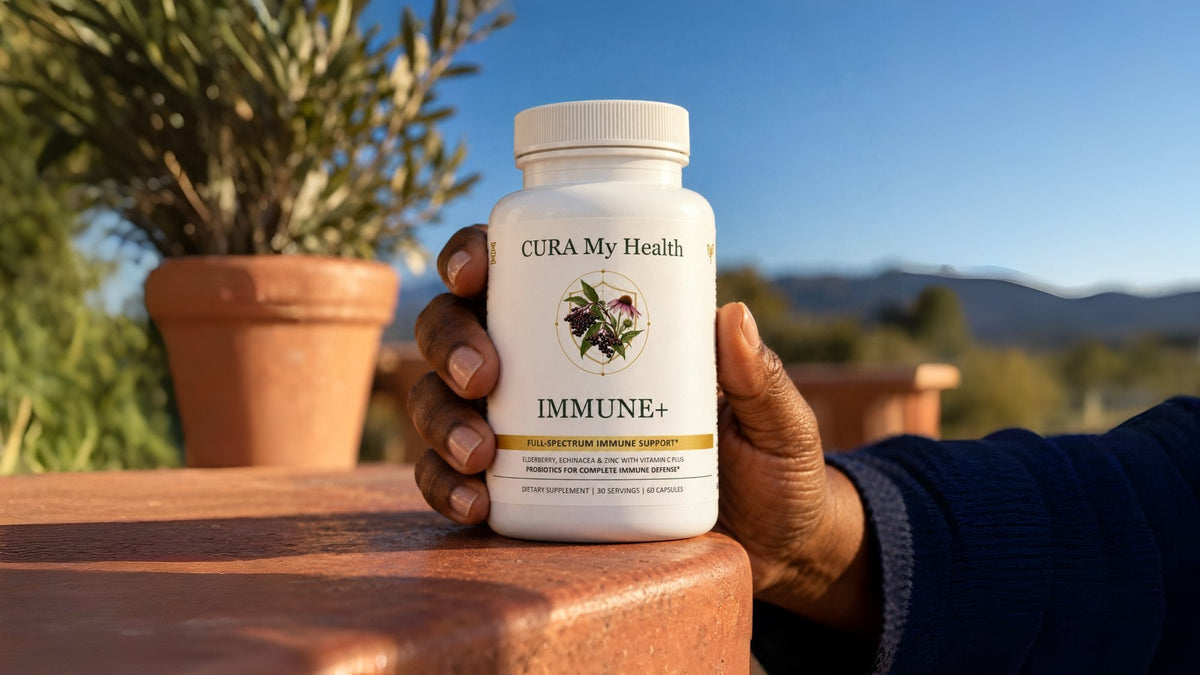
A daily immune support supplement is a simple way to cover the nutrients your immune system relies on every day, on top of a balanced diet. Our pick for that job is Immune+, a ten-ingredient formula built around European elderberry extract, with vitamin C, zinc, vitamins E and B6, echinacea, garlic, turmeric, L-glutamine and a probiotic. Every amount is on the label. Below, we explain what is inside, what it supports, how to take it and who should check with a healthcare professional first.
Key takeaways
- Immune+ is a ten-ingredient formula built around 300 mg of European elderberry extract in every 2-capsule serving.
- Immune+ supports a healthy immune system, helps maintain antioxidant defenses and supports seasonal wellness.*
- The suggested use is two veggie capsules once a day, 20 to 30 minutes before a meal with an 8 fl oz glass of water.
- The label says: Do not exceed recommended dose. Pregnant or nursing mothers, children under the age of 18, and individuals with a known medical condition should consult a physician before using this or any dietary supplement.
- NIH sources add more: NCCIH calls echinacea extracts likely safe for most adults for short periods of time and conventionally formulated oral turmeric likely safe in the recommended amounts for up to 2 or 3 months, and says garlic above food amounts may not be safe in pregnancy or breastfeeding and turmeric supplements may be unsafe in pregnancy; the Office of Dietary Supplements says scientists don't know if echinacea or elderberry is safe during pregnancy.
- A supplement works best beside the basics: enough sleep, a varied diet, regular movement and good hand hygiene.
What does a daily immune support supplement actually do?
Your immune system is not one organ. It is a network of cells, tissues and signals spread through your skin, gut, airways, blood and lymph nodes. To do its everyday work, that network uses a steady supply of nutrients. According to the NIH Office of Dietary Supplements, vitamin C, zinc, vitamin E and vitamin B6 are among the nutrients that play a part in normal immune function.
Food is the first source of those nutrients. A daily supplement is a back-up: it helps fill the gaps on busy weeks, when meals are rushed or variety drops. It is worth being clear about what that means. A supplement supports normal function. It is not a shield, it does not replace a doctor, and no capsule can make up for short sleep or a poor diet. A good daily formula simply makes the nutrient side of the picture easier to keep steady.
Meet Immune+: elderberry plus nine more ingredients

Where most immune bottles stop at vitamin C and zinc, Immune+ adds elderberry, echinacea, garlic, turmeric, L-glutamine and a probiotic. Immune+ is a ten-ingredient formula built around 300 mg of European elderberry extract in every 2-capsule serving. Here is the full label, grouped by type:
| Ingredient (per 2-capsule serving) | Amount | Group |
|---|---|---|
| European elderberry extract (fruit) | 300 mg | Hero botanical |
| Vitamin C (as ascorbic acid) | 180 mg (200% DV) | Vitamin |
| Vitamin E (DL-alpha tocopherol acetate) | 20 mg (133% DV) | Vitamin |
| Vitamin B6 (as pyridoxine HCl) | 3.4 mg (200% DV) | Vitamin |
| Zinc (as zinc oxide) | 16 mg (146% DV) | Mineral |
| Echinacea purpurea powder (aerial parts) | 200 mg | Supporting botanical |
| Garlic powder (bulb) | 100 mg | Supporting botanical |
| Turmeric, 95% curcuminoids (root) | 100 mg | Supporting botanical |
| L-glutamine HCl | 200 mg | Amino acid |
| Lactobacillus acidophilus | 4.8 Billion CFU | Probiotic |
The only other ingredient is the vegetable capsule itself (hypromellose). There is no proprietary blend, so you can see exactly how much of each ingredient you take. For a closer look at what each one does, read our guide to Immune+ ingredients.
What does Immune+ support?
Immune+ supports a healthy immune system, helps maintain antioxidant defenses and supports seasonal wellness.* It also helps maintain overall respiratory health and provides daily nutrient support.* Those are the benefits on our product page, and we keep our wording to them.
Vitamin C and vitamin E are both antioxidants, which means they help protect cells from everyday oxidative stress. Elderberry is naturally rich in anthocyanins, the deep purple plant pigments that give the berry its colour. Zinc and vitamin B6 are classic immune nutrients, and the probiotic and L-glutamine bring the gut into the picture, which matters because a large share of immune tissue sits along the digestive tract.
How is Immune+ different from a basic vitamin C and zinc product?
A vitamin C and zinc tablet is a fine place to start. Immune+ is built for people who want a broader daily formula in one step. The main differences:
- Elderberry as the lead ingredient. Each serving carries 300 mg of extract from the fruit of Sambucus nigra, the European black elder.
- Four nutrients, not two. Vitamins C, E and B6 sit beside zinc, each at or above the Daily Value.
- Three supporting botanicals. Echinacea, garlic and turmeric are traditional immune-season herbs, used here in modest amounts.
- A gut angle. Lactobacillus acidophilus and L-glutamine reflect the close link between the gut and the immune system.
- Clean by design. The formula is vegan, gluten free, non-GMO, sugar free and free of the top 9 allergens.
Broader is not automatically better for everyone. If you already take a multivitamin or another zinc or vitamin C product, add it up: one serving of Immune+ gives 180 mg of vitamin C, 20 mg of vitamin E, 3.4 mg of vitamin B6 and 16 mg of zinc. The NIH Office of Dietary Supplements lists adult upper limits of 2,000 mg of vitamin C, 40 mg of zinc and 100 mg of vitamin B6 a day, and 1,000 mg of vitamin E a day from supplements.
How to take Immune+
The suggested use is two veggie capsules once a day, 20 to 30 minutes before a meal with an 8 fl oz glass of water. You can also take it as directed by your healthcare professional. A bottle holds 60 capsules, which is 30 servings, or 30 days when used as directed. Do not exceed the recommended dose. NCCIH says products with extracts of Echinacea purpurea are likely safe for most adults for short periods of time, and that conventionally formulated oral turmeric or curcumin is likely safe in the recommended amounts for up to 2 or 3 months, so ask your healthcare professional about long-term daily use of Immune+ (it contains Echinacea purpurea powder and turmeric).
Consistency matters more than the exact hour. Many people tie it to breakfast or lunch, whichever meal they never skip. Our guide to taking Immune+ covers timing, routines and combining it with other supplements, and our article on taking an immune supplement every day covers year-round use.
Habits that work alongside an immune supplement
A supplement works best beside the basics: enough sleep, a varied diet, regular movement and good hand hygiene. In practice that looks like:
- Enough sleep on most nights. Our article on sleep and the immune system explains why.
- Colourful fruit and vegetables most days, for vitamin C and plant compounds.
- Protein foods such as fish, meat, beans, nuts and seeds, which bring zinc.
- Fibre and fermented foods to feed a varied gut microbiome.
- Regular, moderate movement and time outdoors.
Who should talk to a healthcare professional first?
Immune+ is made for adults. The label warning reads: Do not exceed recommended dose. Pregnant or nursing mothers, children under the age of 18, and individuals with a known medical condition should consult a physician before using this or any dietary supplement. Keep out of reach of children. Do not use if safety seal is damaged or missing. Store in a cool, dry place.
The cited NIH sources add stronger cautions for pregnancy and longer use. NCCIH says products with extracts of Echinacea purpurea are likely safe for most adults for short periods of time, and that some studies suggest echinacea extracts are possibly safe for up to 7 days during the first trimester of pregnancy. The NIH Office of Dietary Supplements (ODS) says scientists don't know if echinacea or elderberry is safe to take during pregnancy, and NCCIH says little is known about the safety of either while breastfeeding. NCCIH also says garlic may not be safe during pregnancy or while breastfeeding when taken orally in amounts greater than those found in foods. For turmeric, NCCIH says conventionally formulated oral turmeric or curcumin is likely safe in the recommended amounts for up to 2 or 3 months, that the use of turmeric supplements during pregnancy may be unsafe, and that little is known about whether turmeric above food amounts is safe while breastfeeding.
The same sources name these medicine and health-condition cautions:
- Garlic: NCCIH says garlic supplements may increase the risk of bleeding, so tell your health care providers you take them, especially if you are going to have surgery or take anticoagulants, aspirin or other medicines that may affect bleeding. ODS adds that garlic might interact with blood thinners and blood pressure medications.
- Echinacea: ODS says echinacea might cause allergic reactions in rare cases and might reduce the effectiveness of some medications, including medications that suppress the immune system. NCCIH says allergic reactions may be severe, that there is conflicting evidence about whether echinacea interacts with some drugs metabolized by the liver, and that echinacea might interact with immunosuppressants or caffeine. Echinacea belongs to the daisy family, so check first if you react to ragweed, daisies or sunflowers.
- Elderberry: ODS says elderberry might affect insulin and blood sugar levels and might reduce the effectiveness of medications that suppress the immune system.
- Vitamins C and E: ODS says both might reduce the effectiveness of radiation therapy and chemotherapy, and that vitamin E might interact with blood thinners. ODS adds that higher amounts of vitamin C might cause false readings on blood sugar monitors and, in people with hemochromatosis (an iron overload disorder), iron build-up in the body.
- Zinc: ODS says zinc supplements might interact with antibiotics, penicillamine and thiazide diuretics.
- Vitamin B6: the ODS vitamin B6 sheet says B6 supplements might interact with cycloserine, a tuberculosis antibiotic, and worsen any seizures and nerve cell damage the drug might cause; certain epilepsy drugs could lower B6 levels and reduce the drugs' ability to control seizures; and theophylline can lower B6 levels and cause seizures.
- Turmeric: NCCIH says liver damage has been reported in some people who consumed curcumin products made for higher bioavailability, and that if you notice liver damage symptoms such as fatigue, nausea, poor appetite, dark urine or jaundice, you should stop consuming turmeric or curcumin products immediately and talk with your health care provider.
- Lactobacillus acidophilus: ODS says that in people who are very ill or have immune system problems, probiotics might cause severe illness, and that antibiotics or antifungal medications might make some probiotics less effective.
If you take any prescription medicine, or have an immune-related condition, ask your doctor or pharmacist before starting Immune+.
Tested for what matters
Every batch of Immune+ is third-party tested by an outside lab for purity and potency. It is manufactured in USA with globally sourced materials, in an NSF-certified, GMP-certified, FDA-registered U.S. facility. You can read how we test on our Our Standards page, and every order is backed by our 60-day guarantee. Browse the rest of our immune support collection to see what pairs well.
Frequently asked questions about Immune+
What is the best daily immune support supplement?
The best choice is one with clear amounts, sensible doses and real testing that fits the rest of your routine. Immune+ lists all ten ingredients with exact amounts, and every batch is third-party tested for purity and potency. If you already take a multivitamin, compare labels so you do not double up: each 2-capsule serving of Immune+ has 180 mg of vitamin C, 20 mg of vitamin E, 3.4 mg of vitamin B6 and 16 mg of zinc, and the NIH Office of Dietary Supplements lists adult upper limits of 2,000 mg of vitamin C, 1,000 mg of vitamin E from supplements, 100 mg of vitamin B6 and 40 mg of zinc a day.
What is the main ingredient in Immune+?
European elderberry extract from the fruit of Sambucus nigra is the lead ingredient, at 300 mg per 2-capsule serving. Vitamin C, zinc, vitamins E and B6, echinacea, garlic, turmeric, L-glutamine and Lactobacillus acidophilus complete the formula.
Can I take Immune+ every day?
Yes. Immune+ is designed as a daily formula: two veggie capsules once a day, 20 to 30 minutes before a meal with an 8 fl oz glass of water. NCCIH says products with extracts of echinacea, one of its ingredients, are likely safe for most adults for short periods of time and possibly safe for up to 7 days during the first trimester of pregnancy. NCCIH also says conventionally formulated oral turmeric, another ingredient, is likely safe in the recommended amounts for up to 2 or 3 months, and that turmeric supplements may be unsafe during pregnancy. Ask your healthcare professional about long-term daily use. In pregnancy, the NIH Office of Dietary Supplements says scientists don't know if echinacea or elderberry is safe, and NCCIH says garlic above food amounts may not be safe while pregnant or breastfeeding. The Immune+ label says: Do not exceed recommended dose. Pregnant or nursing mothers, children under the age of 18, and individuals with a known medical condition should consult a physician before using this or any dietary supplement.
Is Immune+ vegan?
Yes. Immune+ comes in vegetable capsules and is listed as vegan, vegetarian, gluten free, non-GMO, sugar free, lactose free and free of the top 9 allergens.
How long does one bottle of Immune+ last?
One bottle holds 60 veggie capsules. At two capsules a day, that is 30 servings, or a 30-day supply when used as directed.
Related reading from our Wellness Hub
- Elderberry vs. Echinacea: How Two Immune Botanicals Differ
- Zinc Explained: What It Does, Food Sources and Where Immune+ Fits
- Third-Party Tested, Every Batch: Here’s the Receipt
Sources
- NIH Office of Dietary Supplements - Dietary Supplements for Immune Function and Infectious Diseases, updated March 10, 2025
- NIH Office of Dietary Supplements - Vitamin B6: Fact Sheet for Consumers, updated June 16, 2023
- NCCIH - European Elder (Elderberry), updated November 2024
- NCCIH - Echinacea, updated November 2024
- NCCIH - Garlic, updated February 2025
- NCCIH - Turmeric, updated April 2025
Individual results vary.
*These statements have not been evaluated by the Food and Drug Administration. This product is not intended to diagnose, treat, cure, or prevent any disease.

