
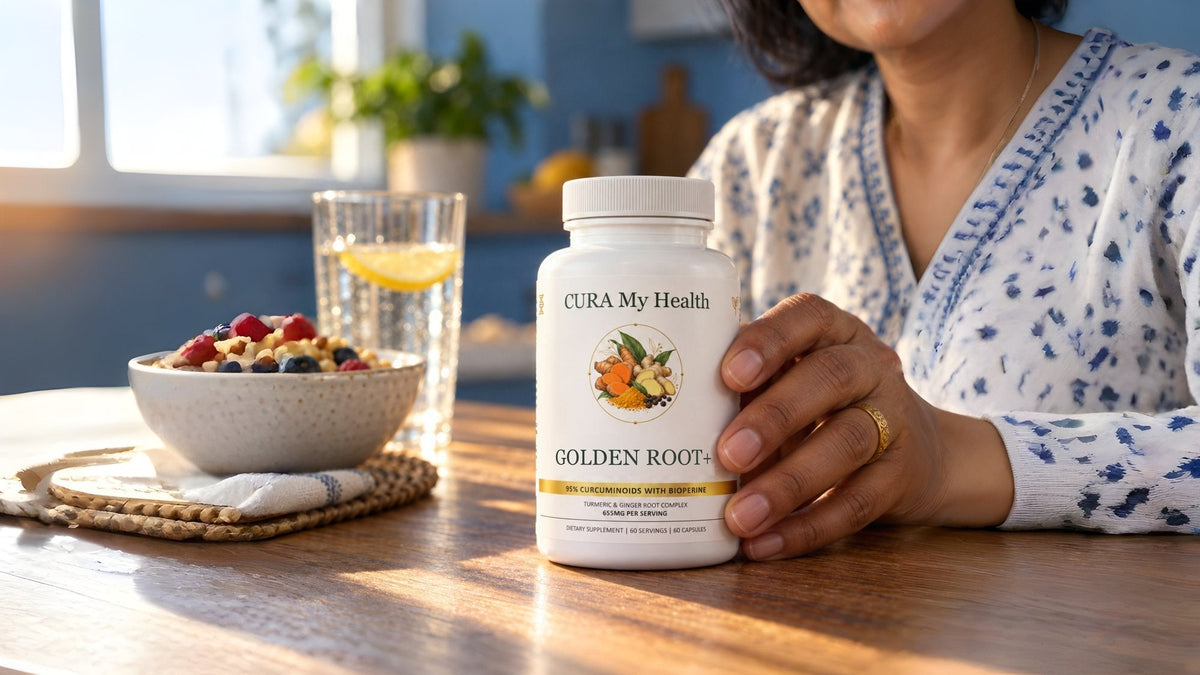
Ginger for digestion and turmeric for joint support are paired because each root brings a different strength. Ginger has the stronger research record for the stomach, while turmeric has the larger body of research on joint comfort. Golden Root+™ combines both, taken as one capsule twice a day, to promote digestive health and joint mobility.* Very few studies have tested the two together, so the honest way to understand the pairing is to look at each root on its own.
Key takeaways
- Ginger has the stronger research record for the stomach, while turmeric has the larger body of research on joint comfort.
- In a small trial of healthy volunteers, ginger capsules helped the stomach empty faster than a placebo.
- NCCIH describes the early evidence for turmeric and curcumin on joint discomfort as positive but says higher-quality studies are needed.
- Very few studies have tested ginger and turmeric together, so the pairing rests on each root's own evidence.
Why pair ginger and turmeric at all?
Ginger (Zingiber officinale) and turmeric (Curcuma longa) are botanical cousins. Both belong to the same plant family, both are underground stems called rhizomes, and both have been staples of Asian cooking and traditional wellness practices for centuries. That shared history is part of why they so often appear together in teas, curries and supplements.
Their active compounds are different, though. Ginger's pungent taste comes from gingerols and, in dried ginger, shogaols. Turmeric's color comes from curcuminoids, of which curcumin is the best known. Different compounds, different areas of research: that is the real logic behind pairing them.
What does the research say about ginger for digestion?
Ginger has a long folk history for an unsettled stomach, and some of that use has been tested. In a small trial of healthy volunteers, ginger capsules helped the stomach empty faster than a placebo. In that 2008 study, 24 people took 1,200 mg of ginger or a placebo before a light soup, and the stomach emptied in about half the time after ginger, though the volunteers reported no difference in how they felt.
A 2019 systematic review of human trials found the most consistent evidence for ginger and nausea, and said studies on other digestive concerns were too few to draw firm conclusions. NCCIH reaches a similar view: ginger may help with nausea in pregnancy, it generally has not helped motion sickness, and many ginger studies were not high quality.
What ginger may not do
Ginger is not a fix for every digestive complaint, and it has its own side effects. NCCIH lists abdominal discomfort, heartburn, diarrhea and mouth or throat irritation. The amounts used in studies also differ from what any one supplement provides, so a study result is not a promise for a particular product. For daily amounts in food and supplements, see How Much Ginger per Day?
What does the research say about turmeric for joint support?
Turmeric has been studied far more than ginger, and joint comfort is one of the most researched areas. NCCIH describes the early evidence for turmeric and curcumin on joint discomfort as positive but says higher-quality studies are needed. Most of those trials used concentrated curcumin extracts rather than plain turmeric powder, often at amounts different from any one product.
Absorption is the other caveat. Curcumin is poorly absorbed and quickly broken down, which is why many formulas add black pepper extract. A 2017 review in Foods sums up the field well: interest is high, results are promising in places, and form and dose matter. For a deeper look, read Curcumin for Joint Comfort: What the Research Shows.
Ginger and turmeric at a glance
| Ginger | Turmeric | |
|---|---|---|
| Main compounds | Gingerols, shogaols | Curcuminoids (curcumin and two relatives) |
| Strongest research area | Nausea; stomach emptying | Joint comfort |
| Biggest open question | Few large, well-run trials | Absorption, and the quality of trials |
| Common side effects | Heartburn, stomach discomfort | Nausea, acid reflux, stomach upset |
| In each Golden Root+ capsule | 100 mg ginger extract | 500 mg turmeric root + 50 mg 95% curcuminoid extract |
Is turmeric and ginger together better than either alone?
We do not know. Very few studies have tested ginger and turmeric together, so the pairing rests on each root's own evidence. Claims that the two "work in synergy" mostly come from laboratory and animal research, and those findings do not translate directly to people. What the pairing does offer is practical: one routine that covers the area where ginger is best studied and the area where turmeric is best studied, without two separate bottles.
That is also the fair way to judge a combination product. Ask whether each ingredient is present in a stated amount, whether the label is clear about form, and whether the routine is one you can keep.
Where Golden Root+ fits
Golden Root+ provides 100 mg of ginger extract and 500 mg of turmeric root per capsule, along with 50 mg of turmeric extract standardized to 95% curcuminoids and 5 mg of BioPerine black pepper extract. The label directs one capsule twice a day, 20-30 minutes before a meal, so a 60-capsule bottle lasts 30 days. Every amount is printed on the label, with no proprietary blend. The formula is designed to promote digestive health and joint mobility.*
- Third-party tested, every batch, for purity and potency.
- Manufactured in USA with globally sourced materials, in an NSF-certified, GMP-certified, FDA-registered facility.
- Vegan, gluten free, non-GMO and free of the top 9 allergens, in a vegetable capsule.
- Backed by a 60-day guarantee.
See our standards for how testing works, and Best Time to Take Turmeric and Ginger for a simple routine.
Who should check before taking turmeric and ginger together?
The label warning reads: "Pregnant or nursing mothers, children under the age of 18, and individuals with a known medical condition should consult a physician before using this or any dietary supplement." NCCIH notes that turmeric supplements during pregnancy may be unsafe, and advises talking with a provider before using herbs alongside any medicine. Turmeric, ginger and piperine have each been flagged for possible interactions, including with medicines that slow blood clotting, so bring the bottle to your pharmacist if you take prescriptions.
Frequently asked questions about ginger for digestion and turmeric for joints
Is ginger good for digestion?
Ginger has the most consistent research for nausea, and a small trial found it helped the stomach empty faster in healthy volunteers. Evidence for other digestive concerns is limited. It can also cause heartburn in some people.
Does turmeric support joints?
Turmeric and its curcuminoids are among the most studied botanicals for joint comfort. NCCIH calls the early evidence positive but says better studies are needed. Results depend a great deal on form, amount and absorption.
Can I take turmeric and ginger together every day?
Many people do, and both are common foods. As a supplement, follow the label: Golden Root+ is one capsule twice a day. Check with your doctor first if you are pregnant, nursing, have a medical condition or take medication.
Which is better for joints, ginger or turmeric?
Turmeric has the larger body of joint research. NCCIH says oral ginger might help some joint symptoms, but much of that research is weak. That is why a pairing usually leans on ginger for the stomach and turmeric for joints.
How long should I try turmeric and ginger before deciding?
Give a steady routine several weeks, keep simple notes, and judge it on how you feel day to day. NCCIH notes that conventional turmeric is likely safe in recommended amounts for up to 2 or 3 months; talk with your provider about longer use.
Related reading from our Wellness Hub
- Turmeric vs. Curcumin: What Is the Difference on a Supplement Label?
- Why Add Black Pepper to Turmeric? BioPerine and Absorption Explained
- Turmeric and Ginger Supplement: Meet Golden Root+
Sources
- NCCIH. Ginger.
- NCCIH. Turmeric.
- Wu KL, et al. Effects of ginger on gastric emptying and motility in healthy humans. Eur J Gastroenterol Hepatol. 2008.
- Nikkhah Bodagh M, et al. Ginger in gastrointestinal disorders: a systematic review of clinical trials. Food Sci Nutr. 2019.
- Hewlings SJ, Kalman DS. Curcumin: a review of its effects on human health. Foods. 2017.
Individual results vary.
These statements have not been evaluated by the Food and Drug Administration. This product is not intended to diagnose, treat, cure, or prevent any disease.

