
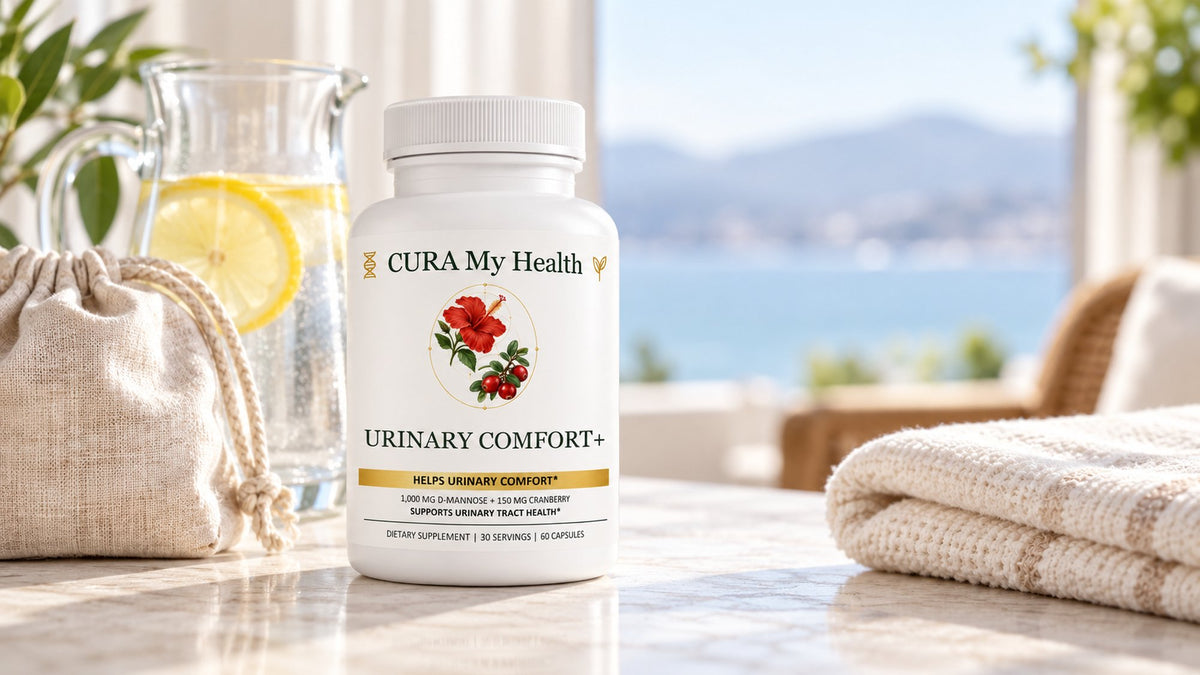
Hibiscus and dandelion in urinary supplements are supporting botanicals, not the main event. In Urinary Comfort+™, the lead ingredient is 1,000 mg of D-mannose; hibiscus flower extract (100 mg) and dandelion root extract (100 mg) sit beside cranberry juice powder. Hibiscus adds a plant rich in organic acids and polyphenols; dandelion adds the root of a plant with a long traditional use for fluid balance, a reputation that rests mostly on the leaf. Human research on both is limited, and that is worth knowing before you buy. Here is what each one is, what it adds, and who should check with a clinician first.
Key takeaways
- Hibiscus and dandelion are supporting botanicals; in Urinary Comfort+ the lead ingredient is D-mannose.
- Hibiscus sabdariffa is rich in organic acids, polyphenols and anthocyanins, the pigments behind its deep red color.
- Dandelion has a long traditional use as a diuretic, but the human research is a small pilot study of a leaf extract.
- If you take blood pressure medicine, a water pill, a blood thinner or diabetes medicine, talk with your healthcare provider before adding either botanical.
What is hibiscus?
The hibiscus used in supplements and teas is Hibiscus sabdariffa, also called roselle. Its fleshy red calyxes, the cup around the flower, are brewed into the tart drink known as sour tea, agua de jamaica or sorrel in different parts of the world. Hibiscus sabdariffa is rich in organic acids, polyphenols and anthocyanins, the pigments behind its deep red color.
Much of the human research on hibiscus has looked at the tea and blood pressure. A 2015 meta-analysis of five randomized trials on hibiscus and high blood pressure (390 participants) found that hibiscus lowered blood pressure readings compared with control groups; the authors said further well-designed trials are necessary to validate these results. That is useful context for a different reason than you might expect: it is why people who already take blood pressure medicine should ask before adding hibiscus in any form.
What does hibiscus add to a urinary supplement?
In a urinary formula, hibiscus is there for its plant compounds. Urinary Comfort+ is rich in antioxidants for whole-body wellness, and the hibiscus flower extract is part of that picture.* We do not claim more for it. Studies of hibiscus and the urinary tract specifically are small and early, and none tested our formula.
One more reason for care: in an animal study, hibiscus extract given with hydrochlorothiazide, a common water pill, increased urine output and changed how long the drug stayed in the blood. Animal results do not translate directly to people, but they are a fair reason to mention hibiscus to your pharmacist if you take a diuretic.
What is dandelion?
Dandelion (Taraxacum officinale) is the familiar yellow-flowered plant of lawns and roadsides. According to NCCIH, its flowers, leaves and root have traditionally been used in Mexican and other North American medicine, and today oral dandelion products are promoted for indigestion, while oral and topical dandelion products are promoted for joint pain. NCCIH is also candid that very little is known about its effects on human health and that there is no compelling scientific evidence for using it for any health condition.
Different parts of the plant are used differently. Dandelion leaf is the part most associated with its reputation as a traditional diuretic; dandelion root is the part more often used in digestive and liver-support formulas. Our guide to artichoke and dandelion covers that side of the plant.
What does dandelion add to a urinary supplement?
Dandelion has a long traditional use as a diuretic, but the human research is a small pilot study of a leaf extract. In that 2009 study, 17 volunteers took a fresh dandelion leaf extract three times in one day. Urination became more frequent in the five hours after the first dose and the output ratio rose after the second, while the third dose changed nothing measurable. The authors called it promising and asked for more research.
Urinary Comfort+ uses dandelion root extract, a different part of the plant, at 100 mg per serving, so that study describes the plant's reputation, not our formula. Within Urinary Comfort+, dandelion is part of a formula that encourages natural detoxification and fluid balance.*
Hibiscus and dandelion side by side
| Hibiscus | Dandelion | |
|---|---|---|
| Plant | Hibiscus sabdariffa (roselle) | Taraxacum officinale |
| Part in Urinary Comfort+ | Flower extract | Root extract |
| Amount per 2-capsule serving | 100 mg | 100 mg |
| Known for | Tart red tea rich in organic acids, polyphenols and anthocyanins | Traditional use for fluid balance and digestion |
| Human research | Much of it on hibiscus tea and blood pressure | One small pilot study of a leaf extract |
| Check first if you take | Blood pressure medicine or a diuretic | Diabetes medicine, blood thinners or a diuretic |
How hibiscus and dandelion fit with D-mannose and cranberry
Hibiscus and dandelion are supporting botanicals; in Urinary Comfort+ the lead ingredient is D-mannose. The full formula, per two veggie capsules, is D-mannose 1,000 mg, cranberry juice powder 150 mg, hibiscus extract 100 mg and dandelion extract 100 mg: 1,350 mg in total. There is no proprietary blend; each amount is printed separately. The other ingredients are hypromellose (the vegetable capsule) and silicon dioxide, which keeps the powder flowing.
Think of the botanicals as rounding out a formula built around D-mannose and cranberry, which are explained in D-mannose vs. cranberry. Every batch is third-party tested for purity and potency, and the formula is made in an NSF-certified, GMP-certified, FDA-registered U.S. facility; see our standards.
Who should check before taking hibiscus or dandelion?
If you take blood pressure medicine, a water pill, a blood thinner or diabetes medicine, talk with your healthcare provider before adding either botanical. NCCIH lists possible interactions between dandelion and diabetes medicines, anticoagulants, antiplatelet drugs and diuretics, and hibiscus is best discussed with your prescriber if you take blood pressure medicine. Also consider:
- Allergies. Dandelion belongs to the daisy family. Evidence is conflicting on whether people sensitive to ragweed, chrysanthemums, marigolds or daisies react to it, so take care if you have those allergies.
- Pregnancy and nursing. The Urinary Comfort+ label asks pregnant or nursing mothers, children under 18 and anyone with a known medical condition to consult a physician before using this or any dietary supplement.
- Symptoms now. Burning, pain, fever or blood in the urine call for a clinician, not a botanical.
Frequently asked questions about hibiscus and dandelion in urinary supplements
Is hibiscus good for the bladder?
Hibiscus is included in urinary formulas mainly for its polyphenols and other plant compounds. Research on hibiscus and the urinary tract is small and early; much of the human research has looked at hibiscus tea and blood pressure.
Is dandelion root a diuretic?
Dandelion has a long traditional reputation as a diuretic, mostly for the leaf. The only human study we know of is a small 2009 pilot using a leaf extract over one day, so the evidence for the root is thinner still.
Can I drink hibiscus tea while taking a supplement with hibiscus?
A cup of hibiscus tea is a common drink, but it adds to the hibiscus in your routine. If you take blood pressure medicine or a diuretic, ask your pharmacist about the combination first.
Who should avoid dandelion?
Talk with a clinician first if you take diabetes medicine, blood thinners or a water pill, or if you are allergic to plants in the daisy family. Pregnant or nursing mothers should consult a physician before using any supplement.
Why not just take D-mannose on its own?
You can; D-mannose alone is a simple, popular choice. Formulas such as Urinary Comfort+ add cranberry, hibiscus and dandelion so one routine covers several traditional ingredients, each with its amount printed on the label.
Related reading from our Wellness Hub
- D-Mannose and Cranberry Supplement: Inside Urinary Comfort+
- D-Mannose vs. Cranberry: How They Differ for Urinary Wellness
- Artichoke and Dandelion for Liver Support: Liver+™ Ingredients
- Hydration for Bladder Health: Daily Water and Bathroom Habits
Sources
- NCCIH - Dandelion: usefulness and safety, updated November 2024
- Clare BA, et al. The diuretic effect in human subjects of an extract of Taraxacum officinale folium over a single day. J Altern Complement Med, 2009 (PubMed)
- Serban C, et al. Effect of sour tea (Hibiscus sabdariffa L.) on arterial hypertension: a systematic review and meta-analysis of randomized controlled trials. J Hypertens, 2015 (PubMed)
- Ndu OO, et al. Herb-drug interaction between the extract of Hibiscus sabdariffa L. and hydrochlorothiazide in experimental animals. J Med Food, 2011 (PubMed)
Individual results vary.
These statements have not been evaluated by the Food and Drug Administration. This product is not intended to diagnose, treat, cure, or prevent any disease.

