
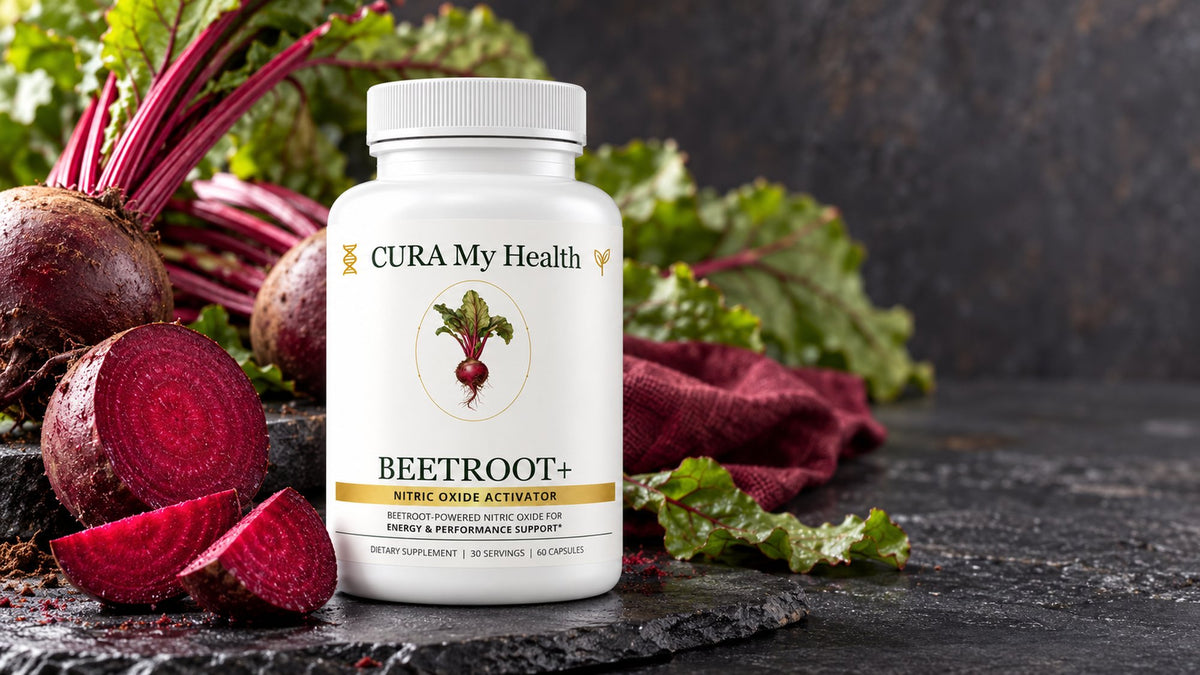
If you are wondering how to choose a beetroot supplement, start with the label, not the front of the bottle. Check how much beetroot is in each serving, how many capsules or scoops that serving takes, what else is in the product, and whether every batch is tested by an outside lab. Those four details tell you more than any front-label promise. This guide walks through each one, explains why nitrate comes up so often, and shows where our Beetroot+™ capsules fit.
Key takeaways
- A good beetroot label shows the amount of beetroot per serving, the serving size, and every other ingredient.
- A beetroot weight on the label is not the same thing as a nitrate dose.
- Capsules give a fixed amount with no taste, while powders and juices are larger servings that you mix or drink.
- Third-party testing checks that a product contains what its label says, but it does not show that a product works.
- Beetroot+ provides 1,300 mg of beetroot root powder in each two-capsule serving, taken once a day with food.
- The Beetroot+ label says: "Do not exceed recommended dose. Pregnant or nursing mothers, children under the age of 18, and individuals with a known medical condition should consult a physician before using this or any dietary supplement."
What should you check on a beetroot supplement label?
The NIH Office of Dietary Supplements explains that every product sold as a dietary supplement carries a Supplement Facts label that lists the active ingredients, the amount per serving, and other ingredients such as fillers, binders and flavorings. That panel is where a fair comparison starts. A good beetroot label shows the amount of beetroot per serving, the serving size, and every other ingredient.
Use this checklist when you compare two products side by side:
| What to check | What to look for | Why it matters |
|---|---|---|
| Amount per serving | A number in mg or g per serving | Lets you compare products on equal terms |
| Serving size | How many capsules or scoops make one serving | A per-capsule figure can look smaller or larger than the full serving |
| Plant part and name | Beetroot (Beta vulgaris) root, as powder, juice or extract | Tells you what form of beet you are getting |
| Nitrate | Some labels list it; many list only the beetroot amount | The studies below report nitrate, not beet weight |
| Other ingredients | Capsule material, flavors, sweeteners, added vitamins | Matters for taste, diet preferences and what else you take |
| Testing | A clear statement about outside lab testing | Shows someone checked the contents against the label |
| Warnings | Pregnancy, medical-condition and dose cautions | Tells you when to talk with a clinician first |
Why does nitrate matter in a beetroot supplement?
A 2014 review in Sports Medicine explains that inorganic nitrate is abundant in green leafy vegetables and beetroot. After you eat it, the body converts nitrate to nitrite, and in conditions of low oxygen, nitrite can be converted into nitric oxide. The same review says nitrate supplementation can, in some circumstances, enhance exercise tolerance and performance. You can read more about food sources in our guide to foods that boost nitric oxide.
What the beet juice studies measured
The two beet juice studies below report nitrate, not beet weight. In a 2013 study in the Journal of Applied Physiology, 10 healthy men drank 70, 140 or 280 ml of concentrated beetroot juice, containing 4.2, 8.4 and 16.8 mmol of nitrate. The 70 ml dose did not change their responses to cycling, while the 140 and 280 ml doses extended time to task failure by 14% and 12%. The authors found no extra gain from the highest dose over the middle one.
Why beet products are hard to compare
Nitrate in beets is not constant. A 2019 lab analysis in the International Journal of Sport Nutrition and Exercise Metabolism tested 45 lots of 24 beet juice products and found about a 50-fold range in nitrate content between the lowest and highest product. Only five products consistently provided 5 mmol of nitrate or more per serving, which the authors describe as seeming to be the minimal dose required to enhance exercise performance in most people.
So a beetroot weight on the label is not the same thing as a nitrate dose. Some products state a nitrate amount. Others, including Beetroot+, state the amount of beetroot root powder instead. Beetroot+ does not list a nitrate dose, so it cannot be matched to the nitrate doses in these juice studies, and it was not the product tested in them.
Beetroot capsules, powder or juice: which form fits?
Each form has a place. Capsules give a fixed amount with no taste, while powders and juices are larger servings that you mix or drink. Here is how they differ in daily use:
- Capsules: no beet flavor, easy to travel with, and a set amount in every serving. Beetroot+ is a two-capsule serving of 1,300 mg.
- Powders: a bigger scoop of beetroot that you stir into water or a recipe, often with flavors or sweeteners. Our Daily Beets+™ powder lists 4.5 g of beetroot powder per scoop with vitamin C and niacin, berry flavored and sweetened with stevia. Its label says adults take one scoop (7.3 g) daily with 8 ounces of water or a hot or cold recipe, and it carries its own, different label warning:"If you are pregnant, nursing, allergic, have a medical condition or taking any medications, consult a doctor before using this or any other dietary supplement. Do not use if product has been opened or tampered with in any way. Keep out of reach of children. Do not use if safety seal is damaged or missing. Store in a cool, dry place."
- Juices and shots: the form used in the beet studies above, and the 2019 analysis found their nitrate content varied widely.
For a side-by-side look at each form, see our article comparing beetroot capsules, beet juice and powder.
How to choose a beetroot supplement you can trust
A clean label is only useful if the product matches it. The NIH Office of Dietary Supplements notes that medicines must be approved by FDA before they are sold, while supplements do not require this approval, and that supplement companies are responsible for having evidence that their products are safe and their label claims truthful. The same ODS page says independent quality seals indicate a product was properly manufactured, contains the ingredients listed on the label, and does not contain harmful levels of contaminants, and that these seals do not guarantee that a product is safe or effective.
In plain terms, third-party testing checks that a product contains what its label says, but it does not show that a product works. That is still worth checking, because a supplement you cannot trust to match its label cannot be judged on anything else. Every batch of Beetroot+ is third-party tested for purity and potency by an outside lab, and it is produced in an NSF-certified, GMP-certified, FDA-registered U.S. facility. You can see how that testing works on our Our Standards page, and our video guide shows how to read a certificate of analysis line by line.
Are there beetroot supplement side effects to watch for?
One effect is harmless but surprising: MedlinePlus lists beets among the foods that can turn urine pink or red. MedlinePlus also lists medical causes of red urine, so if the color does not match what you ate, or it continues, ask a clinician.
Beyond that, follow the label. The Beetroot+ label warning reads, word for word: "Do not exceed recommended dose. Pregnant or nursing mothers, children under the age of 18, and individuals with a known medical condition should consult a physician before using this or any dietary supplement. Keep out of reach of children. Do not use if safety seal is damaged or missing. Store in a cool, dry place." If you take medicines or manage a health condition, show the label to your clinician or pharmacist before you start.
Meet Beetroot+

Beetroot+ keeps the formula to one active ingredient. Beetroot+ provides 1,300 mg of beetroot root powder in each two-capsule serving, taken once a day with food. The suggested use on the label reads: take two (2) capsules once a day with food or as directed by your health care professional. The 60-capsule bottle is a 30-day supply.
- Per serving (2 capsules): beetroot powder (Beta vulgaris) root, 1,300 mg
- Capsule: hypromellose (vegetable capsule)
- Other ingredients: microcrystalline cellulose, magnesium stearate
- Caffeine-free, so it fits any time of day
Beetroot supports healthy circulation and provides antioxidant support.* Like every CuraMyHealth supplement, Beetroot+ is third-party tested every batch, and it comes with our 60-day guarantee. If you prefer a drink, Daily Beets+ is the powder option. Beetroot+ and Daily Beets+ share the same main active, beetroot root powder, so if you take both, add up the totals first: one Beetroot+ serving gives 1,300 mg and one Daily Beets+ scoop gives 4.5 g (4,500 mg), or 5.8 g of beetroot powder a day together. Both label warnings still apply.
Frequently asked questions about choosing a beetroot supplement
What should I check first on a beetroot supplement label?
Start with the amount of beetroot per serving and the serving size, so you know what one full serving delivers. Then read the other ingredients and the warnings. Finally, look for a clear statement that the product is tested by an outside lab.
Does the label need to list nitrate?
No. Some products list a nitrate amount and many list only the beetroot amount. The beet juice studies cited in this guide report nitrate, so a product without a nitrate figure cannot be matched to those study doses. Beetroot+ lists its beetroot amount, 1,300 mg per serving, and does not list a nitrate dose.
Are beetroot capsules or powder better?
Neither is better for everyone. Capsules suit people who want no taste and a fixed amount, and powders suit people who like a drink and a larger serving. Beetroot+ is our capsule and Daily Beets+ is our powder. Both list beetroot root powder as their main active, so if you take both, add up the totals first: 1,300 mg per Beetroot+ serving (two capsules once a day with food) plus 4.5 g per Daily Beets+ scoop (one scoop daily with 8 ounces of water). The Beetroot+ label says: "Do not exceed recommended dose. Pregnant or nursing mothers, children under the age of 18, and individuals with a known medical condition should consult a physician before using this or any dietary supplement." The Daily Beets+ label says: "If you are pregnant, nursing, allergic, have a medical condition or taking any medications, consult a doctor before using this or any other dietary supplement."
When should I take Beetroot+?
The label says to take two capsules once a day with food, or as directed by your health care professional. It is caffeine-free, so you can pick the meal that is easiest to remember.
Why did my urine turn pink after eating beets?
MedlinePlus lists beets among the foods that can turn urine pink or red. If the color does not match what you ate, or it continues, ask a clinician, because MedlinePlus also lists medical causes.
Related reading from our Wellness Hub
- Beetroot Capsules vs. Beet Juice vs. Powder: Which Form Fits You?
- How to Take Beetroot Capsules: A Daily Routine With Beetroot+
- Foods That Boost Nitric Oxide: Beets, Leafy Greens and More
- How to Read a Supplement Certificate of Analysis (COA)
Sources
- NIH Office of Dietary Supplements: Dietary Supplements: What You Need to Know, updated January 4, 2023
- Sports Medicine (PubMed): Dietary nitrate supplementation and exercise performance, 2014
- Journal of Applied Physiology (PubMed): Beetroot juice and exercise: pharmacodynamic and dose-response relationships, 2013
- International Journal of Sport Nutrition and Exercise Metabolism (PubMed): What's in Your Beet Juice? Nitrate and Nitrite Content of Beet Juice Products Marketed to Athletes, 2019
- MedlinePlus (U.S. National Library of Medicine): Urine - abnormal color, reviewed July 1, 2025
Individual results vary.
These statements have not been evaluated by the Food and Drug Administration. This product is not intended to diagnose, treat, cure, or prevent any disease.

