
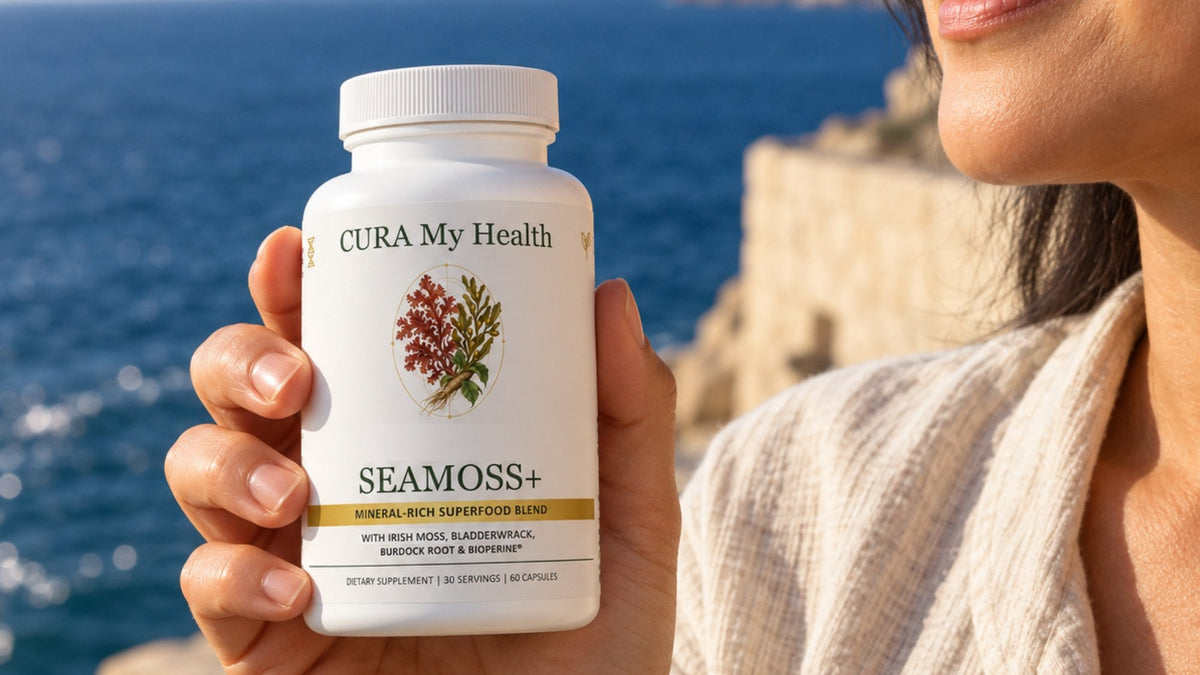
Irish moss vs. bladderwrack vs. burdock root: two are seaweeds and one is a land plant. Irish moss is a red seaweed best known for its gel-forming carrageenan, bladderwrack is a brown seaweed known for its iodine, and burdock is the root of a daisy-family plant eaten as a vegetable in parts of Asia. They often appear together in sea moss formulas, but each brings something different.
Key takeaways
- Irish moss (Chondrus crispus) is a red seaweed from North Atlantic shores and a traditional source of carrageenan, the natural gel that makes sea moss gel set.
- Bladderwrack (Fucus vesiculosus) is a brown seaweed with air-filled bladders on its fronds. Brown seaweeds such as kelp can be very high in iodine: a 2004 Thyroid study of 12 edible seaweeds (Teas et al.) measured 16 mcg per gram in nori, a red seaweed, and more than 8,000 mcg per gram in one sample of processed kelp granules.
- Burdock (Arctium lappa) is a land plant whose root contains inulin, a prebiotic fiber.
- Seamoss+™ contains all three per two-capsule serving: 500 mg of Irish moss, 500 mg of bladderwrack and 400 mg of burdock root, plus 5 mg of BioPerine. The label says not to exceed the recommended dose, and that pregnant or nursing mothers, children under 18 and anyone with a known medical condition should consult a physician before use.
Irish moss vs. bladderwrack vs. burdock root at a glance
| Irish moss | Bladderwrack | Burdock root | |
|---|---|---|---|
| Latin name | Chondrus crispus | Fucus vesiculosus | Arctium lappa |
| What it is | Red seaweed | Brown seaweed | Land plant (daisy family) |
| Where it grows | Rocky North Atlantic coasts | North Atlantic and North Sea shorelines | Europe and Asia, now widespread |
| Known for | Carrageenan, the gel-former | Iodine, alginate and fucoidan | Inulin fiber and polyphenols |
| Iodine | Present; amounts vary by harvest | Present; brown seaweeds such as kelp can be very high (Teas et al., 2004) | Not a meaningful source |
| Traditional use | Boiled into puddings, drinks and gels | Coastal food and a historical iodine source | Cooked root vegetable (gobo in Japan) |
What is Irish moss?
Irish moss (Chondrus crispus) is a red seaweed from North Atlantic shores and a traditional source of carrageenan, the natural gel that makes sea moss gel set. It grows on rocks along the coasts of Ireland, Britain, Brittany and Atlantic Canada, and ranges in color from deep purple-red to bleached gold.
"Sea moss" is a looser term. Products sold as sea moss may be Chondrus crispus or warm-water red seaweeds from the Gracilaria or Eucheuma groups, harvested in the Caribbean and Asia. They look similar once dried or made into gel, so the Latin name on the label is the only reliable way to know which one you are buying.
Irish moss supplies small amounts of minerals and naturally contains iodine. As with any seaweed, the amounts vary from harvest to harvest.
What is bladderwrack?
Bladderwrack (Fucus vesiculosus) is a brown seaweed with air-filled bladders on its fronds. Those bladders keep the fronds floating toward the light at high tide, and they are the easiest way to tell it apart from Irish moss, which has none. Brown seaweeds such as kelp can be very high in iodine: a 2004 Thyroid study of 12 edible seaweeds (Teas et al.) measured 16 mcg per gram in nori, a red seaweed, and more than 8,000 mcg per gram in one sample of processed kelp granules.
Bladderwrack contains alginate (a gel-forming fiber), fucoidan (a sulfated polysaccharide studied in the lab) and iodine. Iodine itself was first discovered in 1811 in the ash of seaweeds such as these. A 2021 review on iodine and seaweed advises caution with brown seaweeds in particular, because even small amounts can affect thyroid function and labels may not say how much iodine is present. Our guide to sea moss and iodine covers the numbers.
What is burdock root?
Burdock (Arctium lappa) is a land plant whose root contains inulin, a prebiotic fiber. The long, thin root is eaten as a cooked vegetable in Japan and Korea, and burdock has a long history in traditional European and Asian herbal practice.
Burdock belongs to the daisy family (Asteraceae), the same family as ragweed, chrysanthemums and marigolds. A review of burdock notes that it can cause contact dermatitis and other allergic responses, so people who react to plants in that family should take care. For a plain explanation of what prebiotic fiber does, see Prebiotics vs. Probiotics vs. Synbiotics: A Plain-English Guide.
Why are they combined in sea moss formulas?
The pairing comes from herbal tradition more than from trials of the combination. Two seaweeds give a broader mix of marine compounds than one, and burdock adds a land-based root with fiber. There is little published research on the three-way combination itself, so a fair reading is "complementary ingredients," not "proven trio."
When you compare sea moss products, look for three things: the Latin name of each seaweed, the amount of each ingredient in milligrams per serving, and whether each amount is listed or only a blend total is given. Some formulas list only a blend total, and some use concentrated extracts with ratios such as 4:1, which means the weight on the label stands for more raw plant. Neither approach is wrong, but you can only compare like with like.
Our own Seamoss+ lists each ingredient by name and amount. Seamoss+ contains all three per two-capsule serving: 500 mg of Irish moss, 500 mg of bladderwrack and 400 mg of burdock root, plus 5 mg of BioPerine. BioPerine is a black pepper extract included to enhance nutrient absorption.* There is no proprietary blend; each amount is printed on the label. The formula promotes digestive and gut health and supports thyroid function and iodine balance.* The label direction is two capsules once a day, 20 to 30 minutes before a meal.
For more on that label, read Sea Moss Ingredients: What Is in Seamoss+, Line by Line.
Safety: what to check before taking these ingredients
- Iodine: both seaweeds contain it, and the Seamoss+ label does not list an iodine amount, so your daily total cannot be added up exactly. The NIH Office of Dietary Supplements lists an upper limit of 1,100 mcg of iodine a day from all sources for adults 19 and older; if you also eat seaweed or take another iodine supplement, talk with your healthcare provider. The same fact sheet notes that taking high doses of iodine with antithyroid medications can have an additive effect and could cause hypothyroidism, and that some people, such as those with autoimmune thyroid disease or iodine deficiency, may experience adverse effects with iodine intakes considered safe for the general population. If you have a thyroid condition or take thyroid medication, talk with your healthcare provider before starting. The Seamoss+ label asks anyone with a known medical condition to consult a physician before use.
- Allergies: burdock is in the daisy family; take care if you react to ragweed or related plants.
- Dose: the Seamoss+ label says to take two capsules once a day and not to exceed the recommended dose.
- Pregnancy, nursing and medical conditions: consult a physician first; the same applies to children under 18.
- Purity: seaweeds absorb what is in the water around them, so testing matters. Every batch of our formulas is third-party tested for purity and potency; see our standards.
Frequently asked questions about Irish moss vs. bladderwrack
Is Irish moss the same as sea moss?
All Irish moss is sea moss, but not all sea moss is Irish moss. "Sea moss" can also mean warm-water red seaweeds such as Gracilaria or Eucheuma, so check the Latin name.
Which has more iodine, Irish moss or bladderwrack?
Bladderwrack is a brown seaweed, and the highest iodine level in a 2004 analysis of 12 edible seaweeds (Teas et al., Thyroid) came from kelp, also a brown seaweed: more than 8,000 mcg per gram in one sample of processed kelp granules, against 16 mcg per gram in nori, a red seaweed like Irish moss. Amounts vary widely between harvests, so the iodine in any one batch of Irish moss or bladderwrack is hard to predict.
Why is burdock root in a sea moss supplement?
Burdock adds a land-based root with inulin fiber to the two seaweeds, a pairing drawn from herbal tradition. It is a complementary ingredient rather than a seaweed.
Can I take bladderwrack if I have a thyroid condition?
Talk with your healthcare provider first. Bladderwrack contains iodine, and changes in iodine intake can affect thyroid function. The NIH Office of Dietary Supplements notes that taking high doses of iodine with antithyroid medications can have an additive effect and could cause hypothyroidism. The same fact sheet notes that some people, such as those with autoimmune thyroid disease or iodine deficiency, may experience adverse effects with iodine intakes considered safe for the general population.
Is sea moss gel different from capsules?
Gel is soaked and blended seaweed, while capsules hold measured dried amounts. Our article on sea moss capsules vs. gel compares them fairly.
Related reading from our Wellness Hub
- Is Sea Moss Good for Gut Health? What the Research Says
- Best Time to Take Sea Moss Capsules: A Simple Daily Routine
- Third-Party Tested, Every Batch: Here’s the Receipt
Sources
- Iodine, Seaweed, and the Thyroid (2021 review)
- Teas et al., Thyroid, 2004: Variability of iodine content in common commercially available edible seaweeds (PubMed)
- Chan et al., Inflammopharmacology, 2011: A review of the pharmacological effects of Arctium lappa (burdock) (PubMed)
- NIH Office of Dietary Supplements: Iodine, Health Professional Fact Sheet (updated 2024)
Individual results vary.
*These statements have not been evaluated by the Food and Drug Administration. This product is not intended to diagnose, treat, cure, or prevent any disease.

