
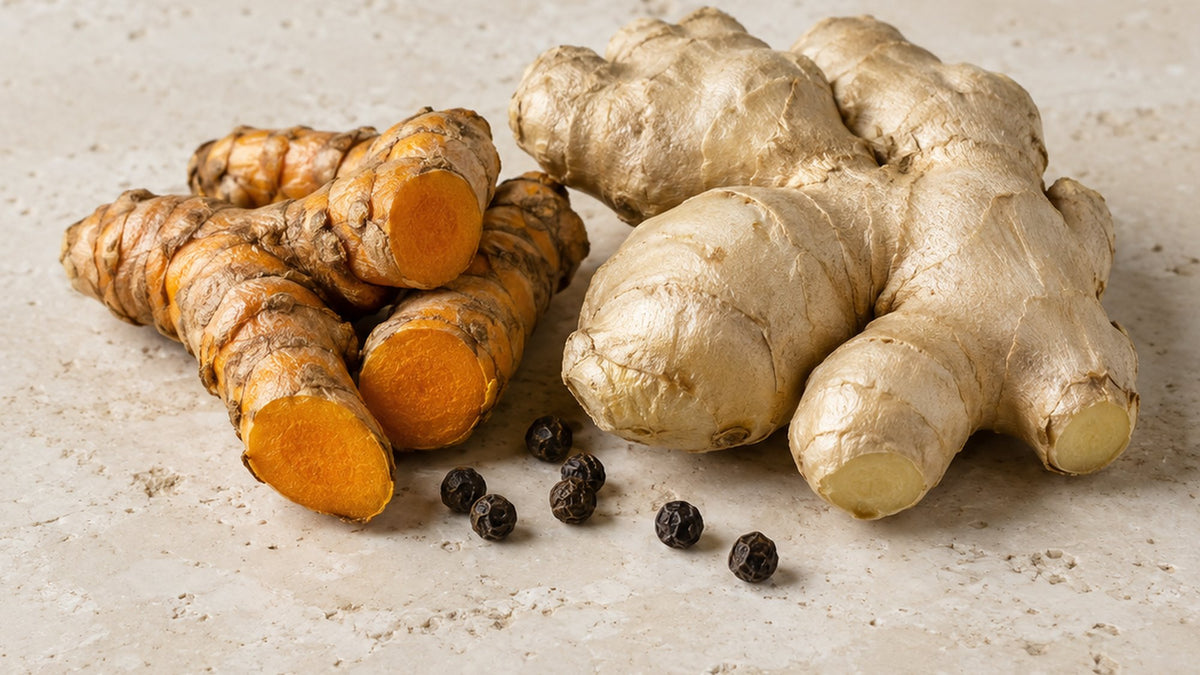
Turmeric spice vs. supplement: is cooking with turmeric enough? For flavor and everyday nutrition, cooking with turmeric is a lovely habit. For the amounts of curcuminoids used in research, it usually is not enough. Curcuminoids, turmeric's active compounds, make up only a few percent of the dried root, so a teaspoon in a curry delivers far less than the amounts most studies use. A turmeric supplement concentrates those compounds and often adds black pepper extract to help absorption. This guide explains the difference, when the spice is enough, and how to choose a supplement if you want one.
Key takeaways
- Curcuminoids make up only a few percent of dried turmeric root, so a teaspoon of the spice holds a small amount.
- Matching the curcuminoid amounts in many studies would take several tablespoons of the spice a day.
- Cooking turmeric with black pepper and a little fat helps you absorb more of it.
- A good supplement lists the turmeric root, the standardized extract and the black pepper extract with their amounts.
What is the difference between turmeric spice and a turmeric supplement?
Ground turmeric is simply the dried, powdered root of Curcuma longa. A turmeric supplement starts from the same plant but usually does three things differently:
- It measures the dose. Every capsule holds a set amount, so you know what you take each day.
- It concentrates the active compounds. Many supplements add an extract standardized to 95% curcuminoids, which is far more concentrated than the root itself.
- It addresses absorption. Curcuminoids are poorly absorbed on their own, so supplements often include black pepper extract, which contains piperine.
How much curcumin is in turmeric spice?
Curcuminoids make up only a few percent of dried turmeric root, so a teaspoon of the spice holds a small amount. Reviews of turmeric commonly put curcumin at roughly 2 to 5 percent of the powder by weight. A level teaspoon of ground turmeric weighs only a few grams, so it carries well under a couple of hundred milligrams of curcuminoids, and less if the spice is old or low quality.
Many turmeric studies used curcuminoid amounts that would take several tablespoons of the spice every day to match. A 2016 meta-analysis of joint studies, for example, noted that the trials commonly used about 1,000 mg of curcumin a day. Very few people eat that much turmeric, and it would overwhelm most dishes.
| Turmeric spice | Turmeric supplement | |
|---|---|---|
| Curcuminoids | A few percent of the powder | Often adds a 95% standardized extract |
| Dose | Varies by recipe | Measured per capsule |
| Absorption help | Depends on black pepper and fat in the dish | Often includes black pepper extract |
| Testing | Rarely tested for potency | Varies by brand; look for third-party testing |
| Best for | Flavor, color, everyday cooking | A consistent daily amount |
How to get more from turmeric in your cooking
If you love the spice, keep using it. A few kitchen habits help:
- Add black pepper. Black pepper and a little fat help the body absorb curcuminoids from food. Many traditional recipes already combine all three.
- Cook it in oil. Warming turmeric briefly in olive oil, ghee or coconut oil at the start of a dish is a classic technique.
- Use it often. Soups, lentils, roasted vegetables, eggs, rice and smoothies all take a pinch well.
- Try golden milk. Warm milk or a plant milk with turmeric, black pepper, ginger and cinnamon is an easy evening habit.
- Buy fresh and store it well. Ground spices lose quality over time. Keep turmeric sealed, away from light and heat.
When does a turmeric supplement make sense?
A supplement makes sense when you want a consistent, measured amount of turmeric every day, for example as part of a joint or healthy-aging routine. When you compare products, a good supplement lists the turmeric root, the standardized extract and the black pepper extract with their amounts. Avoid labels that hide the turmeric inside a proprietary blend.
Turmeric with BioPerine+ is built that way. Each capsule provides 600 mg of turmeric root plus 50 mg of turmeric extract standardized to 95% curcuminoids, with 5 mg of BioPerine® black pepper extract. The label directs one capsule twice a day, 20 to 30 minutes before a meal, which adds up to 1,300 mg of turmeric a day, including 100 mg of extract standardized to 95% curcuminoids. That is less curcumin than many studies used; the study amounts describe those trials, not our capsule. It promotes joint mobility and digestive health, and supports healthy aging. Like everything we make, it is third-party tested, every batch, for purity and potency; see our standards for what that means.
If you like turmeric and ginger together, Golden Root+™ pairs the two in one capsule, also with black pepper extract.
Is turmeric spice safer than turmeric supplements?
Turmeric in food is generally considered low risk. Concentrated supplements deliver much more, so a few groups should check with a doctor or pharmacist first:
- People taking blood-thinning medication.
- People with gallbladder problems.
- Anyone who is pregnant or nursing.
- Anyone with a medical condition or taking prescription medicine.
Some people notice mild stomach upset with supplements; taking them before a meal, as the label directs, suits most people. Do not combine several turmeric products without advice, so the total stays where you intend it.
Frequently asked questions about turmeric spice vs. supplements
Is cooking with turmeric as good as taking a supplement?
Cooking with turmeric is a healthy habit, but it delivers far fewer curcuminoids than most studies use. A supplement gives a measured, more concentrated daily amount.
How much turmeric spice equals a turmeric capsule?
It depends on the capsule, so compare the curcuminoid amounts on the label rather than the total weight. Turmeric with BioPerine+ lists 600 mg of turmeric root plus 50 mg of extract standardized to 95% curcuminoids per capsule.
Does black pepper really help turmeric absorption?
Yes. Piperine, the active compound in black pepper, raised blood levels of curcumin well above curcumin alone in an early human study. That is why many turmeric supplements include black pepper extract.
Can I cook with turmeric and take a supplement too?
Yes. Culinary amounts are small, and most people can enjoy turmeric in food alongside a supplement. Follow the supplement's label and check with your doctor if you take medication.
What should I look for on a turmeric supplement label?
Look for the turmeric root amount, a standardized curcuminoid extract with its percentage, black pepper extract with its amount, and evidence of third-party testing. Every amount should be on the label.
Related reading from our Wellness Hub
- Turmeric vs. Curcumin: What Is the Difference on a Supplement Label?
- Why Add Black Pepper to Turmeric? BioPerine and Absorption Explained
- Curcumin for Joint Comfort: What the Research Shows
Sources
- NCCIH: Turmeric
- Hewlings SJ, Kalman DS. Curcumin: a review of its effects on human health. Foods, 2017.
- Daily JW, Yang M, Park S. Efficacy of turmeric extracts and curcumin for alleviating the symptoms of joint arthritis: a systematic review and meta-analysis of randomized clinical trials. Journal of Medicinal Food, 2016.
- Shoba G et al. Influence of piperine on the pharmacokinetics of curcumin. Planta Medica, 1998.
Individual results vary.
These statements have not been evaluated by the Food and Drug Administration. This product is not intended to diagnose, treat, cure, or prevent any disease.

