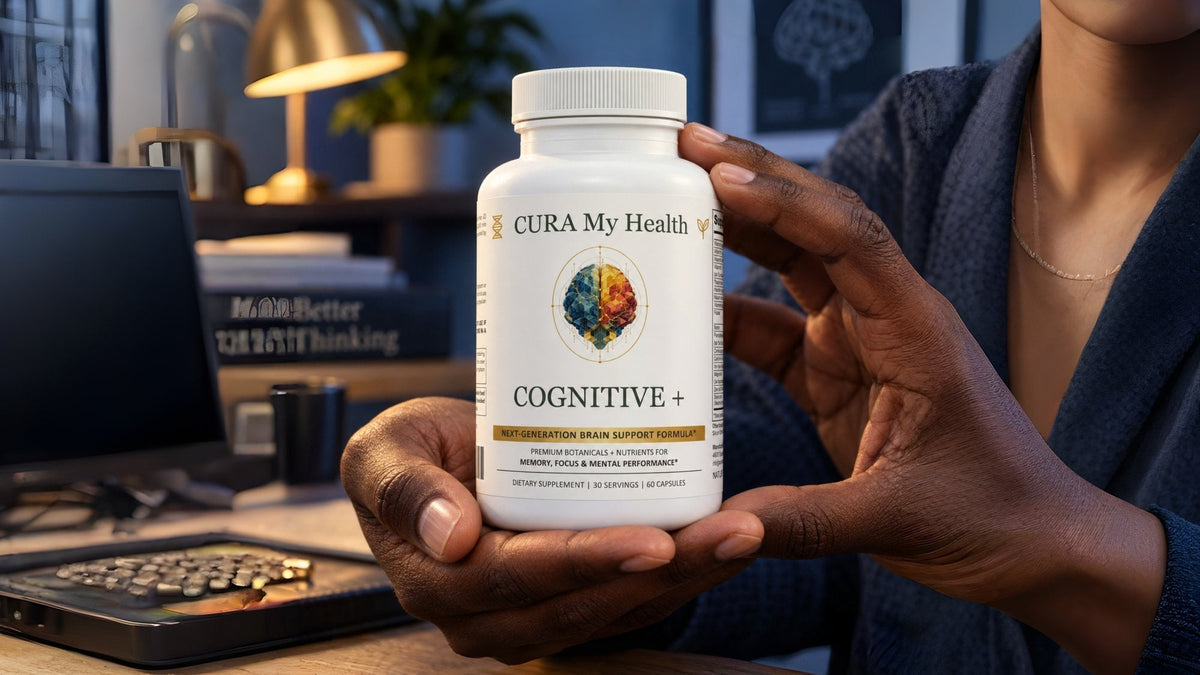
Cognitive +™ ingredients, in one sentence: each two-capsule serving holds a 609 mg proprietary blend of eighteen ingredients (including DMAE, L-glutamine, green tea extract, bacopa, GABA, phosphatidylserine, DHA from tuna and huperzine A), plus twelve vitamins and ten minerals with their own amounts. The capsule is a vegetable capsule, and the formula contains soy, fish (tuna), iron and natural caffeine. This guide walks through the label line by line in plain English, so you know what each name is before you decide whether it fits you.
Key takeaways
- One serving is two veggie capsules, and one bottle holds 30 servings.
- Blend totals are on the label; the amounts inside each blend are not.
- Every vitamin and mineral outside the blend is listed with its own amount and % Daily Value; boron and vanadium sit inside the blend.
- The green tea extract in the blend is a natural source of caffeine.
- The label carries an iron warning and an allergen statement for soy and fish (tuna).
Serving size and supply
One serving is two veggie capsules, and one bottle holds 30 servings. The label's suggested use is two capsules once a day, 20-30 minutes before a meal with an 8 fl oz glass of water, or as directed by your healthcare professional. At that rate, the 60-capsule bottle is a 30-day supply. Every amount below is per two-capsule serving, not per capsule.

The 609 mg proprietary blend, ingredient by ingredient
Under FDA labeling rules, a proprietary blend shows its total weight and lists its ingredients in descending order by weight, without each individual amount. Blend totals are on the label; the amounts inside each blend are not. Here is each blend ingredient, in label order, with a plain description of what it is.
| Label name | What it is |
|---|---|
| DMAE bitartrate | Dimethylaminoethanol, a compound related to choline |
| L-glutamine HCl | An amino acid |
| Glutamic acid | An amino acid |
| Green tea extract (leaf) | Tea leaf extract; a natural source of caffeine |
| Bacopa extract (whole herb) | An herb from Ayurvedic tradition |
| Inositol | A vitamin-like compound found in cell membranes |
| Bilberry fruit extract | A relative of the blueberry |
| GABA | Gamma-aminobutyric acid, an amino acid |
| Grape seed extract | A plant extract rich in polyphenols |
| Grapefruit seed extract | A citrus seed extract |
| Olive leaf | Leaf of the olive tree |
| Cassia bark extract | Bark of a cinnamon species |
| Licorice root extract | Root of the licorice plant |
| Boron (as boron citrate) | A trace mineral |
| DHA 14% | Docosahexaenoic acid, an omega-3 fat; sourced from tuna |
| Vanadium (as vanadyl sulfate) | A trace mineral |
| Phosphatidylserine (seed) | A phospholipid found in cell membranes; sourced from soy |
| Huperzine A (whole herb) | A compound from Chinese club moss (Huperzia serrata) |
Two things are not on this list: ginkgo and alpha-GPC. If you want to compare a few of these ingredients in more depth, our guide to phosphatidylserine, bacopa, ginkgo and huperzine A explains each one and the research behind it, and our DMAE guide covers the first name on the blend.
Which vitamins are in Cognitive +?
Every vitamin and mineral outside the blend is listed with its own amount and % Daily Value; boron and vanadium sit inside the blend. The vitamins per serving are:
- Vitamin A (as beta-carotene): 122 mcg RAE (14% DV)
- Vitamin C (as ascorbic acid): 125 mg (139% DV)
- Vitamin D (as cholecalciferol): 3 mcg (15% DV)
- Vitamin E (as dl-alpha tocopheryl acetate): 40 mg (266% DV)
- Thiamin: 3 mg (250% DV); riboflavin: 1.7 mg (131% DV); niacin: 12.5 mg NE (78% DV)
- Vitamin B6 (as pyridoxine HCl): 12 mg (706% DV)
- Folate: 680 mcg DFE (170% DV), from 400 mcg folic acid
- Biotin: 3 mcg (10% DV); pantothenic acid: 12 mg (240% DV); choline: 50 mg (9% DV)
The B6 figure stands out at 706% DV. If you also take a multivitamin or a B-complex, add up the B6 and folic acid across your products and review the total with your clinician.
Which minerals are in Cognitive +?
- Calcium (as calcium carbonate): 20 mg (2% DV)
- Iron (as ferrous fumarate): 2.6 mg (14% DV)
- Magnesium (as magnesium oxide): 50 mg (12% DV)
- Zinc (as zinc oxide): 10 mg (91% DV)
- Selenium (amino acid chelate): 50 mcg (91% DV)
- Copper (as copper gluconate): 0.052 mg (6% DV); manganese: 0.4 mg (17% DV)
- Chromium (as chromium picolinate): 12 mcg (34% DV); molybdenum: 10 mcg (22% DV)
- Potassium (as potassium citrate): 94 mg (2% DV)
Other ingredients and allergens
The other ingredients are rice flour, hypromellose (the vegetable capsule), magnesium stearate and silicon dioxide. The label's allergen statement reads: contains soy and fish (tuna). Because the DHA is sourced from tuna, the formula is not suitable for a plant-based diet. It is listed as gluten free, non-GMO, sugar free and lactose free, and it is manufactured in USA with globally sourced materials.
Warnings, in the label's own words
The label carries an iron warning and an allergen statement for soy and fish (tuna). It also says: do not exceed recommended dose. Pregnant or nursing mothers, children under the age of 18, and individuals with a known medical condition should consult a physician before using this or any dietary supplement. Keep out of reach of children. Do not use if safety seal is damaged or missing. Store in a cool, dry place.
IRON WARNING: Accidental overdose of iron-containing products is a leading cause of fatal poisoning in children under six (6). In case of accidental overdose, call a doctor or poison control center immediately.
The green tea extract in the blend is a natural source of caffeine. The caffeine amount is not listed separately, so count Cognitive + alongside coffee and tea, and take it earlier in the day if you are sensitive. Huperzine A and green tea can both interact with some medicines, so bring the label to your pharmacist if you take prescription medication.
What the label tells you, and what it does not
The label tells you every ingredient, the exact vitamin and mineral amounts, the blend total, the source of the DHA and phosphatidylserine, and the allergens. It does not tell you how much bacopa, phosphatidylserine or huperzine A is inside the blend, so research doses for those ingredients cannot be matched to a serving. Read Cognitive + as what it is: a combined formula designed to support focus, concentration, mental clarity, energy levels and alertness.* Our guide to nootropic blends vs single ingredients explains the trade-off.
What you can verify is the quality. Every batch is third-party tested for purity and potency by an outside lab, and Cognitive + is made in an NSF-certified, GMP-certified, FDA-registered facility. See our standards or view Cognitive +.
Frequently asked questions about Cognitive + ingredients
Does Cognitive + contain ginkgo?
No. Ginkgo is not on the Cognitive + label, and neither is alpha-GPC or acetyl-L-carnitine. The blend ingredients are the eighteen listed in the table above.
How much caffeine is in Cognitive +?
The label does not list a caffeine amount. The caffeine comes naturally from the green tea extract in the blend, so if you are sensitive, take it with breakfast or lunch rather than later in the day.
Why does Cognitive + contain iron?
Iron is part of the formula's mineral base, at 2.6 mg (14% DV) per serving. Because of it, the label carries the standard iron warning; store the bottle away from children.
Is Cognitive + vegetarian?
No. The capsule is a vegetable capsule, but the DHA comes from tuna. The phosphatidylserine comes from soy.
Why are the blend amounts not listed?
Cognitive + uses a proprietary blend, which FDA rules allow to show a total weight and the ingredient order by weight instead of each amount. The vitamins and minerals are still listed individually.
Related reading from our Wellness Hub
- Brain and Focus Supplement: Meet Cognitive +
- When to Take Cognitive +: Timing, Meals and a Focus Routine
- How to Read a Supplement Facts Label: A Step-by-Step Guide
Sources
- FDA: Dietary Supplement Labeling Guide, Chapter IV. Nutrition Labeling
- NCCIH: Green Tea
- NIH Office of Dietary Supplements: Iron
- NIH Office of Dietary Supplements: Omega-3 Fatty Acids
- Ma X, et al. Huperzine A from Huperzia species: an ethnopharmacological review. J Ethnopharmacol, 2007.
Individual results vary.
These statements have not been evaluated by the Food and Drug Administration. This product is not intended to diagnose, treat, cure, or prevent any disease.