
Nootropic blends vs single ingredients comes down to one question: can you see how much of each ingredient you are taking? A single-ingredient product lists one active and its exact amount, so you can hold it up against the research. A proprietary blend lists several ingredients under one total weight; U.S. rules require that total and the order of ingredients by weight, but not each amount. Neither format is automatically better. This guide shows you how to read both, using two of our own labels as worked examples.
Key takeaways
- A proprietary blend must show its total weight, and its ingredients are listed in descending order by weight.
- Vitamins and minerals with a Daily Value are still listed one by one with their own amounts, even in a blend formula.
- A single-ingredient label lets you compare the amount with the dose used in research; a blend label usually does not.
- Blends trade dose detail for convenience, while single ingredients trade convenience for control.
- Whatever the format, check serving size, standardization, caffeine sources, allergens and warnings before you buy.
What is a proprietary blend on a supplement label?
A proprietary blend is a group of ingredients a manufacturer lists together under one name and one total weight. The FDA's Dietary Supplement Labeling Guide explains how it must appear on the Supplement Facts panel: the blend name and its total weight on one line, then the ingredients indented underneath in descending order of predominance by weight. A proprietary blend must show its total weight, and its ingredients are listed in descending order by weight. What the rule does not require is the weight of each ingredient inside the blend.
Vitamins and minerals with a Daily Value are still listed one by one with their own amounts, even in a blend formula. So a blend product can tell you exactly how much vitamin B6 or zinc you get while keeping the herb and nootropic amounts inside the blend total.
What does a single-ingredient label tell you?
A single-ingredient product, or a formula that lists every active separately, gives you a number for each one. That number is useful only alongside three other details:
- Form and part. Leaf, root, seed, whole herb, fruiting body or mycelium: research on one part does not always apply to another.
- Standardization. A line such as "standardized to 24% flavones" tells you how much of a marker compound the extract is set to contain.
- Serving size. The amount is per serving, and a serving may be two or more capsules.
A single-ingredient label lets you compare the amount with the dose used in research; a blend label usually does not. Research doses are specific: a 2014 meta-analysis of bacopa, for example, included only trials of standardized extracts taken daily for at least 12 weeks.
Nootropic blends vs single ingredients: side by side
| Question | Single ingredient | Proprietary blend |
|---|---|---|
| Amount of each active shown? | Yes | Blend total only; order by weight |
| Easy to compare with research? | Usually | Rarely |
| Number of bottles for several ingredients | Several | One |
| Adjust one ingredient on its own? | Yes | No |
| Spot which ingredient you react to? | Easier | Harder |
| Risk of doubling up when you stack products | Higher if you buy several | Lower, but check your other products |
Blends trade dose detail for convenience, while single ingredients trade convenience for control. A long list inside a small blend total leaves less room per ingredient, but some ingredients are used in very small amounts and others in hundreds of milligrams, so the list length alone does not tell you much.
Two worked examples from our own shelf
A label that lists every active: Ginkgo+
Ginkgo+ lists three actives per two-capsule serving, each with its own amount. Red Asian ginseng extract standardized to 7% ginsenosides comes in at 700 mg. Ginkgo leaf powder is 600 mg, and a ginkgo leaf extract standardized to 24% flavones is 120 mg. You can see the part of the plant, the standardization and the amount, which makes it straightforward to compare with published research.
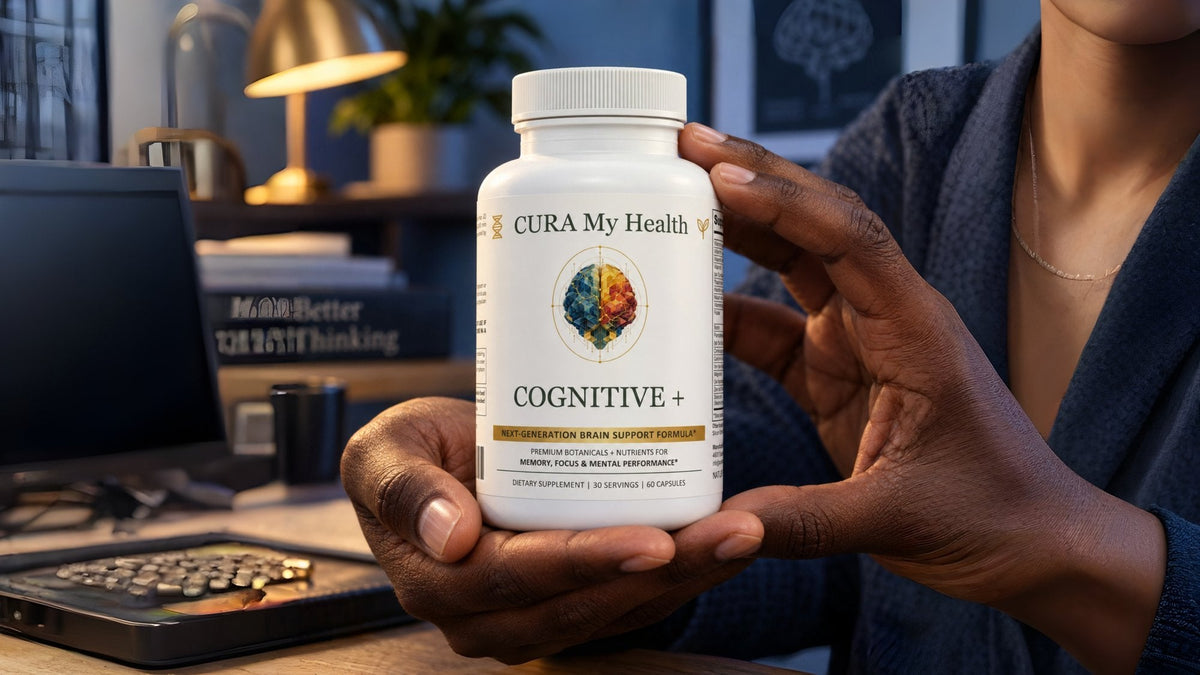
A blend label: Cognitive +™
Cognitive + lists a 609 mg proprietary blend of eighteen ingredients, including DMAE, bacopa, GABA, phosphatidylserine, DHA from tuna, green tea extract and huperzine A, plus twelve vitamins and ten minerals with individual amounts. Cognitive + is a blend product: blend totals are on the label; the amounts inside each blend are not. Its vitamins and minerals are fully itemized, for example vitamin B6 at 12 mg and zinc at 10 mg. Because a single blend line covers many ingredients, research doses for any one of them cannot be mapped onto the formula. The trade-off is convenience: one two-capsule serving covers a broad nutritional base and the blend.
A hybrid: Lions Mane 10x+™
Lions Mane 10x+ sits in between. It lists four named mushrooms at 266 mg each (cordyceps, reishi, shiitake and lion's mane) plus a 266 mg blend of six more. That gives you the amount for the four headline mushrooms and a blend total for the rest. You can read more about its mushroom parts in our fruiting body vs mycelium guide.
How to read a brain supplement label in six steps
- Find the serving size. Every amount on the panel is per serving, not per capsule.
- Find the blend line, if any. Note the total weight and the first few ingredients, which are present in the largest amounts.
- Read the form and standardization. Look for plant part, extract strength and the source of ingredients such as DHA or phosphatidylserine.
- Count caffeine sources. Green tea, guarana, yerba mate and coffee extracts all add caffeine, and blends often do not state the amount.
- Check allergens and warnings. Fish, soy, iron and medication cautions matter more than any benefit list.
- Check the testing. Third-party testing confirms a product matches its label; it does not promise a result.
Whatever the format, check serving size, standardization, caffeine sources, allergens and warnings before you buy. For the general skill, see our step-by-step guide to reading a Supplement Facts label.
Which format fits you?
A single-ingredient approach suits people who want to test one ingredient at a time, match a research dose, or adjust an amount with their clinician. A blend suits people who want one simple daily step and are comfortable not knowing every individual amount. If you combine products, add up overlapping ingredients and caffeine, and bring the labels to your pharmacist if you take medication. Every CuraMyHealth batch, blend or not, is third-party tested for purity and potency; see our standards.
Frequently asked questions about nootropic blends and single ingredients
What is the difference between a single-ingredient nootropic and an all-in-one blend?
A single-ingredient product gives you one active at a stated amount. An all-in-one blend combines several actives in one formula, and if it uses a proprietary blend, only the total weight and the order of ingredients are shown.
Are proprietary blends legal?
Yes. FDA labeling rules allow them, as long as the label shows the blend's total weight and lists its ingredients in descending order by weight. Nutrients with a Daily Value must still be listed with their own amounts.
Is a proprietary blend a bad sign?
Not by itself. It means you cannot check each amount against research, so weigh the testing, the ingredient sources and the brand's other label details more heavily.
How do I know which ingredient I am reacting to in a blend?
Often you cannot tell from the blend alone. Stop the product, note what happened, and talk to your clinician; a single-ingredient trial later can help pin it down.
Can I take a nootropic blend and single ingredients together?
Check for overlap first: the same herb, the same vitamin or extra caffeine can add up quickly. Ask your pharmacist or clinician, especially if you take medication.
Related reading from our Wellness Hub
- Cognitive + Ingredients: A Plain-English Guide to the Label
- Phosphatidylserine, Bacopa, Ginkgo and Huperzine A Explained
- How to Read a Supplement Certificate of Analysis (COA)
Sources
- FDA: Dietary Supplement Labeling Guide, Chapter IV. Nutrition Labeling
- 21 CFR 101.36: Nutrition labeling of dietary supplements
- Kongkeaw C, et al. Meta-analysis of randomized controlled trials on cognitive effects of Bacopa monnieri extract. J Ethnopharmacol, 2014.
- NCCIH: Using Dietary Supplements Wisely
Individual results vary.
These statements have not been evaluated by the Food and Drug Administration. This product is not intended to diagnose, treat, cure, or prevent any disease.

