
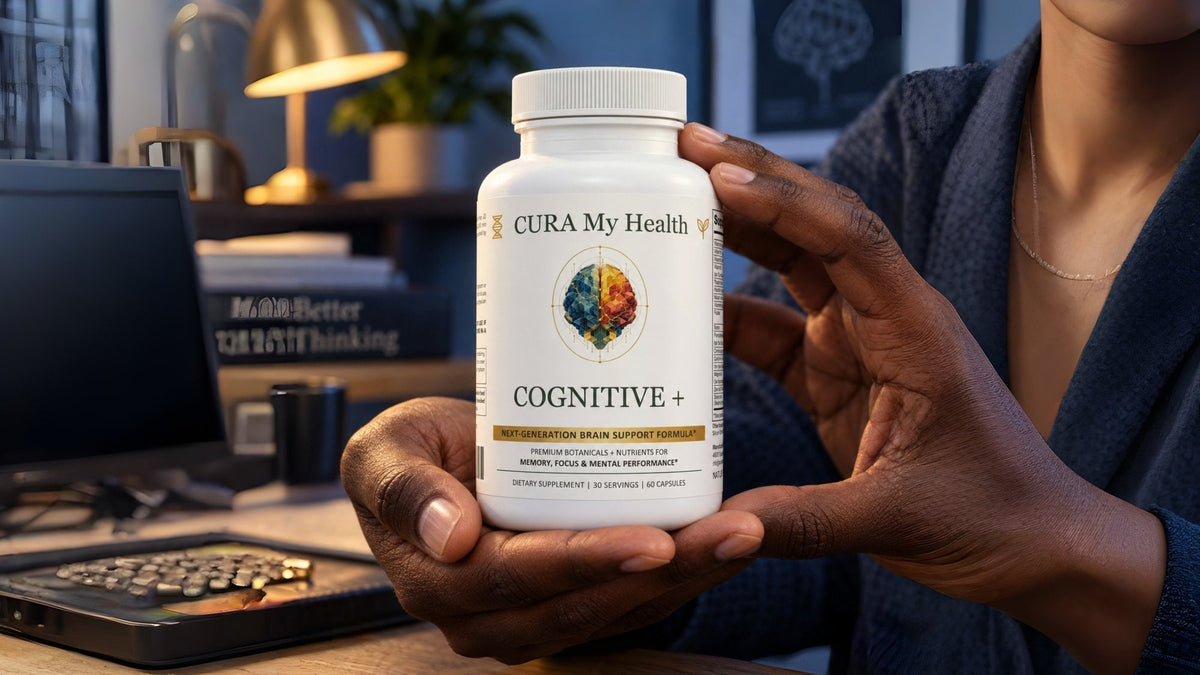
Phosphatidylserine, bacopa, ginkgo and huperzine A are four of the most common names on brain supplement labels, and they work in quite different ways. Phosphatidylserine is a fat-like building block of nerve cell membranes. Bacopa is an Ayurvedic herb studied for attention over weeks of daily use. Ginkgo is a tree-leaf extract with mixed research results. Huperzine A is a club moss compound that slows the breakdown of acetylcholine. Here is what each one is, what the research actually looked at, the safety points to know, and which of our formulas contain them, including Cognitive +™.
Key takeaways
- Phosphatidylserine is a phospholipid that forms part of nerve cell membranes.
- Bacopa research looks at standardized extracts taken daily for 12 weeks or longer.
- Ginkgo may increase bleeding risk in people who take blood thinners such as warfarin.
- Huperzine A slows the enzyme that breaks down acetylcholine, so it can interact with medicines that act on the same system.
- Cognitive + contains phosphatidylserine, bacopa and huperzine A, but not ginkgo; ginkgo is in Ginkgo+.
The four ingredients at a glance
| Ingredient | What it is | What research looks at | In our formulas |
|---|---|---|---|
| Phosphatidylserine | A phospholipid in cell membranes | Memory and thinking in older adults | Cognitive + (from soy, inside the blend) |
| Bacopa | An Ayurvedic herb | Attention speed and memory over 12+ weeks | Cognitive + (whole herb extract, inside the blend) |
| Ginkgo | Leaf of the ginkgo tree | Memory and circulation, with mixed results | Ginkgo+ (not in Cognitive +) |
| Huperzine A | A compound from Chinese club moss | Acetylcholine activity and memory | Cognitive + (inside the blend) |
What is phosphatidylserine?
Phosphatidylserine is a phospholipid that forms part of nerve cell membranes. Your body makes it. A 2015 review in the journal Nutrition describes it as required for healthy nerve cell membranes and myelin, the insulating layer around nerve fibers, and summarizes studies of phosphatidylserine supplements and memory and thinking in older adults. Those studies used daily amounts in the hundreds of milligrams, mostly in older adults, so read them as a research area rather than a promise.
Phosphatidylserine is made from different sources. The one in Cognitive + comes from soy, which matters if you avoid soy.
What is bacopa?
Bacopa (Bacopa monnieri) is a creeping herb with a long history in Ayurvedic tradition. Its studied compounds are called bacosides, and quality extracts are standardized to them. Bacopa research looks at standardized extracts taken daily for 12 weeks or longer. A 2014 meta-analysis pooled nine placebo-controlled trials with 518 participants and found faster performance on attention tests, while noting that larger trials are still needed.
The practical lesson is patience: bacopa is not a same-day ingredient. It is also one of the reasons we suggest giving any focus routine several weeks before judging it. Bacopa sits inside the 609 mg blend in Cognitive +.
What is ginkgo?
Ginkgo (Ginkgo biloba) supplements are made from the leaves of one of the oldest living tree species. Extracts are often standardized to flavones or flavone glycosides. According to the National Center for Complementary and Integrative Health, the large Ginkgo Evaluation of Memory study, which followed more than 3,000 adults aged 75 and older for about six years, found that ginkgo did not lower the rate of dementia, and it is unclear whether ginkgo helps thinking in healthy people.
Safety is the bigger point. Ginkgo may increase bleeding risk in people who take blood thinners such as warfarin. It may also interact with other medicines, and fresh ginkgo seeds are toxic when eaten. Ginkgo is not an ingredient in Cognitive +. Our ginkgo formula is Ginkgo+, which lists 600 mg of ginkgo leaf powder and 120 mg of ginkgo leaf extract standardized to 24% flavones per serving, alongside red Asian ginseng. For more, read what ginkgo biloba does.
What is huperzine A?
Huperzine A is a compound first isolated from Chinese club moss (Huperzia serrata), a plant used in traditional Chinese practice. It attracted scientific attention because it inhibits acetylcholinesterase, the enzyme that breaks down acetylcholine, a chemical messenger involved in attention and learning. Most of its research comes from China and focuses on clinical groups rather than healthy adults.
Huperzine A slows the enzyme that breaks down acetylcholine, so it can interact with medicines that act on the same system. That includes some prescription medicines, so tell your clinician and pharmacist if you take it, and mention it before any surgery. Huperzine A is part of the Cognitive + blend.
How do these ingredients compare?
- Speed: none of the four is a quick fix; the research runs over weeks to months.
- Strength of evidence: bacopa has the most consistent small trials for attention; phosphatidylserine and huperzine A have mixed or narrower evidence; ginkgo's largest trial was negative.
- Safety focus: ginkgo (bleeding and medicine interactions) and huperzine A (acetylcholine medicines) need the most care.
- Source: phosphatidylserine can come from soy; bacopa, ginkgo and huperzine A are botanicals.
Why single-ingredient research does not transfer to a blend
Each study above tested one ingredient, at one dose, in one group of people. A formula that combines several ingredients cannot borrow those results. Cognitive + contains phosphatidylserine, bacopa and huperzine A, but not ginkgo; ginkgo is in Ginkgo+. In Cognitive + those three sit inside a 609 mg proprietary blend with DMAE, GABA, DHA from tuna, green tea extract and other ingredients. Blend totals are on the label; the amounts inside each blend are not. So the honest way to read it is as a combined formula designed to support focus, concentration, mental clarity, energy levels and alertness, not as a stack of study doses.* For more on reading these labels, see nootropic blends vs single ingredients.
Every CuraMyHealth batch is third-party tested for purity and potency; see our standards. Before starting any brain supplement, check with your clinician if you are pregnant or nursing, take medication, or have a medical condition.
Frequently asked questions about phosphatidylserine, bacopa, ginkgo and huperzine A
Does Cognitive + contain ginkgo?
No. Cognitive + lists phosphatidylserine, bacopa and huperzine A in its blend, but ginkgo is not on the label. Ginkgo is in our Ginkgo+ formula, together with red Asian ginseng.
Which of these four has the strongest research?
Bacopa has the most consistent set of small trials, mostly on attention and memory tests after 12 weeks or more of standardized extract. The evidence for the other three is mixed, narrower, or, for ginkgo's largest trial, negative.
Can I take ginkgo and huperzine A together?
Ask your clinician first. Ginkgo carries a bleeding and interaction caution, and huperzine A acts on acetylcholine, so the combination deserves a medication review.
How long do these ingredients take to work?
The research runs over weeks to months, not hours. Give any routine at least several weeks alongside steady sleep and meals before you judge it.
Is phosphatidylserine vegan?
It depends on the source. The phosphatidylserine in Cognitive + comes from soy, but the formula also contains DHA from tuna, so Cognitive + is not suitable for a plant-based diet.
Related reading from our Wellness Hub
- Ginkgo Biloba vs Bacopa: Ginkgo+ or Cognitive + for Your Focus?
- What Is DMAE? What the Research Says About This Focus Ingredient
- Brain and Focus Supplement: Meet Cognitive +
Sources
- Glade MJ, Smith K. Phosphatidylserine and the human brain. Nutrition, 2015.
- Kongkeaw C, et al. Meta-analysis of randomized controlled trials on cognitive effects of Bacopa monnieri extract. J Ethnopharmacol, 2014.
- NCCIH: Ginkgo
- Ma X, et al. Huperzine A from Huperzia species: an ethnopharmacological review. J Ethnopharmacol, 2007.
- NCCIH: Using Dietary Supplements Wisely
Individual results vary.
These statements have not been evaluated by the Food and Drug Administration. This product is not intended to diagnose, treat, cure, or prevent any disease.

