
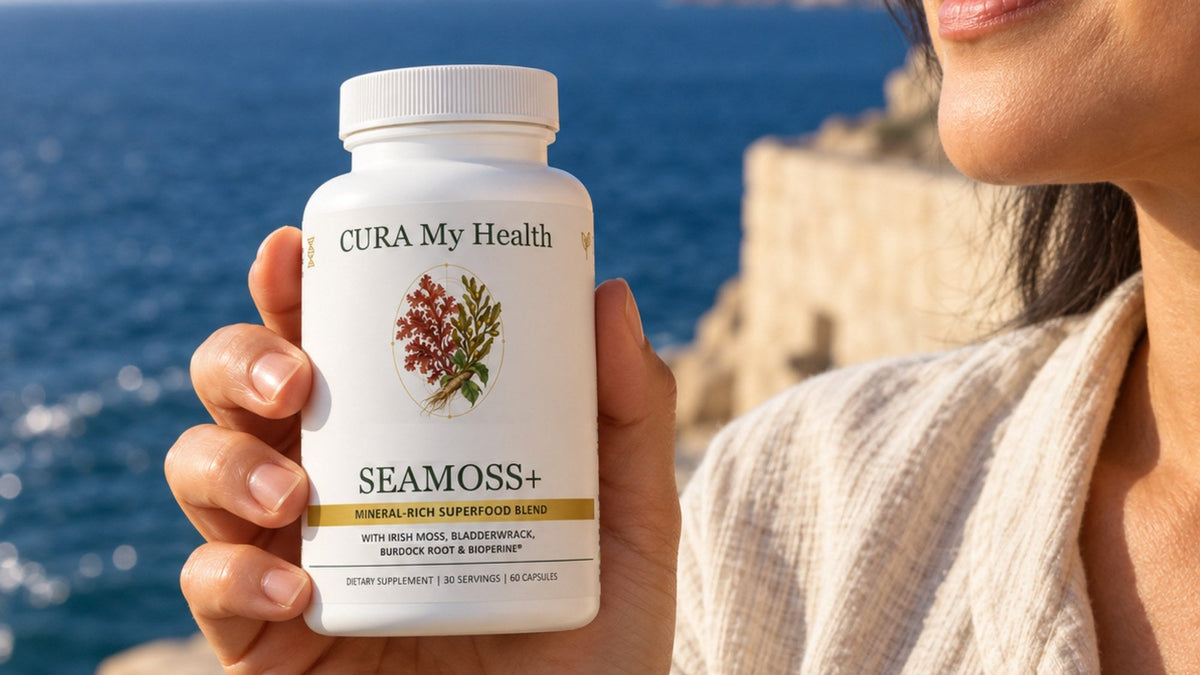
Sea moss vs. greens powder is really a question of narrow versus broad. A sea moss supplement concentrates one or two seaweeds, valued for their marine minerals and iodine, while a greens powder blends many dried land plants, grasses and algae into a drink. Neither replaces vegetables on your plate; they suit different goals, and the right pick depends on what your diet is missing and how you like to take things.
Key takeaways
- A sea moss supplement is narrow and marine: seaweed in a capsule, with naturally occurring iodine.
- A greens powder is broad and land-based: a scoop of many dried plant ingredients mixed into water.
- Seamoss+™ lists four ingredients with an amount for each, while Daily Greens+ lists seventeen ingredients inside one 4,180 mg blend.
- Iodine is the main check for sea moss; caffeine, allergens and added botanicals are the main checks for a greens powder.
- The Seamoss+ label says: "Do not exceed recommended dose. Pregnant or nursing mothers, children under the age of 18, and individuals with a known medical condition should consult a physician before using this or any dietary supplement." A 2021 review in the European Thyroid Journal advises caution with brown seaweeds (the review calls them kelps), because even small amounts can have antithyroid actions and product labelling may be insufficient; bladderwrack, one of the Seamoss+ ingredients, is a brown seaweed. Per the NIH Office of Dietary Supplements, high doses of iodine taken with antithyroid medicines can have an additive effect, and people with autoimmune thyroid disease may have adverse effects at iodine intakes considered safe for the general population, so check with your healthcare provider first if you have a thyroid condition.
- The Daily Greens+ label says: "If you are pregnant, nursing, allergic, have a medical condition or taking any medications, consult a doctor before using this or any other dietary supplement." Daily Greens+ also contains ashwagandha: the NIH National Center for Complementary and Integrative Health (NCCIH) says ashwagandha should be avoided during pregnancy and should not be used while breastfeeding, may be safe in the short term (up to 3 months), and is not recommended before surgery or for people with autoimmune or thyroid disorders. NCCIH also lists rare cases of liver injury, possible interactions with diabetes, blood pressure, immunosuppressant, sedative, anti-seizure and thyroid hormone medicines, and says people with hormone-sensitive prostate cancer should avoid it.
What is a sea moss supplement?
Sea moss is a red seaweed, most often Irish moss (Chondrus crispus). In supplement form it is dried and milled into capsules, often alongside other seaweeds such as bladderwrack. A sea moss supplement is narrow and marine: seaweed in a capsule, with naturally occurring iodine. Seaweeds also carry small amounts of other minerals, but those amounts vary by harvest and are rarely printed on the label.
Our Seamoss+ pairs 500 mg of Irish moss and 500 mg of bladderwrack with 400 mg of burdock root and 5 mg of BioPerine, in two capsules taken once a day before a meal. It promotes digestive and gut health and supports thyroid function and iodine balance.* More on that formula in Sea Moss Supplement: Meet Seamoss+ With Irish Moss and Bladderwrack.
What is a greens powder?
A greens powder is broad and land-based: a scoop of many dried plant ingredients mixed into water. Typical ingredients include cereal grasses (wheatgrass, barley grass), leafy greens (spinach, kale), algae (spirulina, chlorella), and often fruit powders, fiber, probiotics or herbs. Because there are so many ingredients, most greens powders use a proprietary blend.
Our Daily Greens+ is one scoop (5.4 g) a day in 8 ounces of water or a recipe. It holds a 4,180 mg proprietary blend of seventeen ingredients, from wheatgrass, moringa, spirulina and kale to matcha, ashwagandha and Bacillus coagulans. Blend totals are on the label; the amounts inside each blend are not. It is citrus-flavored, sweetened with stevia, and the tub holds 28 servings. It may support daily energy levels and helps the body fight oxidative stress.* For how to use it, see How to Take Greens Powder: 6 Easy Ways to Use Daily Greens+.
Sea moss vs. greens powder side by side
| Sea moss supplement (Seamoss+) | Greens powder (Daily Greens+) | |
|---|---|---|
| Source | Two seaweeds plus burdock root | Grasses, greens, algae, fruit, herbs and a probiotic |
| Format | Two capsules once a day | One scoop in 8 ounces of liquid |
| Label style | Four ingredients, each with its own amount | Seventeen ingredients in one blend total |
| Taste | None (capsule) | Citrus, stevia-sweetened |
| Main check | Iodine and thyroid health | Matcha (caffeine), coconut (tree nut), added herbs |
| Diet fit | Vegan, gluten free, no corn | Check the allergen line: contains coconut |
Seamoss+ lists four ingredients with an amount for each, while Daily Greens+ lists seventeen ingredients inside one 4,180 mg blend. Both approaches are legitimate; they simply answer different questions.
Which one fits your routine?
Start with your plate. Most adults eat fewer vegetables than recommended, and no powder or capsule matches the fiber, water and variety of whole vegetables. With that in mind:
- A greens powder may fit if you want a broad, convenient top-up of plant ingredients, you like a morning drink, and caffeine from matcha suits you.
- A sea moss supplement may fit if you want a simple seaweed source without the taste, prefer capsules, and have no thyroid concerns (or have cleared it with your provider).
- Both can work together for many people, but introduce one at a time so you can judge each, and look at your whole routine for overlap.
Wondering what greens powders can realistically do? Do Greens Powders Work? What They Can and Can't Do gives a fair answer.
What neither one can do
It helps to be clear about the limits. Neither a seaweed capsule nor a scoop of greens is a complete multivitamin: sea moss labels rarely state mineral amounts, and greens blends do not list how much of each plant you get. Neither replaces the fiber of whole vegetables, beans and grains. And neither will feel dramatic; both are steady, daily habits. If you are trying to fill a specific gap, such as vitamin D, iron or B12, a product that states that nutrient in milligrams or micrograms is the clearer tool.
Safety checks for each
Sea moss
Irish moss and bladderwrack are both iodine-rich seaweeds, and the iodine amount is not printed because it varies by harvest. If you have a thyroid condition or take thyroid medication, talk with your healthcare provider before starting. A 2021 review in the European Thyroid Journal advises caution with brown seaweeds (the review calls them kelps), because even small amounts can have antithyroid actions and product labelling may be insufficient; bladderwrack is a brown seaweed. The NIH Office of Dietary Supplements notes that some people, such as those with autoimmune thyroid disease or iodine deficiency, may have adverse effects at iodine intakes considered safe for the general population, and that high doses of iodine taken with antithyroid medicines can have an additive effect and could cause hypothyroidism. The Seamoss+ label says: "Do not exceed recommended dose. Pregnant or nursing mothers, children under the age of 18, and individuals with a known medical condition should consult a physician before using this or any dietary supplement. Keep out of reach of children. Do not use if safety seal is damaged or missing. Store in a cool, dry place." Our guide to sea moss and iodine covers daily needs and the upper limit.
Greens powder
Daily Greens+ contains matcha tea, which naturally contains caffeine, and coconut, a tree nut allergen. Its label says: "If you are pregnant, nursing, allergic, have a medical condition or taking any medications, consult a doctor before using this or any other dietary supplement. Do not use if product has been opened or tampered with in any way. Keep out of reach of children. Do not use if safety seal is damaged or missing. Store in a cool, dry place. Contains: Tree Nut (Coconut)."
It also includes ashwagandha. The NIH National Center for Complementary and Integrative Health (NCCIH) says ashwagandha may be safe when taken in the short term (up to 3 months), that it should be avoided during pregnancy and not used while breastfeeding, and that it is not recommended for people about to have surgery or for those with autoimmune or thyroid disorders. NCCIH also notes rare cases of liver injury, possible interactions with medicines for diabetes and high blood pressure, immunosuppressants, sedatives, anti-seizure medicines and thyroid hormone medicines, and says people with hormone-sensitive prostate cancer should avoid it.
Both products are third-party tested, every batch, for purity and potency, and both are manufactured in USA with globally sourced materials in an NSF-certified, GMP-certified, FDA-registered facility. Read more on our standards page.
Frequently asked questions about sea moss vs. greens powder
Is sea moss a greens powder?
No. Sea moss is a seaweed, usually taken on its own or with one or two other seaweeds, while a greens powder blends many land plants. Some greens powders include algae such as spirulina or chlorella, which are different from sea moss.
Which has more nutrients, sea moss or greens powder?
A greens powder usually covers a wider range of plant ingredients, while sea moss offers seaweed-specific compounds and iodine. "More" depends on what your diet already provides, so compare labels against your own gaps.
Can I take sea moss and a greens powder together?
Many people do; introduce one at a time so you can judge each. Seamoss+ contains iodine from Irish moss and bladderwrack, but its label does not print an iodine amount. The NIH Office of Dietary Supplements lists an upper limit of 1,100 mcg of iodine a day from food and supplements for adults 19 and older, so ask your healthcare provider before adding it to another iodine source such as a multivitamin. Daily Greens+ contains matcha tea, which naturally contains caffeine, so count it with your other caffeine. The Seamoss+ label says: "Do not exceed recommended dose. Pregnant or nursing mothers, children under the age of 18, and individuals with a known medical condition should consult a physician before using this or any dietary supplement." A 2021 review in the European Thyroid Journal advises caution with brown seaweeds (the review calls them kelps), because even small amounts can have antithyroid actions and product labelling may be insufficient; bladderwrack, one of the Seamoss+ ingredients, is a brown seaweed. If you have a thyroid condition or take thyroid medication, talk with your healthcare provider first: the NIH Office of Dietary Supplements notes that people with autoimmune thyroid disease or iodine deficiency may have adverse effects at iodine intakes considered safe for the general population, and that high doses of iodine taken with antithyroid medicines can have an additive effect. The Daily Greens+ label says: "If you are pregnant, nursing, allergic, have a medical condition or taking any medications, consult a doctor before using this or any other dietary supplement." Daily Greens+ also contains ashwagandha. Per the NIH National Center for Complementary and Integrative Health (NCCIH), ashwagandha should be avoided during pregnancy, should not be used while breastfeeding, may be safe when taken in the short term (up to 3 months) and is not recommended for people about to have surgery or for those with autoimmune or thyroid disorders. NCCIH adds that rare cases of liver injury have been linked to ashwagandha supplements, that it might interact with some medicines, including those for diabetes and high blood pressure, immunosuppressants, sedatives, anti-seizure medicines and thyroid hormone medicines, and that people with hormone-sensitive prostate cancer should avoid it.
Does a greens powder replace vegetables?
No. A scoop provides a few grams of plant powders, while vegetables provide fiber, water and volume that a powder cannot. Think of any greens powder as a top-up, not a swap.
Does Daily Greens+ contain caffeine?
It contains matcha tea, which naturally contains caffeine. If you are sensitive to caffeine, take it earlier in the day. Its label says: "If you are pregnant, nursing, allergic, have a medical condition or taking any medications, consult a doctor before using this or any other dietary supplement." Daily Greens+ also contains ashwagandha, which the NIH National Center for Complementary and Integrative Health (NCCIH) says should be avoided during pregnancy and should not be used while breastfeeding. NCCIH also says ashwagandha may be safe in the short term (up to 3 months), is not recommended before surgery or with autoimmune or thyroid disorders, has been linked in rare cases to liver injury, may interact with some medicines (including those for diabetes and high blood pressure, immunosuppressants, sedatives, anti-seizure medicines and thyroid hormone medicines) and should be avoided by people with hormone-sensitive prostate cancer.
Related reading from our Wellness Hub
- Irish Moss vs. Bladderwrack vs. Burdock Root: What Is the Difference?
- Sea Moss Capsules vs. Gel: Which Form Fits Your Routine?
- Third-Party Tested, Every Batch: Here’s the Receipt
Sources
- Iodine, Seaweed, and the Thyroid (2021 review)
- NIH Office of Dietary Supplements: Iodine
- CDC MMWR, 2017: Disparities in State-Specific Adult Fruit and Vegetable Consumption - United States, 2015
- Harvard T.H. Chan School of Public Health: Vegetables and Fruits
- NCCIH: Ashwagandha (updated March 2023)
Individual results vary.
These statements have not been evaluated by the Food and Drug Administration. This product is not intended to diagnose, treat, cure, or prevent any disease.

