
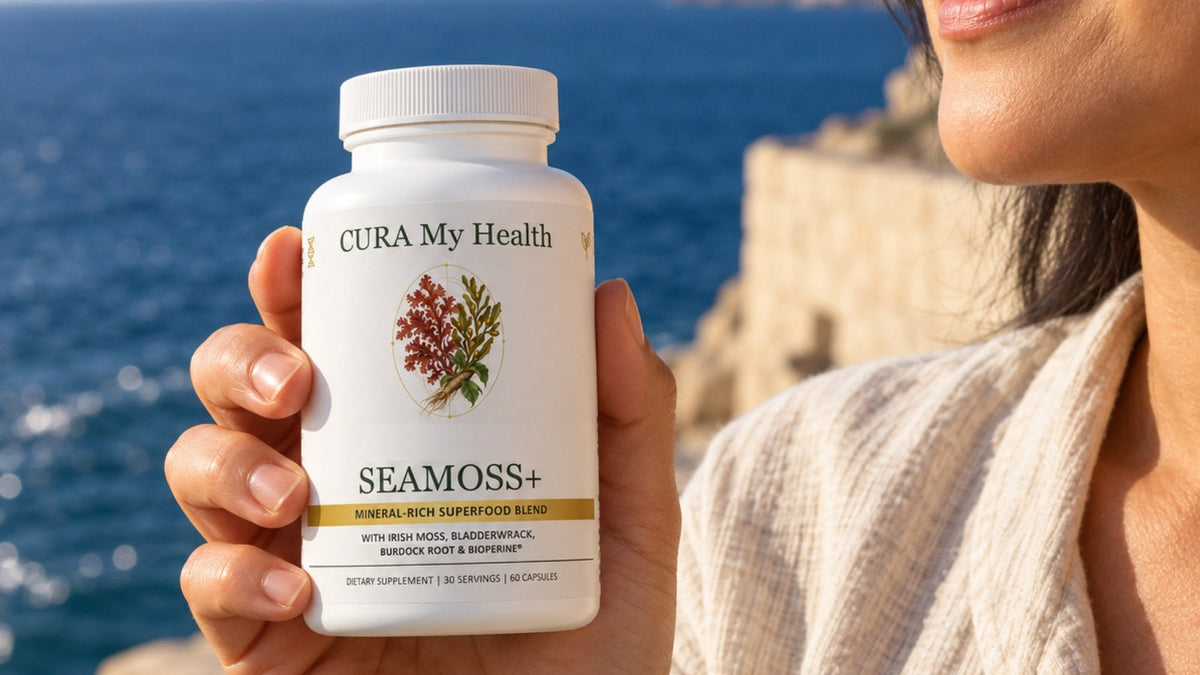
A sea moss supplement puts dried sea moss, usually Irish moss, into a capsule or powder so you get a measured amount each day without making gel. Seamoss+™ is ours: Irish moss and bladderwrack, two seaweeds, with burdock root and BioPerine black pepper extract, every amount printed on the label. It promotes digestive and gut health and supports thyroid function and iodine balance.* Here is what it is, who it suits, and who should ask a clinician first.
Key takeaways
- Seamoss+ contains 500 mg of Irish moss, 500 mg of bladderwrack, 400 mg of burdock root and 5 mg of BioPerine per two-capsule serving.
- A capsule gives you the same measured amount every day, which is hard to do with homemade sea moss gel.
- Irish moss and bladderwrack are both iodine-rich seaweeds, so anyone with a thyroid condition or on thyroid medication should talk with a provider before starting.
- The label direction is two capsules once a day, 20 to 30 minutes before a meal, and the bottle is a 30-day supply.
- Do not exceed recommended dose. Pregnant or nursing mothers, children under the age of 18, and individuals with a known medical condition should consult a physician before using this or any dietary supplement.
What is a sea moss supplement?
Sea moss is a red seaweed, most often Irish moss (Chondrus crispus) from North Atlantic shores, with warm-water cousins such as Gracilaria harvested in the Caribbean. People have eaten it for generations, boiled into drinks and puddings or blended into a gel that thickens as it cools.
A sea moss supplement skips the soaking and blending. The seaweed is dried and milled, then measured into capsules. A capsule gives you the same measured amount every day, which is hard to do with homemade sea moss gel. Gel can be stirred into food and some people enjoy the ritual; capsules travel well and keep for longer. Our article on sea moss capsules vs. gel compares the two fairly.
Meet Seamoss+
We built Seamoss+ around two seaweeds rather than one, then added a land root and an absorption partner. Seamoss+ contains 500 mg of Irish moss, 500 mg of bladderwrack, 400 mg of burdock root and 5 mg of BioPerine per two-capsule serving.
- Irish moss, the classic red sea moss, used whole.
- Bladderwrack, a brown seaweed with small air bladders on its fronds.
- Burdock root, a land plant whose root contains inulin fiber.
- BioPerine, a black pepper extract included to enhance nutrient absorption.*
The capsule is pullulan, a plant-based material, and it is the only other ingredient. There is no proprietary blend. The formula is vegan, gluten free, sugar free, non-GMO, lactose free, free of the top 9 allergens and contains no corn. For a deeper look at each line, read Sea Moss Ingredients: What Is in Seamoss+, Line by Line.
What Seamoss+ is designed to support
| Area | What Seamoss+ is formulated to support |
|---|---|
| Digestion | Promotes digestive and gut health.* |
| Thyroid | Supports thyroid function and iodine balance.* |
| Absorption | Enhances nutrient absorption.* |
| Daily wellness | Encourages natural detoxification and may support immune system health.* |
Sea moss is a daily wellness ingredient: Seamoss+ is formulated to support thyroid function, iodine balance and natural detoxification day to day, not to promise a particular change.* Human research on sea moss itself is still limited, so we describe what the formula is designed to support rather than quote study results as outcomes. For the gut question in detail, see Is Sea Moss Good for Gut Health? What the Research Says
How to take Seamoss+
The label direction is two capsules once a day, 20 to 30 minutes before a meal, and the bottle is a 30-day supply. You can also follow the direction of your healthcare professional.
- Pick a meal you never skip. Before breakfast suits many people; before lunch works too.
- Take both capsules with water. The serving is two capsules at once.
- Keep it to one seaweed product. Kelp tablets, seaweed snacks and sea moss together can add up in iodine. The NIH Office of Dietary Supplements lists an upper limit of 1,100 mcg of iodine a day for adults 19 and older. The Seamoss+ label does not state an iodine amount, so count it alongside any kelp, seaweed foods or other supplements that contain iodine.
- Keep this formula connected to your wider routine. Look at your multivitamin, greens and mineral products together, and do not count on the formula as a multivitamin substitute.
More on timing: Best Time to Take Sea Moss Capsules: A Simple Daily Routine.
Is a sea moss supplement a good fit for you?
It can be a sensible choice if you want a simple, measured way to add seaweed to your day, you prefer capsules to gel, and you like a short label you can read in a few seconds. It is a poorer fit if you already take kelp or another iodine-rich product, if you are managing a thyroid condition without your provider's input, or if you are hoping one capsule will stand in for a varied, plant-rich diet. Food still does most of the work; a supplement sits on top of it.
Who should check with a clinician first?
The Seamoss+ warning reads: Do not exceed recommended dose. Pregnant or nursing mothers, children under the age of 18, and individuals with a known medical condition should consult a physician before using this or any dietary supplement. Keep out of reach of children. Do not use if safety seal is damaged or missing. Store in a cool, dry place.
Irish moss and bladderwrack are both iodine-rich seaweeds, so anyone with a thyroid condition or on thyroid medication should talk with a provider before starting. A 2021 review in the European Thyroid Journal advises caution with brown seaweeds such as kelp, because even small amounts can have antithyroid effects and product labelling may be insufficient; bladderwrack is a brown seaweed. The NIH Office of Dietary Supplements notes that high doses of iodine taken with antithyroid medicines such as methimazole can have an additive effect and could cause hypothyroidism. The same fact sheet notes that some people, such as those with autoimmune thyroid disease or iodine deficiency, may have adverse effects at iodine intakes considered safe for the general population. The label does not state an iodine amount, because seaweed iodine varies widely; a 2004 study in Thyroid (Teas et al.) measured 12 edible seaweeds and found iodine levels that differed by species and by harvest conditions. Our guide to sea moss and iodine explains daily needs and the upper limit. Diet, goals, allergies, medication, health history and the rest of the supplement stack all matter, and burdock belongs to the daisy family, so take care if you react to ragweed.
Why testing matters for seaweed
Seaweeds take up minerals from the water they grow in, which is why outside testing matters more here than for many ingredients. Every batch of Seamoss+ is third-party tested for purity and potency, and it is manufactured in USA with globally sourced materials in an NSF-certified, GMP-certified, FDA-registered facility. See our standards for how it works.
Frequently asked questions about sea moss supplements
What is the difference between sea moss and Irish moss?
Irish moss (Chondrus crispus) is one specific red seaweed. "Sea moss" is a broader market name that can also cover warm-water red seaweeds such as Gracilaria; Seamoss+ uses Irish moss.
Why does Seamoss+ include bladderwrack?
Bladderwrack is a brown seaweed that adds a second set of marine compounds alongside Irish moss. Pairing the two, with burdock root, is a common sea moss formula pattern.
Can I take a sea moss supplement with a probiotic?
Many people pair them as part of a gut-focused routine; our Gut Reset Bundle includes both, alongside a third digestive formula. Introduce one new product at a time so you can tell how each fits.
How long does one bottle last?
The bottle holds 60 capsules, which is 30 days at two capsules a day.
Is a sea moss supplement safe with thyroid medication?
Ask your healthcare provider first. Both seaweeds in Seamoss+ contain iodine, and iodine intake can affect thyroid function and thyroid medication. According to the NIH Office of Dietary Supplements, taking high doses of iodine with antithyroid medicines such as methimazole can have an additive effect and could cause hypothyroidism, and people with autoimmune thyroid disease may have adverse effects at iodine intakes considered safe for the general population. The Seamoss+ label asks anyone with a known medical condition to consult a physician before use.
Related reading from our Wellness Hub
- Irish Moss vs. Bladderwrack vs. Burdock Root: What Is the Difference?
- Sea Moss vs. Greens Powder: Two Ways to Support Daily Nutrition
- Third-Party Tested, Every Batch: Here’s the Receipt
Sources
- Smyth, 2021: Iodine, Seaweed, and the Thyroid (European Thyroid Journal, PMC)
- NIH Office of Dietary Supplements: Iodine, Health Professional Fact Sheet, updated November 5, 2024
- Teas et al., 2004: Variability of iodine content in common commercially available edible seaweeds (Thyroid, PubMed)
Individual results vary.
*These statements have not been evaluated by the Food and Drug Administration. This product is not intended to diagnose, treat, cure, or prevent any disease.

